Blinds & Tree Stands · Gear type
Box Blind
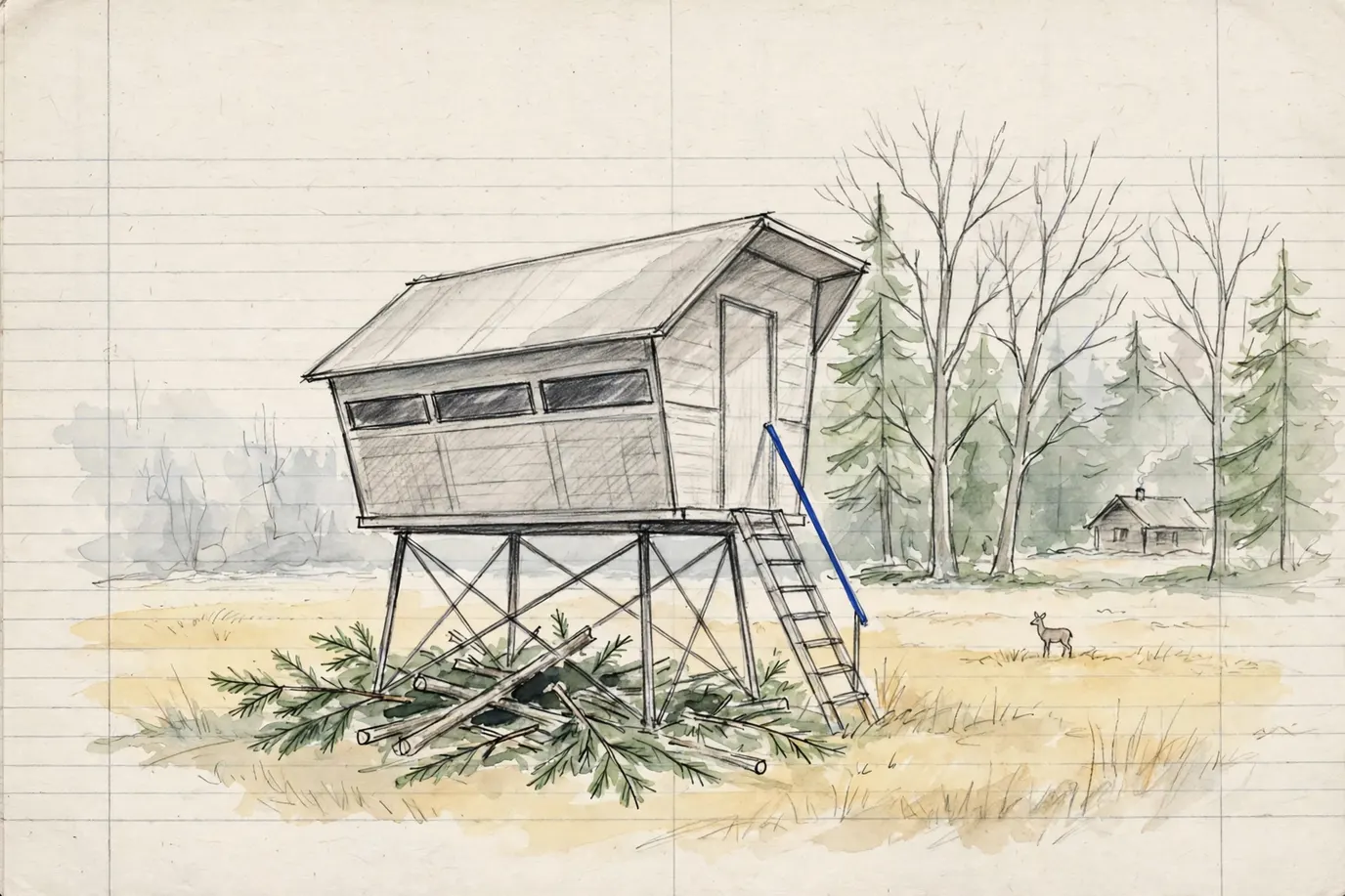
A box blind is a hard-sided hunting blind, a small shed with windows that sits on the ground or on a tower. You pick one by shell material, window type, footprint for the number of hunters, and whether it goes on a tower you buy separately. It's the most comfortable seat in the deer woods and the least mobile one. Set it once, early, in a spot you already know deer use. (It's also the only blind at Hemlock Run that nobody has ever had to chase downhill.)
We earn a commission if you buy through our links, at no cost to you. Disclosure
| Model | Material | Camo / color | Capacity | Type | Footprint / platform | Amazon |
|---|---|---|---|---|---|---|
Guide Gear 6-Foot Tripod Tower Blind 2-ManBox blind More specs
| — | RT APXlisting | 2 personslisting | Tower with blindlisting | 4 x 4listing | Check price |
Guide Gear 6-Foot Quad Pod Tower BlindBox blind More specs
| Steellisting | RT APXlisting | 3 personslisting | Tower with blindlisting | 6 x 6listing | Check price |
Hawk Compound Steel Box BlindBox blind More specs
| Steellisting | — | — | Tower with blindlisting | 7.25 x 5.75listing | Check price |
Hawk Double Steel Box BlindBox blind More specs
| Steellisting | — | — | Tower with blindlisting | 4 x 6listing | Check price |
Millennium Treestands Q400 Guard House Buck HutBox blind More specs
| Steellisting | — | — | Tower with blindlisting | — | Check price |
Muddy Soft Side 360 Tower BlindBox blind | Steellisting | — | — | Tower with blindlisting | 72 x 72 inlisting | Check price |
OL'MAN 7 ft Base Camp Deluxe Quad Pod TowerBox blind More specs
| — | — | 2 personslisting | Tower with blindlisting | 5 x 5listing | Check price |
OL'MAN 12 ft Fortress Deluxe Quad Pod TowerBox blind More specs
| — | — | 2 personslisting | Tower with blindlisting | 5 x 5listing | Check price |
Bolderton 12 ft 2-Man Quad PodBox blind More specs
| Steellisting | Crater Harvestlisting | 2 personslisting | — | 4.8 x 4.8listing | Check price |


What’s in this listHard-sided box blinds, alone or sold on a tower, that we track on Amazon US. Bare platforms are on their own page. “—” means neither the maker nor the Amazon listing states it.
What makes a box blind different
A box blind is a hunting blind with hard walls and a real roof. Fabric ground blinds pop up and come down. A box blind stays. It sits on the ground, on skids or on a tower, with a door, a floor and windows that open and close. Up on a tower, it's what most people call an elevated box blind. Some people call it a shooting house, a hardshell hunting blind or an enclosed deer stand. It's all the same idea: a small room in the woods.
The table on this page lists hard-sided box blinds, alone or sold on a tower. It shows each one's Type, Weight, Material, Capacity, Footprint, Height to platform when there's a tower, Weight capacity and Windows, as the maker states them, or as the Amazon listing does where the maker is silent (marked as listing values; weight stays the maker's figure). Bare tower platforms without a blind are on the hunting blind platform page. Towers sold as a stand with their own blind are on the tower deer stand page.
Here's the thing. Every other blind and stand on this site is about getting in, getting set and getting out quietly. A box blind is about staying. That changes what matters.
What to look at in a box blind
These are the columns that decide it, in the order I'd read them.
Material decides how long it lasts out there
The Material column tells you what the shell is made of: fiberglass, steel, plastic or polymer, or wood, as the maker or the listing lists it. On towers with fabric blinds, it's the steel frame.
- Fiberglass: one maker's line is built entirely of fiberglass in one piece with no seams, per Deer & Deer Hunting, with a drip edge over the windows and a 2-inch roof overhang to shed rain
- Steel: hard and heavy; one recent line pairs foam-insulated walls with insulated, powder-coated steel floors and 1-inch rubber mats to keep noise down
- Plastic or polymer: molded shells and window frames
- Wood: the old shop-class answer, if the maker offers it
A box blind lives outside all year. Sun, hail, snow load and mice all get a vote. (Mice especially. Mice always vote.) Pick the shell you won't mind looking after, because the blind won't come home for the winter.
Window type is how you see and how you shoot
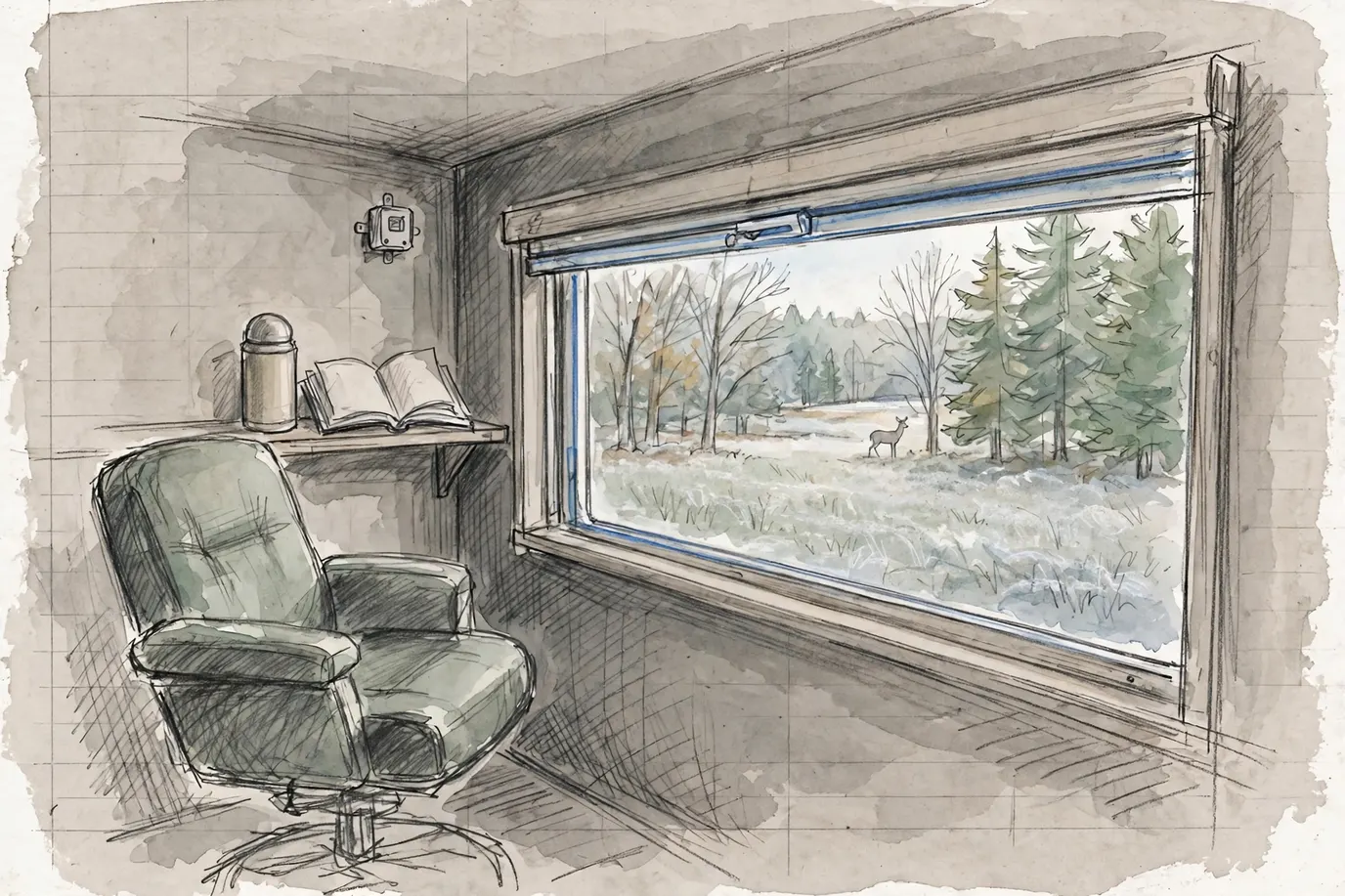
The Windows column lists the type: glass, plexiglass, fabric zippered panels or clip-on panels. This is the field most box blinds compete on, and for good reason. You'll open and close those windows more than you'll do anything else in there.
What to look for:
- Quiet operation: one recent line advertises a one-hand, silent window system with residential glass
- Rain control: eaves or drip edges over the openings keep water off the glass
- Shooting height: windows low enough to shoot from your chair, high enough to stand
Inside color matters too. One maker's blinds have an ultra-dark black interior, which Deer & Deer Hunting says reduces shadows and makes it easier to move and shoot. A dark room hides you better than a light one. That's not camouflage, that's just how a porch looks at night.
Footprint and capacity: how many people, and how much elbow room
Capacity is how many hunters the maker or the listing says the blind holds. When a maker says "multiple hunters" without a number, the column stays blank. Footprint is the floor size as the maker or the listing states it, and it's a good stand-in for capacity when there's no number.
Think about what goes in with you. A chair. A pack. A bow, which needs room to draw, and a crossbow, which needs room to swing. A thermos. Maybe a grandson who brought a sleeping bag. One maker's fiberglass line comes in five sizes, from one hunter up to a family, per Deer & Deer Hunting.
Rule of thumb: if two of you will hunt it, don't buy the box that fits two people. Buy the one that fits two people and their coats.
Then spend real thought on the chair. Deer & Deer Hunting's last hard-shell tip is blunt about it: don't buy a great blind and use a poor chair. You'll sit in that chair for hours with your feet flat on the floor, so its height has to match the window height, and it has to turn without a squeak. A chair that's two inches too low makes every window a periscope. Blind chairs are on the hunting blind chair page.
Weight tells you what it takes to set up
The Weight column is the blind's weight as the maker states it. It's never small. A box blind goes in once, usually with a trailer, a tractor or a few friends, and it doesn't come back out on a whim. Count the people and the machine you'll need before you count the windows.
Type: blind only, or blind on a tower
The Type column says whether you're buying a box blind by itself or a tower with a blind. The table holds both. One recent box blind line, per Deer & Deer Hunting, is sold in combinations with a 5-foot or a 10-foot tower base.
If you buy the blind alone, match the tower to the maker's own compatibility list, and use the anchoring hardware and instructions the maker gives for it. A tower under a box blind holds a heavy box high off the ground in the wind, so the base and the anchors are part of the purchase, not an afterthought.
Height to platform, on the tower listings
Height to platform is filled in for towers, empty for blinds sold alone. Higher gives you a wider view and lifts your scent. It also means a longer climb to the door and more wind on the box. Don't buy height for the sake of it. Buy the height your field and your tree line call for.
Weight capacity, when there's a tower
Weight capacity is the most the maker says a tower or platform will hold, and box blinds alone usually don't list it. With a tower, count the blind, the hunters, the chairs and the gear against that number. A tower under a box blind is carrying a house with people in it.
Where to put a box blind
A box blind is the one blind you can't move to fix a mistake. So the location is the decision.
Deer & Deer Hunting's hard-shell tips, condensed:
- Put it in a proven spot. A blind that costs this much belongs where deer already travel.
- Watch the sun. Dawn or dusk sun in your eyes makes it hard to see or shoot.
- Use it where the wind swirls, the spots you can never hunt from a tree stand.
- Set it up as early as possible before the season so deer get used to it.
- Either brush it in well, with cover at least head high around the door, or leave it bare.
Missouri's conservation department adds that deer are wary of new objects, so brush or grass around a blind helps. On the wind, it says the most consistent winds are usually on ridge-tops, and valleys and drainages can swirl, especially on sunny days.
The same writer also suggests mounting a hard-sided blind on a utility trailer if you hunt different spots. I like that idea. It turns the least mobile blind into a slow-moving one.
Box blind vs ground blind vs tree stand
On paper, a box blind beats everything for comfort. In practice, you pay for that comfort by giving up mobility.
- Against a fabric ground blind: the box is quieter, warmer and closer to scent-proof with the windows shut. The ground blind sets up in minutes and goes wherever the deer went last week.
- Against a tree stand: the box keeps you out of the wind, and Missouri's agency notes tree stands get cold when temperatures drop and winds pick up. The stand goes on almost any tree.
- Against a saddle: one saddle maker admits a box blind is more comfortable than its own saddles, since you can stand and stretch. I'll take that.
Missouri's agency notes a ground blind is much warmer than a tree stand and blinds can be hot in early season. A box blind is the same story with a roof, so check that the windows open enough to move air in September.
Here's the plain version. In deep cold, the hunter who's comfortable stays put, and the one who isn't goes back to the truck by nine. Comfort buys hours, and hours are when things move. That's the case for a box blind in one line.
Heaters, smoke and the closed room
A box blind is the one place people are tempted to bring a heater. Treat that as a serious decision.
Propane heaters burn oxygen and give off carbon monoxide. One heater maker says its heaters should not be used in a structure without a window or roof vent, and says to check for leaks every time a hose or tank is connected. Minnesota's natural resources department recommends a carbon monoxide detector in any blind or shelter where a propane heater runs. The Consumer Product Safety Commission warns never to use fuel-burning portable heaters or lanterns while sleeping in enclosed areas. If you get a headache, nausea, dizziness or confusion, shut the heater off and get outside.
Getting in and out safely
If the blind sits on a tower, the climb to the door is the risky part. Keep three points of contact on the ladder going up and down, as Florida's wildlife agency advises for ladders. Use a haul line for your bow, gun or pack so both hands stay free. Inspect the tower, anchors and ladder before each season and after storms, and follow the maker's instructions for anchoring.
During firearms seasons, Missouri's agency suggests wrapping hunter orange ribbon on each side of a blind, or hanging an orange cap or jacket on the roof, so other hunters can see it. Rules on hunter orange, permanent blinds and blinds on public land vary by state and by property, so check your state wildlife agency.
Box blind care between seasons
A box blind stays out, so it gets checked in place.
- Open every window and clean the tracks
- Check the door seal and the roof for leaks
- Look for wasps and mice before opening day
- Check tower bolts and anchors, and tighten what's loose
- Take the chair cushions home
That's a Saturday-afternoon fix, once a year, with a broom and a 7/16 wrench.
Who should skip a box blind
- You hunt ground where a structure can't stay up all season
- You move with the deer every week
- You don't have the machine or the friends to set one up
- You hunt mostly from trees and like it
If you're in that list, a ground blind or a hunting saddle will serve you better. If you're not, buy the blind for the coldest sit you plan to make, not the nicest one. The nice mornings take care of themselves.
Brands in this list
Related
Questions people ask
Ground blind vs elevated blind: which is better?
They solve different problems. A ground blind goes up fast, moves easily and needs no climbing. Missouri's conservation department notes your scent stays closer to the ground in one, so wind matters more, and you can't see as far. An elevated box blind gives a wider view and better scent control but is heavy, stays put, and adds a climb to the door.
Are box blinds scent-proof?
Mostly, with the windows closed. A Deer & Deer Hunting writer says most hard-shell blinds are scent-proof that way, which lets you hunt winds that would ruin a tree stand. Open a window to shoot and the seal is gone, so keep paying attention to wind direction.
Do box blinds come with a tower?
Some do and many don't. This page lists both box blinds sold alone and blinds sold on a tower, and some makers sell blind and tower combinations with different tower heights. The Type column on this page tells you which you're looking at. Bare tower platforms are on their own page.
Is it safe to run a heater in a box blind?
Only a heater built for it, used exactly as its maker says. Propane heaters burn oxygen and give off carbon monoxide. Minnesota's natural resources department recommends a carbon monoxide detector in any blind where a propane heater runs. If you get a headache, dizziness or nausea, shut the heater off and get out.
Sources
- Deer & Deer Hunting: 10 tips for hunting from hard-shell blinds — accessed 2026-10-22
- Deer & Deer Hunting: Product spotlight, fiberglass box blinds — accessed 2026-10-22
- Deer & Deer Hunting: New box blinds (insulated walls, window systems) — accessed 2026-10-22
- Missouri Department of Conservation: Stand locations — accessed 2026-10-22
- U.S. Consumer Product Safety Commission: Portable heaters and camping equipment — accessed 2026-10-22
- MeatEater: Propane heater accidents in hunting blinds (Minnesota DNR advice) — accessed 2026-10-22
- Florida Fish and Wildlife Conservation Commission: Test your knowledge about treestand safety — accessed 2026-10-22
- Tethrd: Saddle hunting 101 (comfort compared with a box blind) — accessed 2026-10-22