Section
Camping Lights, Lighters and Fire Starters
Camping lights come in two shapes that do two jobs: a headlamp lights what you're looking at, a lantern lights the place you're sitting. Fire gear is the other half of this section: lighters, ferro rods and starters that get a fire going when you need one. Pack at least one of each kind, plus a backup that runs on different power. Real talk: I own more headlamps than socks. Renee has counted both.
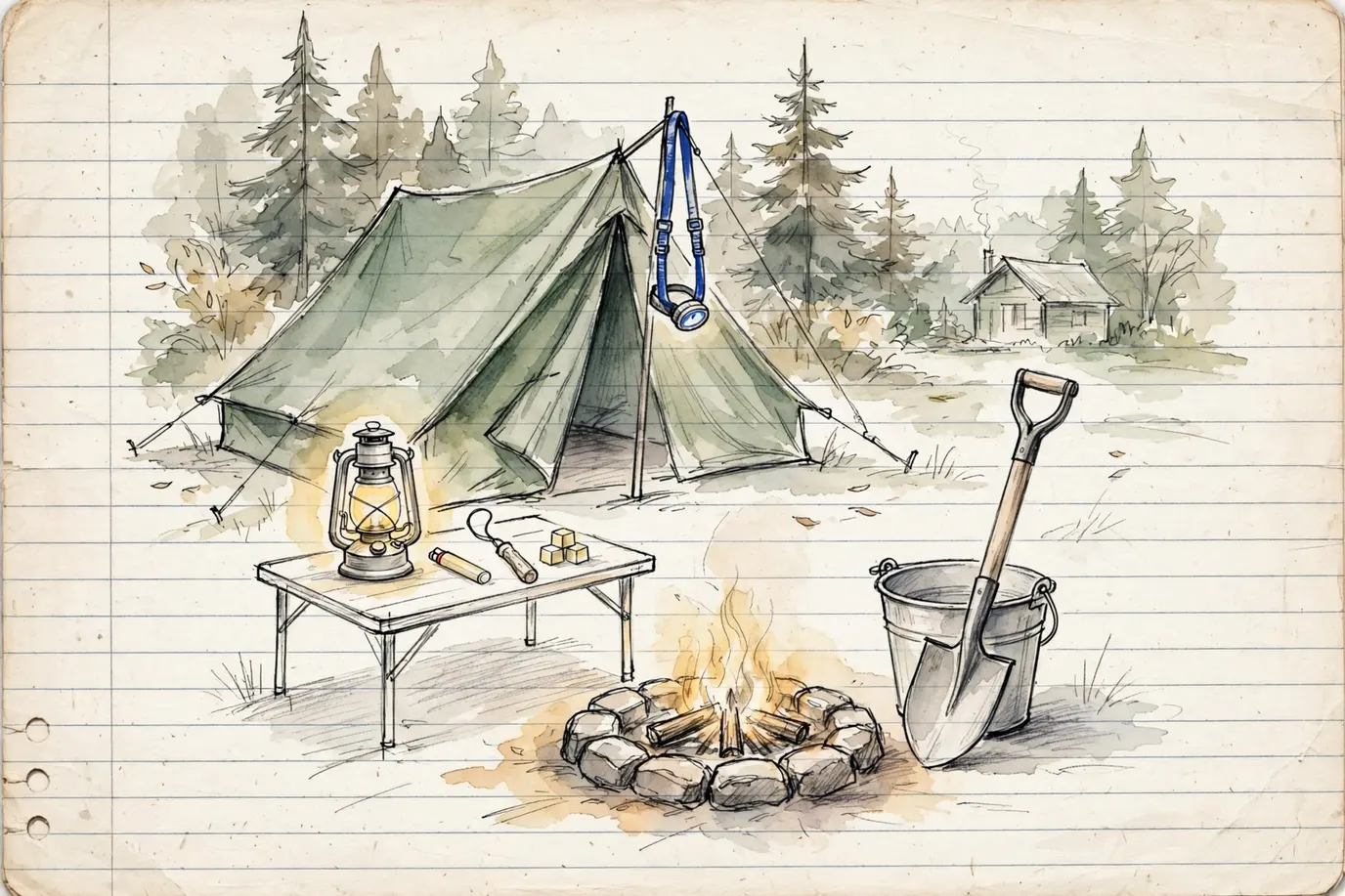
Gear in this section
Best-of lists
Best Torch Lighter for Camp and the Fire Kit
Refillable torch lighters, as stated by the maker or the Amazon listing, most jets first.
Best Camping Lighter
Windproof lighters that refill or recharge, as stated by the maker or the Amazon listing.
Best Headlamp for Hunting and Camp
Headlamps whose maker or Amazon listing states output and runtime, brightest first, two per brand at most.
Brands in this section
Camping lights: what goes where
Here's how I split camping lights, and how this section is laid out:
- Headlamps: hands-free light that points where you look
- Camping lanterns: light that fills a table, a tent or a cabin room
- Flashlights and hunting lights: a narrow beam in the hand, for searching and tracking
Then the fire side:
- Torch lighters: a hot, wind-resistant jet flame
- Fire starters: ferro rods, strikers and kits
- Fire starter sticks: cubes, sticks and tinder that hold a flame long enough to catch kindling
Light and fire share a page because they share a problem: both run out at the worst possible time, usually right after Walt says, "We've got plenty."
Headlamps: the light you'll use most
Lumens, beam and runtime
Lumens is total light output. Black Diamond's guide says 150 to 250 lumens covers reading and camp tasks, while more than 400 lumens suits route-finding over rough ground. Lumens alone don't predict how far a beam reaches, because the lens shapes it.
Under the ANSI FL 1 standard, as Streamlight explains it, runtime runs from 30 seconds after switch-on until output drops to 10% of that starting level. Beam distance is where the light falls to 0.25 lux. Peak beam intensity, in candela, is how bright the center of the beam is. Makers follow the standard voluntarily, so read the box as "under their test," not "in your tent at 4 a.m."
Real talk: the runtime number is the whole runtime, not the bright part. A light rated for a long runtime on high may spend most of it on a lot less than high.
Red light, and why it matters before dawn
A red light mode lets you walk to the stand without wrecking your night vision. The National Park Service explains that night vision depends on a pigment called rhodopsin, which bright light breaks down; it takes 20 to 40 minutes to start working again. Dim red light doesn't break it down the same way. The NPS adds that bright red still costs you some, so dim is the setting you want.
Red light headlamps are their own page in this section. Hunters who need to follow a trail at night sometimes look at green or other color modes too; the maker's mode list tells you what you get.
Rechargeable, batteries or both
- Disposable batteries: buy anywhere, swap in a minute
- Rechargeable: built-in battery, charge from USB, no waste
- Hybrid: a rechargeable pack that also takes standard batteries
Black Diamond notes some of its lights run on either AAA batteries or a rechargeable pack. That's the setup I like for long trips, because a dead rechargeable with no outlet nearby is a very nice paperweight.
Waterproof, ultralight and tactical headlamps
Waterproof headlamps carry an IPX rating, a standard water resistance level that goes up with the number. Read the maker's actual IPX number, not the word on the box. Ultralight headlamps trade battery size and modes for grams, which suits backpack hunters. Tactical headlamps usually add a tougher housing, a focused beam and sometimes a helmet mount. None of those labels mean anything until you read the specs under them.
The headlamp count
A few seasons ago I did inventory at the cabin and found nine headlamps. Three had dead batteries. None of them were on Walt's head, which was the problem I was trying to solve. Now every camper gets one light with fresh batteries in it, and one spare set in a labeled bag in the truck. Nine headlamps don't help if nobody knows where the working one is.
Lanterns: light for the whole table
A camping lantern spreads light around instead of throwing it forward. You'll see three power types:
- Battery-operated lanterns: safe indoors, quiet, the default for tents
- Rechargeable lanterns: often double as a power bank for a phone
- Gas and fuel lanterns: bright and warm-toned, outdoors only
Camping string lights and tent lights are the low-key end: they hang from a ridgeline and light a tent without blinding anybody. Inflatable solar lanterns pack flat and charge in the sun on the dash.
My one opinion: no fuel-burning lantern inside a closed tent
Never run a fuel-burning heater or lantern inside a closed tent. Carbon monoxide doesn't care how cold you are. The U.S. Consumer Product Safety Commission warns against sleeping with fuel-burning heaters or lanterns on in tents, campers and vehicles, because CO builds up. It lists headache, dizziness, nausea and confusion as warning signs, and says a camp "flu" may be CO poisoning. Use battery light inside. Keep the gas lantern on the picnic table.
Fire gear: lighters and starters
Torch lighters
A torch lighter burns butane in a hot, focused jet that holds up in wind better than a soft flame. Some are refillable from a butane can; check the maker's refill steps. Long lighters reach into a grill or lantern; windproof lighters and mini torches are pocket-sized.
The CPSC's lighter rules require child-resistant mechanisms on disposable and novelty lighters and on multi-purpose lighters for grills and candles, so that most children under 5 can't work them. A torch lighter is a tool, not a toy. Keep it with the fire kit, not in a kid's pocket.
Ferro rods, strikers and fire-starting kits
A ferro rod is a sparking rod you scrape with a steel striker to throw hot sparks onto tinder. It has no fuel to run out of, which is the whole reason it rides in the kit next to the lighter. Fire starter kits bundle a rod, a striker and tinder. Magnesium fire starters add a block you shave into a pile before you spark it. Fire pistons and flint-and-steel are the old-school end of the shelf.
Fire starter sticks, fatwood and waterproof matches
A spark or flame needs something to catch. Wax starter cubes and sticks hold a flame for a while; fatwood is resin-rich pine that catches easily; waterproof matches are matches that stay usable after a soaking. Smokey Bear's campfire guide breaks the fire into three layers: tinder (small twigs, dry leaves, grass, needles), kindling (sticks smaller than 1 inch around) and logs. Starters help the tinder do its job. They don't replace kindling.
How to choose across fire and lighting
Build a kit with two power sources
- A headlamp per person, with red mode
- A battery lantern for inside, one for the table
- Spare batteries or a charged power bank
- Two ways to make fire: a lighter and a ferro rod
- Fire starters in a waterproof bag
- Water and a shovel for the fire, every time
If one thing fails, the backup should not fail the same way. Two rechargeable lights with one cable is one light. Two lighters in the same wet pocket is zero lighters. (Ask me how I know.)
Match the light to the hunt
Walking in before dawn calls for red light and a low setting. Blood trailing at night calls for a bright, even beam and long runtime; check your state's rules on lights and tracking. Camp evenings call for a lantern you can dim. A headlamp that does all three is fine; a headlamp you can work with gloves on is better.
Charge and store lithium batteries carefully
Use the maker's cable and charger for rechargeable lights, and don't leave a damaged or swollen battery charging. Store spares so the terminals can't touch keys or coins.
Fire safety at camp
No jokes. These are from Smokey Bear and the CPSC.
- Keep the fire at least 15 feet from tents, brush and low branches.
- Clear a 10-foot circle around the fire site.
- Never use flammable liquids to start or boost a fire.
- Keep water and a shovel next to the fire before you light it.
- Put it out with water, stir, water again, and feel. If it's too hot to touch, it's too hot to leave.
- Don't put a fire out with dirt or sand alone.
- Call 911 if the fire spreads beyond the ring.
- No fuel-burning heaters or lanterns in a closed tent, camper or vehicle while you sleep.
Burn bans and fire rules change with the weather and the county. Check local rules before you light anything.
Two lights, two ways to make fire, one bucket of water. Renee says that's a lot of rules for a guy who forgets his sunglasses every July. She's right. I've never once forgotten the headlamps.
Related
Questions people ask
What are the best camping lights for a hunting camp?
One headlamp per person, with red light for walking in before dawn, plus one lantern for the table and one for the tent or cabin. Battery lanterns are the safe pick for inside a tent. Bring spare batteries or a charged power bank for anything rechargeable, and keep lights where you can find them in the dark.
What do lumens and runtime mean on a headlamp?
Lumens is total light output. Under the ANSI FL 1 standard, as Streamlight explains it, runtime is measured from 30 seconds after switch-on until output falls to 10% of that starting level, and beam distance is where the light drops to 0.25 lux. Makers follow the standard voluntarily and run their own tests.
Why do hunters use red light headlamps?
Red light keeps your night vision. The National Park Service explains that night vision depends on a pigment in the eye that bright light breaks down, and it takes 20 to 40 minutes to start working again. Dim red light doesn't break it down the same way, so you can see the trail and still see in the dark.
Can I use a lantern inside a tent?
Use a battery-powered lantern inside. The U.S. Consumer Product Safety Commission warns against sleeping with fuel-burning heaters or lanterns on in tents, campers and vehicles, because carbon monoxide builds up. Gas and fuel lanterns belong outside, in open air.
Sources
- Streamlight: ANSI information — accessed 2026-10-22
- Black Diamond: How to choose the best headlamp — accessed 2026-10-22
- National Park Service: Dark adaptation of the human eye and the value of red flashlights — accessed 2026-10-22
- U.S. Consumer Product Safety Commission: Portable heaters and camping equipment — accessed 2026-10-22
- U.S. Consumer Product Safety Commission: Lighters FAQ — accessed 2026-10-22
- Smokey Bear (USDA Forest Service): How to build your campfire — accessed 2026-10-22
- Smokey Bear (USDA Forest Service): How to maintain and extinguish your campfire — accessed 2026-10-22