Section
Deer Stand and Blind Types, Sorted
A deer stand is anything that puts you where a deer won't see you: up a tree, in a box on legs or inside a blind on the ground. Pick by how you hunt. If you sit the same spot all season, a ladder stand or box blind earns its weight. If you move with the deer, a hang-on, climber or saddle does. If you'd rather not climb, a ground blind is a deer stand too. I've hunted from all of them. My knees have opinions about most of them.
Gear in this section
Best-of lists
Best Ground Blind Picks
Ground blinds whose maker or Amazon listing states capacity, center height and weight, tallest first. Weights are the maker's own figures.
Brands in this section
What counts as a deer stand
People say "deer stand" and mean three different things. Here's the thing: the type you pick decides how you hunt more than any feature on it.
- Elevated and fixed: ladder stands, tripods and towers. You set them up once and sit them all season.
- Elevated and mobile: hang-ons with climbing sticks, climbing tree stands and hunting saddles. You carry them in and out.
- On the ground: ground blinds, box blinds and plain hunting chairs against a tree.
Every page in this section falls into one of those three. The general tree stand page covers the elevated ones together, and hunting blinds covers the ground ones.
Tree stands: ladder, hang-on, climber and saddle
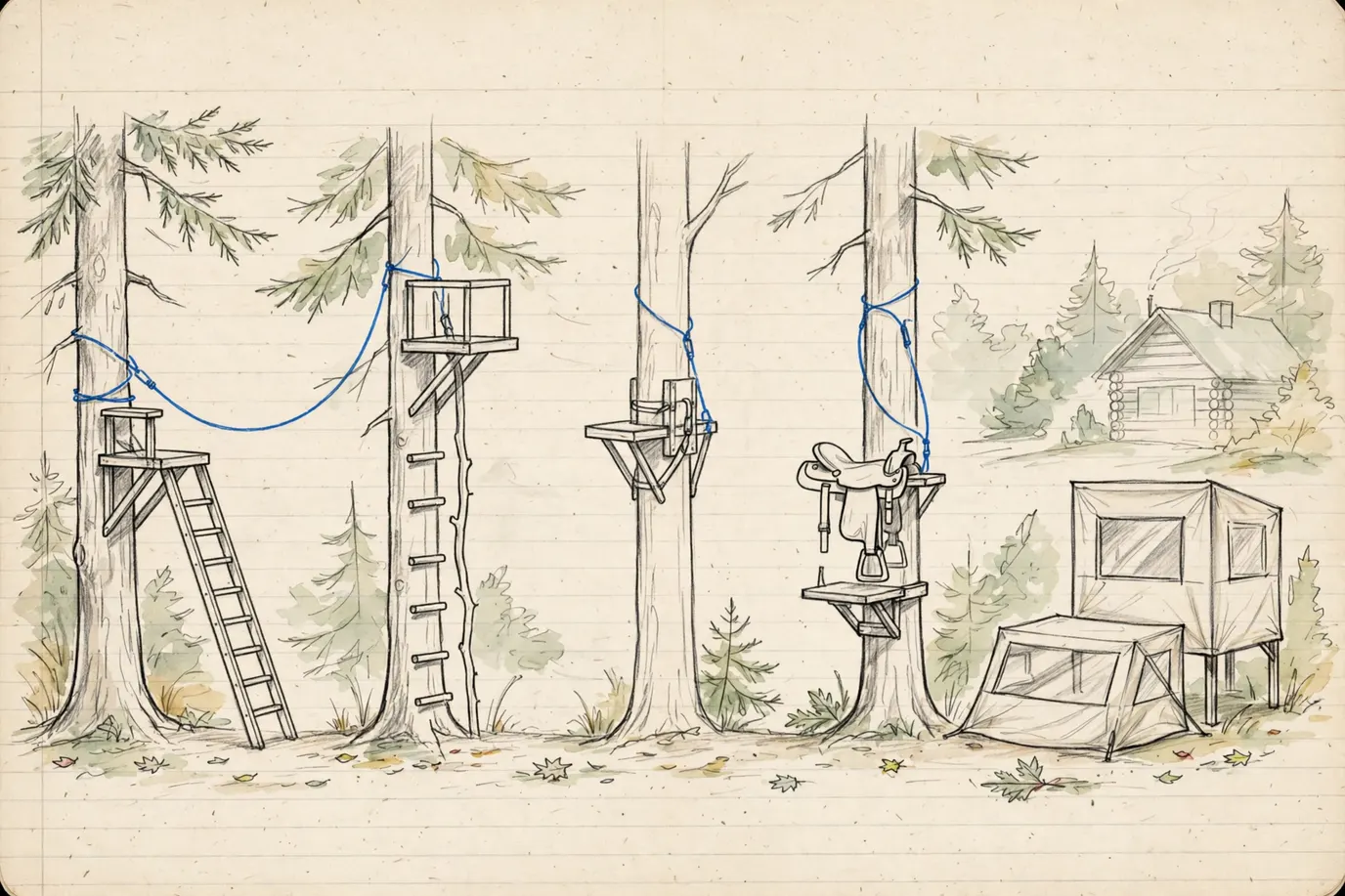
onX Hunt sorts portable tree stands into hang-ons, climbers and ladder stands, and says hang-ons are the most common of the three. I'd add saddles, which have earned their own corner of the cabin.
Ladder stands: set once, sit all season
A ladder stand is a seat on top of its own ladder, strapped to the tree. onX notes they fit a wide range of trees but are more conspicuous, and their platforms can be small for big feet. A ladder stand is a lawn chair with ambition. Treat it like a ladder, not like a chair.
Two-man ladder stands put two seats on one platform. They're the stand for a kid's first season, or for a new hunter who needs somebody next to them. They're also heavy and slow to put up, so plan on two people and a Saturday.
Hang-on stands and climbing sticks
A hang-on tree stand is a platform and seat you strap to the trunk at height. You get up to it with climbing sticks, screw-in steps or a ladder section. It's the most flexible tree stand there is, and the climb is the riskiest part of using one.
Climbing sticks come in aluminum, steel and carbon. Carbon sticks are the light end of the shelf; check the maker's weight and rating, not the material name. An aider, a short rope ladder hung off a stick, lets you take bigger sticks farther apart.
Climbing stands: you walk it up the tree
A climbing stand is two pieces, a seat section and a foot platform, that you inch up the trunk. onX says climbers work best on smooth trees with no branches between you and the ground. That rules out a lot of Pennsylvania woods, and most of the trees I'd want to sit in. Lightweight climbers trade some size and comfort for a lighter walk in.
Hunting saddles: the lightest way up
A saddle is a harness you sit in, tied to the tree with a rope, standing on a small saddle platform or steps. A saddle hunting kit bundles the saddle with ropes and sometimes a platform. Saddle hunting rope (the lineman's rope and the tether) is its own small category, and it's the part you should never cheap out on. Jess wrote the full saddle hunting guide, with the rope-to-rope transfer explained better than I could.
Jess's take: "A saddle is the only stand that fits in a backpack and still makes you practice like it's a new bow." She means the learning curve. She's right.
Ground blinds and box blinds
Pop-up ground blinds
A pop-up blind is a fabric hub-style tent you can see out of and deer can't see into. It hides movement, which is the whole point for bowhunters drawing a bow and kids who can't sit still. A 360 hunting blind has windows all the way around, and some blinds use see-through mesh walls. Chair blinds are a one-person blind built around a seat.
Bowhunter's ground blind advice is practical:
- Brush it in with local branches, but don't let them rub the fabric
- Stake every loop with heavy stakes, and tie the hubs off to trees or brush
- Set it up weeks early so deer get used to it
- Keep the inside dark: seal light leaks, sit back from the window, wear black
- Open only the window you'll shoot through
Blind windows and window covers are a separate accessory category. Mesh window screens let you shoot through or slide them aside at the shot.
A blind that isn't staked is a kite that hasn't left yet. Stake it like you mean it.
Box blinds: the cabin on legs
A box blind is a hard-walled shelter, on the ground or on a stand. It's the comfortable end of hunting: out of the wind, room for a chair, sometimes room for two. It's heavy, permanent for the season and needs a solid base. Insulated walls and real windows make it the stand for long, cold sits and for hunters who can't climb anymore.
Hunting chairs and blind chairs
A hunting blind chair is built low and quiet for sitting inside a blind: adjustable legs for uneven floors, sometimes a swivel seat. A swivel hunting chair turns without scraping. Dove hunting chairs and duck hunting chairs are usually stools or chairs with a storage box under the seat. Some chairs come with a gun rest or shooting rest built on.
Tree stand accessories that earn their place
Here's the short list, in order of importance:
- Full-body harness and tree strap, or a lifeline that runs from the ground to your stand
- Haul line, a bow hoist rope to raise the bow and pack
- Stand straps: replacements for the factory ratchet straps, per the maker's spec
- Tree stand hooks for the bow, pack and binoculars
- Bow holder that screws or straps to the tree
- Shooting rail on ladder stands
- Tree stand umbrella for rain, if you sit it often
Wisconsin DNR's tree stand tips include a haul line to raise an unloaded bow or crossbow. The TMA guidelines go further: never climb with anything in your hands or on your back, and lower your gear on the side of the tree away from your path down.
How to choose a deer stand
Start with the tree, or the lack of one
The Treestand Manufacturers Association says to pick a live, healthy, straight tree within the size range the maker lists, and never a leaning tree. If your spot doesn't have one, that's your answer: tripod, box blind or ground blind.
Decide how often you'll move
Same spot every year? A ladder stand or box blind. New spot every week? A hang-on, climber or saddle. Ground hunter who travels? A pop-up blind.
Add up the weight rating honestly
The TMA guidelines are plain: never exceed the weight limit the maker specifies. That limit counts everything on the stand, you plus the heavy coat, the pack and the bow, not just what the bathroom scale said in August. Do the sum in November clothes before you compare stands.
Count the carry
A stand you hate carrying is a stand you won't move when the deer move. Check the maker's listed weight against the walk from the truck, and remember the walk back. It's longer. It always is.
Safety rules for deer stands
No jokes in this part.
- Wear a full-body fall arrest harness every time you leave the ground, including the climb up and down. The TMA says single-strap belts and chest harnesses are no longer allowed.
- Keep the tether snug. The TMA says there should be no slack when you sit.
- Three points of contact on every step: two hands and a foot, or one hand and two feet.
- Read the maker's warnings and instructions every season, and keep them with the stand.
- Practice at ground level first, with a responsible adult there, including hanging in the harness.
- Inspect the stand and harness before each use. Replace a harness after any fall.
- Carry a phone, whistle and light on you, within reach even while suspended.
- Tell someone where you are and when you'll be back.
- Never leave a stand up more than two weeks, per the TMA.
- Hang orange on a ground blind where hunters may be around. NSSF's ground blind tips say to put it on all sides.
- Crack the windows if you run a heater in a blind, so carbon monoxide doesn't build up.
Wisconsin DNR calls tree stand incidents a leading cause of injury to hunters. Rules on stands, blinds and blaze orange vary by state and by public or private land. Check your state wildlife agency.
A word on the cabin view
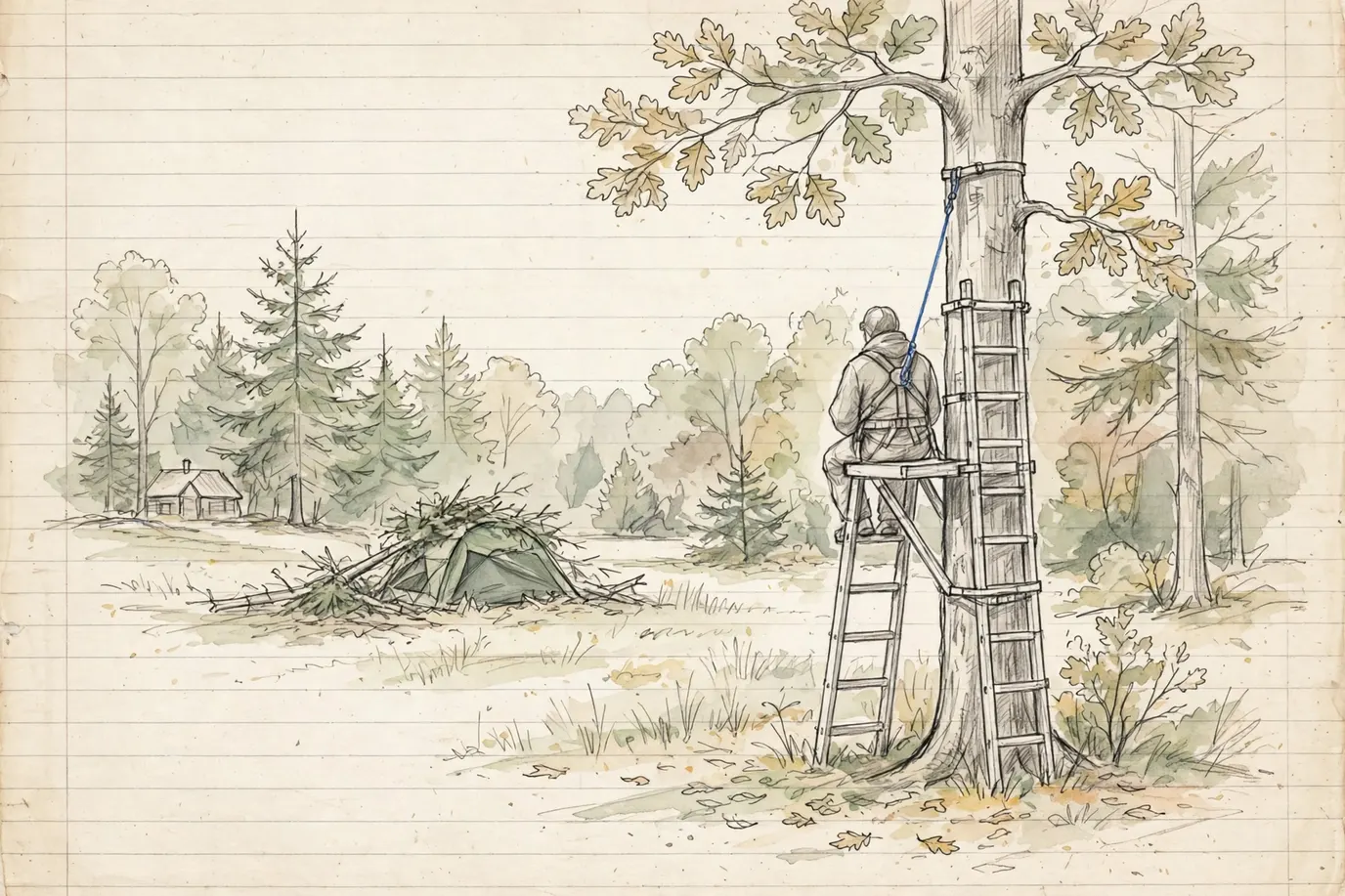
From the cabin porch you can see two of our stands. One is a ladder stand I've strapped to the same white oak for longer than I'll admit. The other is a ground blind Danny set up, so I can see it from the porch, which tells you how well it's brushed in. Danny calls it a work in progress. It has been in progress since Labor Day.
Pick the stand that fits the tree, the hunt and your knees, in that order. Then wear the harness.
Related
Guides
Questions people ask
What is the safest type of deer stand?
None of them is safe without the rules. The Treestand Manufacturers Association says to wear a full-body fall arrest harness every time you leave the ground, including the climb, follow the maker's weight limit and use a haul line. If you can't recover or get down after a fall, the same guidelines say to hunt from the ground.
How long can I leave a tree stand up?
The Treestand Manufacturers Association says never to leave a treestand installed for more than two weeks, because weather and other damage you can't see can weaken it. Check the straps and the stand before every sit, and follow your state's rules on stands left on public land.
Ground blind or tree stand for bowhunting?
A tree stand gets your scent and movement above the deer; a ground blind hides movement inside dark walls and keeps you off a ladder. Ground blinds suit hunters who can't or won't climb, kids, and spots without a good tree. Tree stands suit field edges and trails with sound, straight trees nearby.
What accessories does a tree stand need?
A full-body harness and tree strap or lifeline come first. Then a haul line for the bow and pack, a few screw-in or strap-on hooks, and a bow holder. Climbing sticks or steps get you up to a hang-on. Extra stand straps, a seat cushion and a shooting rail are comfort and convenience.
Sources
- Treestand Manufacturers Association: Treestand Safety Guidelines — accessed 2026-10-22
- Wisconsin DNR: Archery and crossbow safety tips (tree stand safety) — accessed 2026-10-22
- onX Hunt: Tree stands, everything you need to know — accessed 2026-10-22
- Bowhunter: 28 tips for ground blind success — accessed 2026-10-22
- NSSF Let's Go Hunting: Ground blind safety tips for deer and turkey hunting — accessed 2026-10-22