Blinds & Tree Stands · Gear type
Saddle Hunting Platform
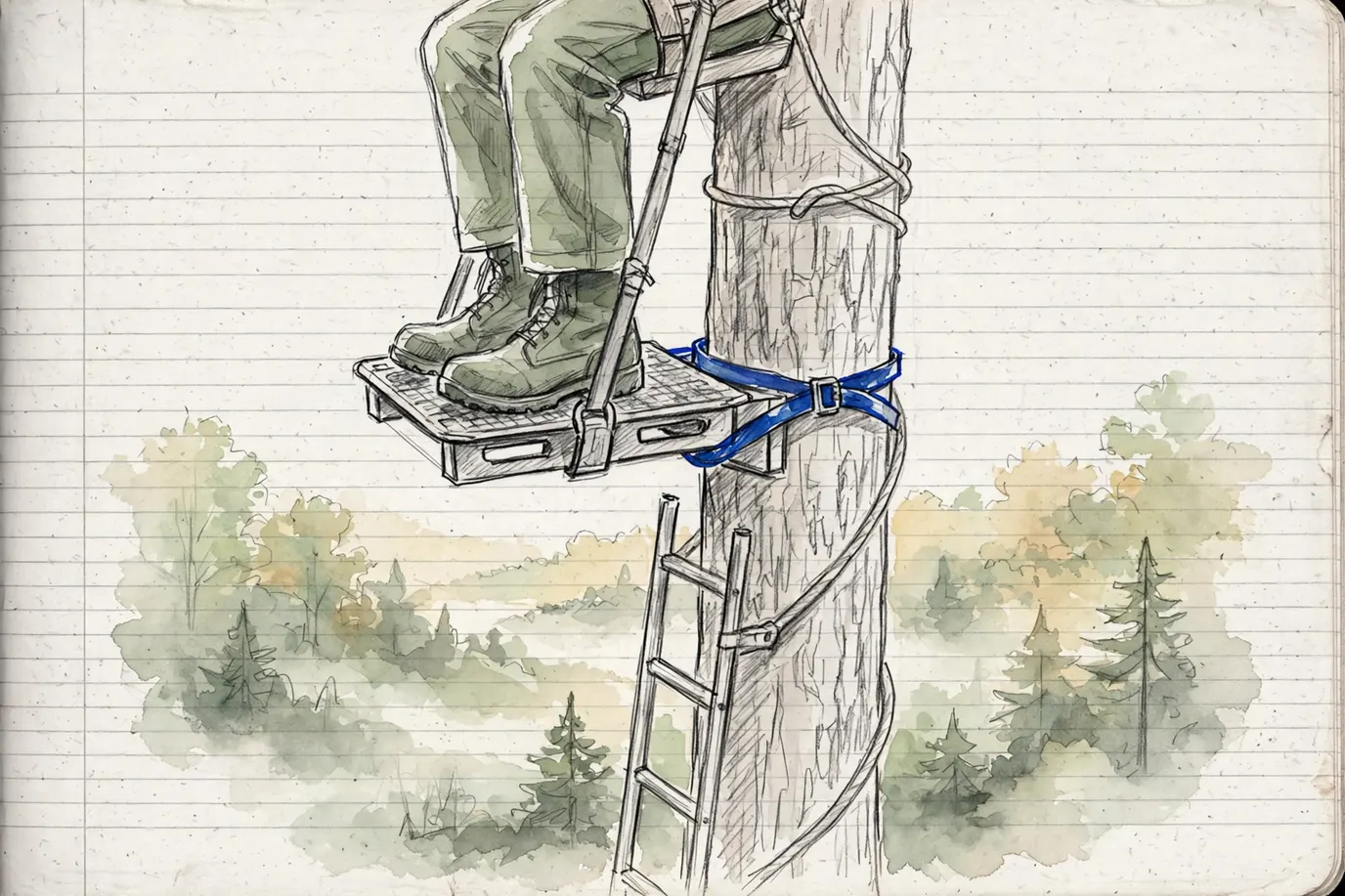
A saddle hunting platform is the small deck you strap to the trunk and stand on while you hunt from a saddle. It doesn't hold you to the tree; the saddle and tether do that. It holds your feet, and your feet decide how long you can stay up there. Pick it by deck size for your boots, carry weight, and whether it levels on the trees you actually hunt. Rule of thumb: the platform is the last thing you'd think about and the first thing your ankles will mention.
We earn a commission if you buy through our links, at no cost to you. Disclosure
| Model | Material | Weight rating | Standing area | Amazon |
|---|---|---|---|---|
Guide Gear Saddle Hunting PlatformSaddle platform | Steellisting | 300 lblisting | — | Check price |
Hawk Helium Hammock PlatformSaddle platform | Aluminumlisting | 300 lblisting | 10 x 6listing | Check price |
Hunter Safety System Legend PlatformSaddle platform | — | — | — | Check price |
Hunter Safety System Legend PlatformSaddle platform | — | — | — | Check price |
Kalkal Die-Cast Saddle PlatformSaddle platform | Aluminumlisting | 350 lblisting | — | Check price |
Kalkal Foldable Saddle PlatformSaddle platform | Aluminumlisting | 300 lblisting | — | Check price |
XOP-Xtreme Outdoor Products InvaderSaddle platform | Aluminumlisting | 350 lblisting | 12 x 11listing | Check price |
XOP-Xtreme Outdoor Products EdgeSaddle platform | Cast aluminumlisting | — | — | Check price |
XOP-Xtreme Outdoor Products Edge 2025Saddle platform | Cast aluminumlisting | 350 lblisting | 13.75 x 11listing | Check price |
XOP-Xtreme Outdoor Products AtomicSaddle platform | Aluminumlisting | 300 lblisting | 14 x 11listing | Check price |


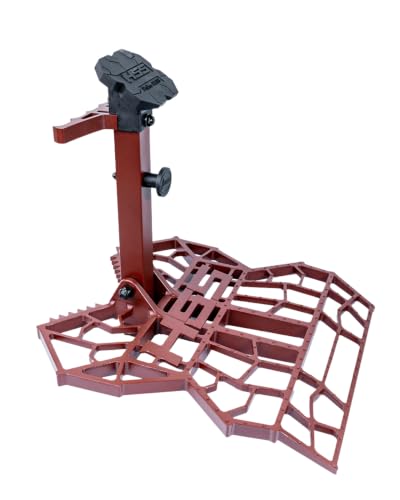


What’s in this listEvery saddle hunting platform we track on Amazon US, lightest first. “—” means neither the maker nor the Amazon listing states it.
What a saddle platform does, and what it doesn't
Saddle hunting is sitting in a light harness tied to the trunk, facing the tree. The full system (saddle, bridge, tether, lineman's rope, sticks) is laid out in the saddle hunting guide and on the hunting saddle page. This page is about one piece of it: the thing under your boots.
Here's the thing. A saddle platform is not a tree stand. It has no seat and no rail, and it doesn't catch you. The saddle and the tether hold you to the tree. The platform holds your feet so the saddle isn't doing all the work, and so you can stand, lean and turn around the trunk for a shot.
Game & Fish describes platforms as what you stand on at hunting height, and says they come in several styles, shapes and sizes. Most are a small deck on a post, with a strap that wraps the trunk. Compared with a hang-on stand, they're small. (The first time Jess showed me one, I asked where the rest of it was.)
The table under this page lists the saddle platforms the site tracks, lightest first. It shows weight, deck size, material, weight rating, whether the deck levels, the camo or color, and any certification the maker or the listing states. The table marks values that come from the listing rather than the maker; a dash means neither lists it.
Platform or a ring of steps
The platform isn't the only way to stand at height. One saddle maker's how-to calls a ring of steps around the trunk the original way to saddle hunt. You place steps in a circle so you can move around the tree for a shot.
The same maker calls a platform much more comfortable and user-friendly than steps. Steps are lower profile and lighter. Plenty of hunters mix the two: a platform as home base and a few strap-on or screw-in steps to reach the far side. Game & Fish lists screw-in steps as an option "where allowed," so check the rules for the property you hunt.
Game & Fish describes the order plainly: once the platform is secured, you step off the climbing stick onto it. The stick gets you there. The platform, or the steps, is where you stand.
What to look at in a saddle hunting platform
Deck size should fit your boots, not your nerves
One saddle maker sells the same platform in a regular and an XL size and writes plainly about who needs which. In average boots, about size 10 to 12, a regular deck typically gives you everything you need. The XL suits bigger feet, bulky late-season boots, and beginners who want something that feels more familiar.
The same article makes a point I'd underline: your feet don't move nearly as much as you think they will. A lot of the extra XL deck goes unused once you're set. And it notes that some hunters buy the XL for the feeling of safety, then buy a second, smaller platform later to cut weight.
The table shows deck size as the maker or the listing states it, usually length by width. Measure your actual hunting boot, sole to sole, on the coldest pair you own. Then compare. Do the measuring in the kitchen, not forty feet up a tree.
Weight is the main reason platforms exist
Saddle hunters carry their whole setup in and out, so weight is what most buyers compare first. That's why the table sorts lightest first.
Read the weight column carefully. One maker's product page lists its deck weight "without attachment method," and the strap ships as a separate line item. A light deck with a heavy strap or bracket isn't light anymore. Add it up before you compare two platforms.
The same maker's size article adds a practical point. A smaller platform packs down more efficiently and is easier and quieter to move through the woods in the dark. A few ounces add up over a season of walking in.
Material changes weight, feel and noise
The table lists the material as the maker or the listing states it. One maker builds its deck from high-pressure die-cast aluminum, a common choice for a part that has to be stiff and light. Other decks use other metals or composites; the table says which.
Look at the deck surface too. The same maker gives its deck a dark powder-coated finish and says it reduces glare and adds traction. Glare is what a deer sees. Traction is what you want with frost on the deck and wet boots on top of it.
Metal on metal is noise. A platform that clanks against your sticks on the walk in is announcing you. Pad it, pack it, or pick one that stacks flat with your sticks.
Leveling turns a crooked tree into a flat deck
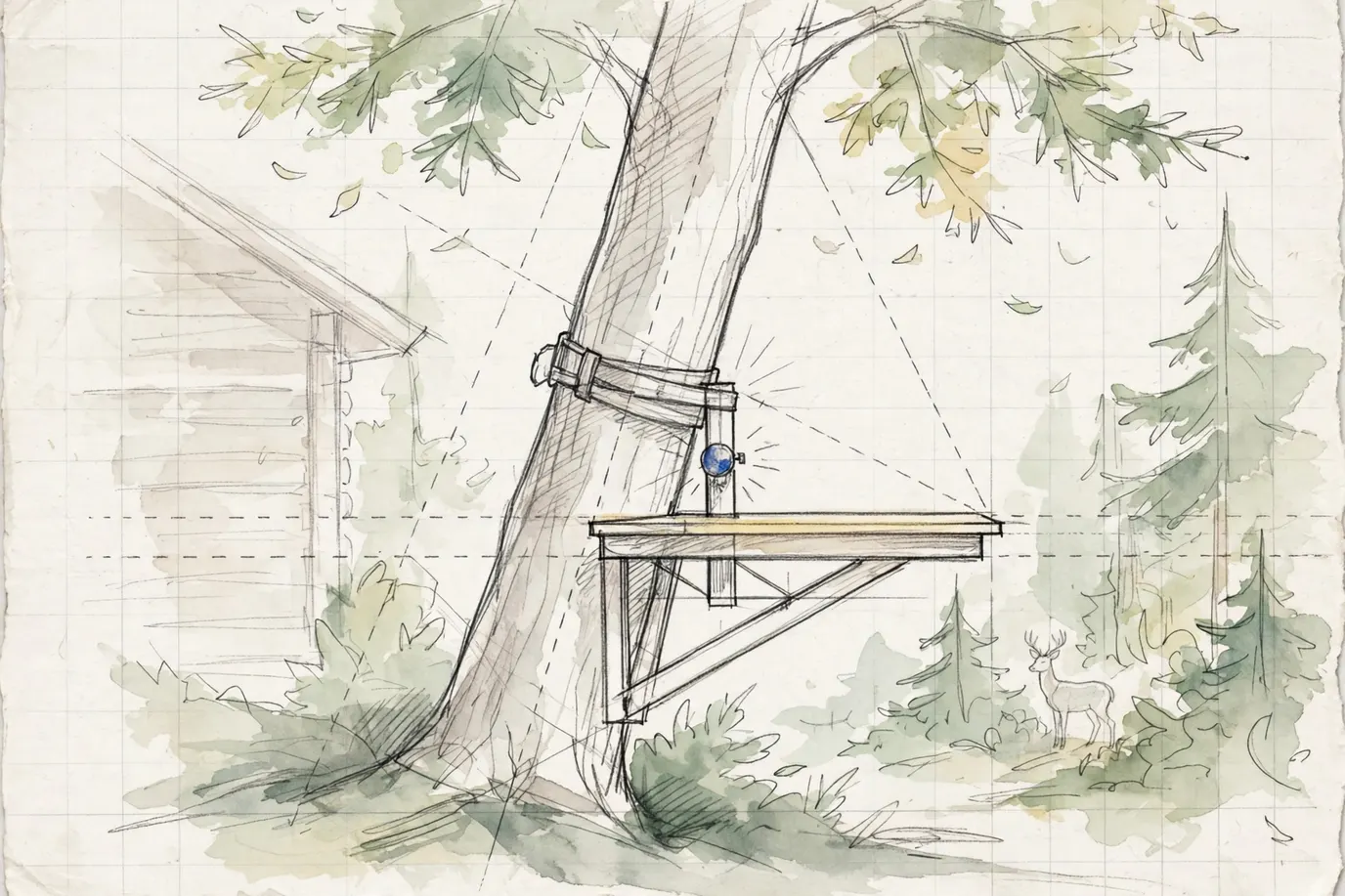
Saddles let you hunt trees a stand won't fit, including leaning and crooked ones. A deck that sits at the tree's angle sits at the wrong angle for your feet. That's what a leveling adjustment is for. One maker's deck has an adjustment knob it says you can work with gloves on. Another lists built-in leveling with 35 degrees of adjustability.
The table marks whether a platform levels or adjusts, as the maker or the listing states it. One maker lists a fully adjustable deck with built-in leveling. That's the feature to look for if your woods are more crooked than straight.
Deck angle is a comfort setting, not just a level
Level isn't always the end of it. One saddle maker writes that the angle of your platform directly affects foot fatigue. Its advice: start with the deck parallel to the ground, see what feels right, and if your feet tire, open up the angle with the adjustment knob on the post.
I taught shop for a long time, and the rule there was the same: one change at a time, so you know which change helped.
Weight rating, with everything you carry
The table shows the weight rating as the maker or the listing states it. Two maker pages I read list 300 lb and 350 lb. Yours will be on the box and in the manual. Count your body weight, your boots, your coat, your pack and your bow. Leave room on top of that total, so you never plan to stand right at the limit.
Certification, as the maker or the listing states it
This is the field makers fill in least, and the table shows it only when the maker or the listing lists it. Here's what the letters mean.
Intertek, a test lab approved by the Treestand Manufacturer's Association (TMA), explains that treestand standards are developed and approved by TMA members and tested against ASTM methods. Its list includes:
- ASTM F2125: static stability and adherence (does it stay put on the tree)
- ASTM F2126: static load capacity
- ASTM F2128: repetitive loading
- ASTM F2531: load capacity of treestand seats
- ASTM F3544: static load capacity of hunting saddles
One platform maker lists F2128, F2126, F2125 and F2531 for its deck. Read it as "the maker had it tested to these methods," nothing more. A test standard on the deck doesn't change the rule below: the platform holds your feet, not your life.
How it straps to the tree
Most platforms strap to the trunk. One maker ships its deck with a roller cam strap; another uses a strap button on the platform. Follow the maker's instructions for how tight and where. Whatever the design, the strap is the part to inspect every single time. It lives outside, it gets wet, and it holds the whole thing up.
Setting a saddle platform at hunting height
Game & Fish lays out the order, and the safety steps are the point of it:
- Climb with your lineman's rope connected to the tree.
- Decide which side of the tree you want to face before you secure the platform.
- Strap the platform to the trunk at hunting height, keeping the lineman's rope on.
- Step off the top stick onto the platform.
One saddle maker's how-to adds the part that matters most: attach your tether before you step onto the platform, and only once the tether is connected and the platform is secure do you take off the lineman's rope. The same maker says most accidents happen in that transition from climbing to the platform.
onX suggests practicing with the platform set a foot or so off the ground before you go high. Do it in daylight, in the yard, with the same boots you'll wear in November. It's also where you'll learn how much you turn. The onX writer describes standing on the platform and rotating 180 degrees, back to the tree, for a shot on the weak side.
Jess's take: "Set the platform for the shot you expect, not the one you hope for." She means the side you'll face, and she's right.
Saddle platform safety
Stay connected to the tree from the moment your boots leave the ground until they're back on it. Follow the saddle maker's instructions for the tether and lineman's rope, and the platform maker's instructions for the strap.
Wisconsin DNR's tree stand advice applies here too: inspect your equipment for wear before each hunt, follow the manufacturer's setup instructions, avoid trees with obvious decay or disease, keep three points of contact while climbing, and use a haul line to raise and lower your bow. Carry a charged phone and tell someone where you'll be. Rules on stands and steps vary by state and property, so check your state wildlife agency.
My one opinion on this page: stay connected every time your boots leave the ground, no exceptions, no "just a minute." The reason is in the maker's own how-to above. The risk is highest while you're moving between ropes and onto the deck, not while you're sitting still.
Who should skip a saddle platform
- You don't saddle hunt. A platform without a saddle isn't a stand. Look at the tree stand page instead.
- You already run a ring of steps and like it. Steps work. A platform is a comfort upgrade, not a requirement.
- You won't practice low first. The platform makes the transition easier to learn, not optional to practice.
For everyone else, start with your boot size, add the strap to the weight, and check the leveling against the crookedest tree you hunt. Climbing gear for getting up there is on the climbing sticks page. Write the platform height that worked in the logbook, next to the tree. That's one less thing to guess in the dark.
Brands in this list
Related
Questions people ask
Do you need a platform for saddle hunting?
You need something to stand on. A platform is one option; a ring of steps around the trunk is the older one, and some hunters mix the two. One saddle maker calls a platform much more comfortable and user-friendly than steps. Steps are lower profile. Either way, don't use the top climbing stick as your only footing.
What size saddle platform do I need?
One saddle maker's advice is that a regular-size platform typically covers hunters in average boots, about size 10 to 12. An XL suits bigger feet, bulky late-season boots and beginners who want more room. The same maker notes that your feet move less than you'd think once you're set up, so much of the extra deck goes unused.
Are saddle platforms safety certified?
Some makers list ASTM test standards for their platforms, and the table shows certification only as the maker or the listing states it. Treestand standards are developed by members of the Treestand Manufacturer's Association and tested by approved labs. The platform still doesn't hold you to the tree. Your saddle and tether do, used exactly as the saddle maker instructs.
What does a leveling platform do?
It lets you set the deck flat, or at the angle you want, on a trunk that leans or bulges. One saddle maker says platform angle directly affects foot fatigue and suggests starting with the deck parallel to the ground, then opening the angle with the adjustment knob if your feet tire. Leveling is often a knob on the post; some can be worked with a foot.
How heavy is a saddle hunting platform?
It varies by size and material, and the table lists weight as the maker states it, lightest first. Compare carefully: at least one maker lists its platform weight without the attachment method, meaning the strap isn't counted. Add the strap before you compare one platform with another.
Sources
- Tethrd: Regular vs XL platforms, which is better? — accessed 2026-10-22
- Tethrd: Saddle hunting 101 (maker's how-to) — accessed 2026-10-22
- Tethrd: How to get comfortable saddle hunting, fix common mistakes — accessed 2026-10-22
- Maker product page: saddle platform kit (material, finish, weight without attachment, cam strap, adjustment knob, rating) — accessed 2026-10-22
- Game & Fish: Complete guide to saddle hunting — accessed 2026-10-22
- onX Hunt: Saddle hunting guide — accessed 2026-10-22
- Intertek: Testing to TMA-approved treestand manufacturing standards — accessed 2026-10-22
- Maker product page: adjustable saddle platform (lists ASTM F2128, F2126, F2125, F2531) — accessed 2026-10-22
- Wisconsin DNR: DNR urges hunters to prioritize tree stand safety this fall — accessed 2026-10-22