Brand · Fire & Lighting
SureFire Flashlights and Headlamps
SureFire is a flashlight company first: compact handheld lights with names like G2X, EDCL and E2D Defender. On this site it covers two types: flashlights, from polymer G2X lights to the rechargeable Fury, and one headlamp, the Maximus HS3-A, with a dial that runs from 1 to 1,000 lumens. This page covers both: what separates the SureFire flashlight families, and what the Maximus does for a hunter. Real talk: with SureFire, the dial is the story. (Renee asked why a headlamp needs a volume knob. Same reason I do, apparently.)
We earn a commission if you buy through our links, at no cost to you. Disclosure
SureFire on Amazon US
14 models- Flashlight
SureFire 6PX Pro
- Body
- Aluminum
- Max output
- 600 lumens
- Flashlight
SureFire G2X Tactical
- Body
- Polymer
- Max output
- 600 lumens
- Flashlight
SureFire G2X Pro
- Body
- Polymer
- Max output
- 600 lumens
- Flashlight
SureFire G2ZX Combatlight
- Body
- Polymer
- Max output
- 600 lumens
- Flashlight
SureFire E2D Defender Tactical
- Max output
- 1,000 lumens
- Flashlight
SureFire G2XLE
- Body
- Polymer
- Max output
- 600 lumens
- Flashlight
SureFire 2211 WristLight
- Body
- Polymer
- Max output
- 300 lumens
- Flashlight
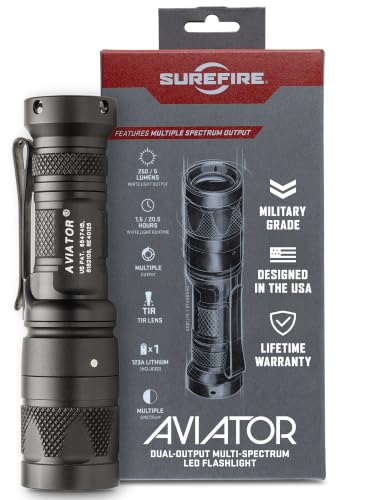
SureFire Aviator
- Body
- Aluminum
- Max output
- 250 lumens
- Red light
- Yes
- Flashlight
SureFire EDCL2-T
- Max output
- 1,200 lumens
- Flashlight
SureFire Fury DFT
- Body
- Aluminum
- Max output
- 1,500 lumens
- Flashlight
SureFire E2D Defender Ultra
- Body
- Aluminum
- Max output
- 1,000 lumens
- Flashlight
SureFire G2X LE
- Max output
- 600 lumens
- Flashlight
SureFire P1RZ Peacekeeper DFT
- Max output
- 1,500 lumens
- Headlamp
SureFire Maximus HS3-A
- Max output
- 1,000 lumens
- Power
- Rechargeable




What SureFire makes, and what this page covers
SureFire's site sorts its catalog into a few groups. The one hunters and campers care about is what the maker calls illumination: handheld flashlights, hands-free lights (headlamps) and a few specialist lights. The catalog also includes hearing protection, batteries, pens and other gear this site doesn't cover.
On this site, SureFire appears in two types: flashlights, which make up almost all of the grid, and headlamps, where the grid holds the Maximus HS3-A. The grid changes as listings come and go, so I'll write about the lights and what separates them, not about what's in stock this week.
SureFire's history page dates its handheld lights back to the Model 6C in 1988. The flashlights came first, and the headlamps came later. So that's the order here too.
SureFire flashlights: the handheld families
If you searched "SureFire flashlight," here's the map from the maker's own flashlight page. It lists handheld lights in a handful of families:
- Stiletto Pro: rechargeable pocket LED lights, with a "Pro II" version the maker gives a hybrid beam
- EDC Turbo: everyday-carry lights in two models, the EDC1 and EDC2
- EDCL: dual-output everyday-carry LED lights, also in two lengths
- G2X: dual-output LED lights, led by the G2X Pro
- FURY: dual-fuel lights, which the maker sells with an auto-adjusting IntelliBeam version
- E2D: the Defender, which SureFire lists at 1,000 lumens
The maker's model pages give each light's outputs and battery types. Read those before you compare two families by name alone.
SureFire flashlights in the grid
Most of those families are in the grid now. Here's how the listings sort them.
G2X: the polymer lights
The G2X is the biggest family in the grid: the G2X Pro, the G2X Tactical, the G2X LE and G2XLE listings and the G2ZX Combatlight. They share a polymer body, a tail switch and the same listed output, a few hundred lumens. The G2X LE listing names CR123A cells. With the output the same on paper, the differences are in details the maker's model pages spell out, so read those before you pick one.
E2D Defender and EDCL2-T: the brighter compacts
The E2D Defender Tactical and the E2D Defender Ultra list around a thousand lumens and a tail switch, and the Ultra lists an aluminum body and CR123A cells. The EDCL2-T is a step brighter again, per its listing, and also uses a tail switch. EDCL is the maker's everyday-carry family, per its flashlight page.
Fury DFT and P1RZ Peacekeeper DFT: 18650 lights
DFT is short for Dual Fuel Tactical, the name SureFire's site gives the FURY. Both of these list an 18650 cell and the highest output among the SureFire flashlights in the grid. The Fury DFT lists an aluminum body and micro-USB charging. (Renee asked why a flashlight needs two fuels when the truck only needs one. I told her the truck doesn't fit in a coat pocket.)
6PX Pro, Aviator and 2211 WristLight: the rest
The 6PX Pro is an aluminum light with a tail switch at a few hundred lumens, the plain everyday option. The Aviator is the one with a red light, per its listing, plus an aluminum body and a tail switch. The 2211 WristLight is a rechargeable polymer light, and its name tells you where it goes. Flashlights across brands are compared on the tactical flashlight page, the hunting flashlight page and the rechargeable flashlight page.
What SureFire means by a tactical flashlight
"SureFire tactical flashlight" is a common search, so here's what the maker's pages actually say. Tactical shows up in some product names, like the FURY Dual Fuel Tactical and the G2X Tactical, and in the E2D Defender's description. In the grid, the listings flag the G2X Tactical, G2X LE, E2D Defender Tactical, Fury DFT and P1RZ as tactical. SureFire's history page calls the Model 6C a big step for handheld tactical lighting. On the flashlight page itself, tactical isn't a separate category. Those lights sit in the same list as the pocket and everyday-carry lights.
For a hunter, the useful part is simpler: a handheld that runs one-handed and turns on to a known output. Walt says every flashlight he's ever owned was tactical, because it was in the truck when he needed it. (It was in the truck. He needed it in the cabin.)
The SureFire headlamp on this site: Maximus HS3-A
The Maximus is SureFire's rechargeable headlamp. Here's what the maker lists on its page:
- Output: 1 to 1,000 lumens on a knurled dial, adjustable "lumen by lumen"
- Beam: a wide, smooth beam the maker calls MaxVision, 4,100 candela peak
- Beam distance: 0 to 128 m
- Runtime: 1.5 hours at high, 550 hours at low, plus an SOS beacon
- Battery: one integrated rechargeable lithium-ion battery with a fuel gauge
- Chargers: wall (AC) and car (DC) chargers included
- Weight: 6.9 oz with batteries
- Housing: magnesium with a hard-anodized finish
- Water: IPX4, which the maker describes as resistant to splashing water from any direction
The light head tilts up and down 90 degrees, and the headband has what SureFire calls a Breath-O-Prene forehead pad. The grid shows the max output and power source from the Amazon listing; the rest comes from the maker.
What the dial changes in practice
Plenty of headlamps make you click through fixed steps, usually past the brightest one at the worst possible moment. The Maximus has a dial. Turn it down for reading a map in the blind, up for a long look across a field.
Here's what the numbers mean. The ANSI FL 1 standard that light makers use defines lumens as total light output, candela as the brightness at the center of the beam, and beam distance as how far the beam reaches before it drops to 0.25 lux. So 1,000 lumens tells you how much light comes out. The 4,100 candela and the 128 m tell you how far it throws.
My one opinion on this page: on any dial lamp, live at the low end of the dial. The reason is in the maker's own runtime numbers: 1.5 hours at 1,000 lumens, 550 hours at 1 lumen. That's a lot of nights between the two. Walking a trail you already know needs a sliver of the dial, not the whole thing.
What IPX4 covers
The maker rates the Maximus IPX4 and describes it as splash-resistant from any direction. Rain on a walk-in is splashing. Dropping it in the creek is not. The Minimus, SureFire's other headlamp, is rated IPX7 by the maker, a different water rating.
Where the Maximus sits next to the Minimus
SureFire lists two headlamps. This site's grid holds the Maximus. The Minimus, per the maker, runs 5 to 300 lumens across 13 preset steps on a dial, takes one 123A lithium cell, lists 1.5 hours at 300 lumens and about 75 at 5, and weighs 4.0 oz with its battery. Smaller output, a disposable cell and less weight. This site doesn't list the Minimus.
A SureFire flashlight or a headlamp for hunting
This is the question under the search, so here's my take as the camp's light guy. A handheld throws light where your hand points. A headlamp throws it where your face points, and leaves both hands free.
At deer camp, most of the jobs that happen in the dark want two hands:
- Climbing into a stand or blind: hands on the ladder or the zipper
- Field dressing: one hand on the knife, one on the deer
- Dragging out: both hands on the rope
- Setting up the camp kitchen: one hand on the stove, one on the coffee
A handheld earns its spot for the other jobs: checking the truck bed, looking under the cabin for whatever is living there this year, or throwing a beam across a field without turning your whole head. Plenty of hunters carry one of each. (I carry one of each, plus a spare of each, plus one for Walt.)
Using the Maximus dial at camp
On a dial lamp, a few settings cover most of a hunt. Set it low for the map or the tag in the blind, middle for dressing a deer, and high only for a long look at a tree line or a blood trail you've lost. The maker lists an SOS beacon too, which it says can run for days. That's the setting you hope you never touch.
One habit that helps: when you're done, leave the dial at the low end. Then the next time the lamp comes on, in a dark blind with a deer somewhere out front, you don't light up the woods at the top of the dial.
How to choose within the SureFire lineup
Battery first
The grid splits on cells. The G2X LE and E2D Defender Ultra list CR123A lithium cells, the Fury DFT and P1RZ use an 18650, and the Maximus and 2211 WristLight are rechargeable. CR123A cells keep for years in a drawer, which suits a truck light. A rechargeable light suits a camp with a warm cabin and an outlet.
Then output and switch
Nearly every SureFire flashlight in the grid lists a tail switch, so the switch type isn't what separates them. Output is. The G2X and 6PX Pro sit at a few hundred lumens, the E2D Defenders around a thousand, and the 18650 lights above that. More output means less runtime from the same cell, the same trade the Maximus dial shows.
Red light
Only the Aviator lists a red light among these flashlights, and the Maximus page doesn't list a red or colored mode. Red matters on a walk-in. The National Park Service explains that night vision builds over roughly 20 to 40 minutes, a few seconds of bright white light can undo it, and dim red light largely doesn't. If you need red, read that line in the grid first.
The headlamps page and the rechargeable headlamp page compare the Maximus with lamps from other brands.
SureFire batteries and charging
SureFire's FAQ gives plain battery rules for its lights:
- Never recharge disposable 123A lithium cells
- Don't mix rechargeable and disposable cells in one light
- Store batteries away from high heat; the maker says shelf life is several years that way
- Recharge rechargeable cells that have sat idle for two years
For the Maximus, there's nothing to swap: you charge the lamp from the wall or the truck. The U.S. Fire Administration's lithium-ion rules apply to it like any other: don't charge below 32°F or above 105°F, keep it out of a hot car, and stop using any battery that smells, swells, leaks or gets too hot. In November, that means charging it in the cabin, not on the dash overnight.
Care and warranty basics
SureFire's warranty page lists lifetime coverage on its products for defects in materials and workmanship, with repair or replacement. Rechargeable batteries and chargers are covered for two years from purchase. Normal wear isn't covered, and the maker names examples that matter on a headlamp: battery drain, worn headbands and headpads, and worn switches. Abuse, alterations and unauthorized repairs aren't covered either.
The FAQ adds two notes for SureFire's battery lights. Using a non-SureFire battery outside the brands it names can void the warranty, and removing a fixed head can too. Keep the receipt, and keep the screwdriver away from it.
SureFire facts
SureFire's history page says the company grew out of Laser Products, founded by engineer Dr. John Matthews, and took the name SureFire, LLC in 2001. The site states that all SureFire illumination products are designed, perfected and manufactured in the USA, with materials and components sourced worldwide.
Dial down, charge indoors, pack a spare light. The fire's my department; the light just has to get me to it.
Where SureFire shows up
Often compared
Questions about SureFire
Are SureFire flashlights and headlamps good?
What can be checked is what the maker and listings state. The SureFire flashlights here list tail switches on nearly every model, with outputs from a few hundred lumens to well over a thousand. SureFire's Maximus page lists 1 to 1,000 lumens on a dial, a magnesium housing, IPX4 splash resistance and 6.9 oz with batteries. Its warranty page lists lifetime coverage for defects in materials and workmanship, with two years on rechargeable batteries and chargers. Whether a light suits you depends on the job, the battery and the weight.
What is a SureFire tactical flashlight?
On SureFire's site, tactical is part of some product names, such as the FURY Dual Fuel Tactical and the E2D Defender, which the maker calls a 1,000-lumen tactical LED flashlight. All of them sit under the maker's handheld flashlight category with the Stiletto Pro, EDC Turbo, EDCL and G2X families. On this site, tactical means a model the maker calls tactical, and several are in the grid.
Does SureFire make headlamps?
Yes. SureFire's headlamp page lists two: the Minimus, a variable-output lamp that runs on one 123A lithium battery, and the Maximus, a rechargeable variable-output lamp. The Maximus HS3-A is the SureFire headlamp in this page's grid. The grid adds headlamps from other brands next to it.
Where are SureFire lights made?
SureFire's site says all SureFire illumination products are designed and manufactured in the USA, and notes that materials and components are sourced worldwide. Its history page says the company took the name SureFire, LLC in 2001, after growing out of an earlier company called Laser Products.
What batteries do SureFire lights use?
It depends on the light. The Maximus has an integrated rechargeable lithium-ion battery with wall and car chargers. The Minimus takes one 123A lithium cell. SureFire's FAQ says disposable 123A cells must never be recharged, and that rechargeable and disposable cells shouldn't be mixed in one light.
Where can I buy SureFire flashlights?
The product grid on this page links to the SureFire flashlight and Maximus headlamp listings on Amazon US. SureFire also sells on its own site and through dealers. Several SureFire lights share a family name, like the G2X Pro, G2X Tactical and G2X LE, so check that the listing names the exact model before you order.
Sources
- SureFire: Home and product categories — accessed 2026-10-28
- SureFire: The SureFire story — accessed 2026-10-28
- SureFire: Flashlights — accessed 2026-10-28
- SureFire: Headlamps — accessed 2026-10-28
- SureFire: Maximus rechargeable variable-output LED headlamp — accessed 2026-10-28
- SureFire: Minimus variable-output LED headlamp — accessed 2026-10-28
- SureFire: FAQ — accessed 2026-10-28
- SureFire: Warranty — accessed 2026-10-28
- Streamlight: ANSI/PLATO FL 1 information — accessed 2026-10-28
- National Park Service: Dark adaptation of the human eye and the value of red flashlights — accessed 2026-10-28
- U.S. Fire Administration: Lithium-ion battery safety — accessed 2026-10-28