

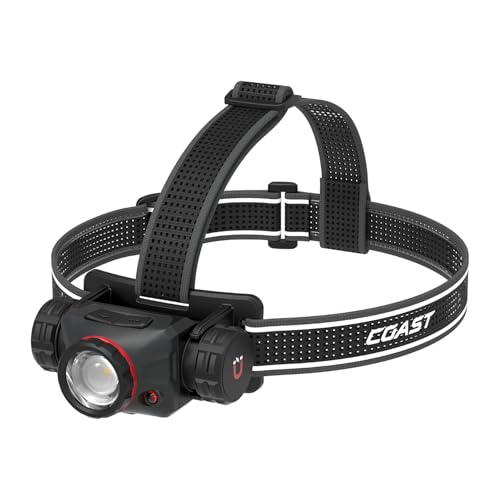


sofirn HS41
Good for the most light, reach and runtime on this list by the listing, 4,000 lumens, a 1,066-foot beam and up to 708 hours, rechargeable.
Skip it if you want a red mode; the data doesn't list one.
Fire & Lighting · Best-of list
The best headlamp is the one with enough beam for your walk and enough runtime for your longest night, on the mode you'll actually use. This list holds headlamps whose maker or Amazon listing states output and runtime, brightest first, two per brand at most. Brightest first is an order, not a verdict: a 4,000-lumen lamp is a lot of light for tying a boot. (I own more headlamps than socks. Renee has counted both. She says the socks are losing.)
How this list is builtHeadlamps whose maker or Amazon listing states output and runtime, brightest first, two per brand at most.
We earn a commission if you buy through our links, at no cost to you. Disclosure
| Model | Max output | Beam distance | Max runtime | Power | Amazon |
|---|---|---|---|---|---|
sofirn HS41Headlamp | 4,000 lumenslisting | 1,066 ftlisting | 708 hourslisting | Rechargeablelisting | Check price |
sofirn HS23Headlamp More specs
| 3,320 lumenslisting | 629 ftlisting | 350 hourslisting | Rechargeablelisting | Check price |
Coast XPH40R HeadlampHeadlamp More specs
| 3,000 lumenslisting | — | 72 hourslisting | Rechargeablelisting | Check price |
OLIGHT Perun 3Headlamp More specs
| 3,000 lumenslisting | 525 ftlisting | 480 hourslisting | Rechargeablelisting | Check price |
Ledlenser H15R CoreHeadlamp | 2,500 lumenslisting | 820 ftlisting | 80 hourslisting | Rechargeablelisting | Check price |
Ledlenser H15R CoreHeadlamp More specs
| 2,500 lumenslisting | 820 ftlisting | 80 hourslisting | — | Check price |
Nitecore HC65 UHEHeadlamp More specs
| 2,000 lumenslisting | 729 ftlisting | 82 hourslisting | Rechargeablelisting | Check price |
Nitecore HC65M UHEHeadlamp More specs
| 2,000 lumenslisting | 729 ftlisting | 82 hourslisting | Rechargeablelisting | Check price |
Fenix HP25R v2.0Headlamp More specs
| 1,600 lumenslisting | 951 ftlisting | 400 hourslisting | Rechargeablelisting | Check price |
Fenix HP25R v2.0 BundleHeadlamp More specs
| 1,600 lumenslisting | 951 ftlisting | 400 hourslisting | Rechargeablelisting | Check price |
Good for the most light, reach and runtime on this list by the listing, 4,000 lumens, a 1,066-foot beam and up to 708 hours, rechargeable.
Skip it if you want a red mode; the data doesn't list one.
Good for 3,320 lumens with red light, a 629-foot beam and up to 350 hours, rechargeable.
Skip it if you want a long throw; seven listings here state a longer beam.
Good for 3,000 lumens with spot and flood beams plus red and green modes, rechargeable, up to 72 hours by the listing.
Skip it if you want a stated beam distance or long nights; the data gives no beam figure, and 72 hours is the shortest runtime here.
Good for 3,000 lumens, red light and up to 480 hours, the second-longest stated runtime here, rechargeable.
Skip it if you want a long throw; its 525-foot beam is the shortest stated on this list.
Good for 2,500 lumens and an 820-foot beam, rechargeable, up to 80 hours.
Skip it if you want a red mode or the lower price tier; the data lists no red light, and it sits in the higher tier.
Good for the same H15R Core figures, 2,500 lumens, an 820-foot beam and up to 80 hours, with a tilting head stated on the listing.
Skip it if you want a red mode; the data doesn't list one, and this listing doesn't state the power source.
Good for 2,000 lumens, a 729-foot beam and red light, rechargeable, up to 82 hours.
Skip it if you want the most output or a long week between charges; six listings here state more lumens.
Good for the same listed figures as the HC65 UHE, 2,000 lumens, a 729-foot beam, red light and up to 82 hours, rechargeable.
Skip it if you want long runtime; 82 hours sits near the bottom of this list.
Good for a 951-foot beam, the second-longest here, with up to 400 hours, red light and spot plus flood, rechargeable.
Skip it if you want the most output or the lower price tier; 1,600 lumens is the lowest figure on the list.
Good for the HP25R v2.0 sold as a bundle, with the same listed 1,600 lumens, 951-foot beam, 400 hours, red light and spot plus flood.
Skip it if you only want the lamp; the single listing is also on this list.
The table opens with the brightest headlamp and works down. Brightness here means the top lumen figure the maker or Amazon listing states. Lumens are total light output, the ANSI/PLATO FL 1 way of counting it, as Streamlight explains the standard.
Two rules shape the list. A headlamp needs a stated output and a stated runtime to get on it at all. And no brand gets more than two spots, so the table shows ten lamps from six brands instead of ten from one.
That spread is useful, even if it's a narrower one than you might expect. The list runs from 4,000 lumens down to 1,600, so every lamp on it is a serious light on its top setting. Stated beams run from 525 to 1,066 feet, and the shortest of those still reaches past a football field and a half. Runtimes run from 72 hours to 708. Somewhere in that range is your walk to the stand.
The Sofirn HS41 lists 4,000 lumens, a 1,066-foot beam and up to 708 hours, by its Amazon listing. Those are the top lumen, beam and runtime figures on the list, and it's rechargeable. The data doesn't list a red mode. The high mode is for looking a long way: across a field, down a logging road, along a creek bank. Running it on high to find the coffee is like using the truck's high beams to read the Sheetz menu. It works, but everybody in the lot has an opinion.
The Sofirn HS23 lists 3,320 lumens, a 629-foot beam, red light and up to 350 hours. It's rechargeable. Next to its brand-mate it trades output, reach and runtime for the red mode the HS41 doesn't list.
The Coast XPH40R lists 3,000 lumens, spot and flood beams, red and green light and up to 72 hours. It's the one lamp here that lists green, and its 72 hours is the shortest stated runtime on the list. The data doesn't give a beam distance, so compare it on lumens, beam type and colors, not reach.
The Olight Perun 3 lists 3,000 lumens, red light and up to 480 hours, rechargeable. Its 525-foot beam is the shortest stated on the list, which fits a lamp whose numbers lean toward long nights over long throw.
Two Amazon listings for the Ledlenser H15R Core made the list, and both give 2,500 lumens, an 820-foot beam and up to 80 hours. One listing says rechargeable; the other doesn't state the power source but does state a tilting head. Neither lists a red mode. Both sit in the higher price tier.
The Nitecore HC65 UHE and HC65M UHE list identical figures: 2,000 lumens, a 729-foot beam, red light and up to 82 hours, rechargeable. The data doesn't separate the two on any field, so read the maker's description for whatever the "M" adds before you choose between them.
The Fenix HP25R v2.0 appears twice, once alone and once as a bundle, with the same figures on both: 1,600 lumens, a 951-foot beam, red light, spot and flood, and up to 400 hours. That's the lowest output on the list, the second-longest beam and the third-longest runtime. Both listings sit in the higher price tier.
The two-per-brand cap counts listings, not model names. When one model is sold under two listings, as the Ledlenser and Fenix pairs are here, it can fill both of its brand's spots. That's why ten listings on this page come down to eight model names, and the two Nitecore names share every listed figure. Check the listing you click: a bundle and a single lamp share a table row's numbers but not a box.
Lumens measure all the light a lamp puts out. They don't say where it goes. A flood beam spreads that light wide and close; a spot beam squeezes it into a narrow throw.
Black Diamond's guide says 150 to 250 lumens covers reading and walking in the dark. Every lamp on this list clears that on its top setting. Jess's take: "Lumens are how much water is in the hose. Beam distance is how hard you squeeze the nozzle." She then asked why I own a hose. I don't. I own headlamps.
Under FL 1, beam distance is how far from the lamp the beam still measures 0.25 lux, per Streamlight's summary. That's dim. A 951-foot figure doesn't mean you'll read a trail sign at 951 feet; it means the light has faded to a faint glow there.
Black Diamond says 30 to 60 meters, about 100 to 200 feet, covers close jobs like camp setup and cooking. On this list, beam distances run from 525 to 1,066 feet. One lamp, the Coast, has no stated beam distance in the data.
My one opinion on this page: buy a headlamp for the beam distance you need, not the lumens on the box. The reason is in the standard. Lumens count all the light, and beam distance tells you where it actually reaches, so two lamps with the same lumens can light very different trails.
FL 1 measures runtime from the output 30 seconds after you switch on with fresh batteries until it drops to 10% of that, per Streamlight. So the headline runtime can include a long tail of dim light, and the biggest number on a box almost always belongs to a low setting.
Princeton Tec's spot-or-flood article says spot beams use higher lumen counts and run shorter, while flood beams spread fewer lumens and run longer. Put those together and the table makes sense: the top lumen figure and the top runtime figure are almost never the same mode. Streamlight also notes the standard is voluntary and makers run their own tests.
Princeton Tec describes flood beams as wide, even light for close work like setting up camp, close enough to daylight that your side vision works. Spot beams are for seeing far ahead, which is why hunters use them to scan. Three listings here state both beams: the Coast XPH40R and the two Fenix HP25R listings. For tracking or walking an unfamiliar logging road, a spot helps. For the tent and the camp kitchen, a flood is kinder to everyone around you.
The National Park Service explains that bright white light breaks down rhodopsin, the pigment your eyes need for night vision, within seconds. Full dark adaptation takes about 20 to 40 minutes. Dim red light doesn't wreck it.
Princeton Tec's hunting article says red light helps you walk to a treestand or blind without startling wildlife, and green adds contrast and is easy for people to see. Seven listings here state a red mode and one states green. Rules about using lights while hunting vary by state; check your state wildlife agency.
Nine of the ten listings say rechargeable, and the tenth doesn't state a power source. Black Diamond's guide says rechargeable lamps use a built-in lithium-ion battery with a USB port, while lamps that take AAA cells let you swap batteries in the field. No listing on this page states that it runs on AA or AAA cells, so if field swaps matter more to you than lumens, the headlamps page has the wider field.
Whichever you buy, carry a second power source: a charged battery bank for a rechargeable, spare cells for the others. A headlamp that dies at 5:15 a.m. is a very nice hat.
Here's how the numbers on this list sort by job:
FDNY's lithium-ion tips say to follow the maker's charging instructions, use the maker's cord and adapter, plug the charger straight into a wall outlet, and charge away from anything that can catch fire. Stop using any battery that smells, swells, changes color, leaks or makes odd noises. A sleeping bag counts as something that can catch fire.
If you only need light inside the cabin or around the picnic table, skip it and look at a camping lantern. A lantern lights the whole table; a headlamp lights whatever you look at, which at dinner is everybody's face. And if a red mode is your deciding spec, the red light headlamp page sorts by that directly. For the full field without the brightness order, see the headlamps page.
A headlamp makes the list when its maker or its Amazon listing states its output in lumens and its runtime in hours. The list then sorts by output, brightest first, with no more than two headlamps per brand.
Values come from the maker's own pages first. Where the maker is silent, the Amazon listing fills in, and the table marks those values. On this list, every value in our data comes from the Amazon listings. A blank means neither source states it.
The list is checked again every week. New lamps that meet the rule join, others drop off, and the order can change. Nothing here is ranked by ratings, and price shows only as a tier, never a number.
Pick the beam for your walk, the runtime for your longest night, and pack a spare. Then put it on your head before you need it. The porch steps at Hemlock Run don't move, but in the dark they sure act like it.
The Sofirn HS41, at 4,000 lumens by its Amazon listing, followed by the Sofirn HS23 at 3,320 and the Coast XPH40R and Olight Perun 3 at 3,000. The HS41 also lists the longest beam here at 1,066 feet. Brightest isn't the same as best for you: high modes drain the battery fastest, and a walk to the stand rarely needs more than a few hundred lumens.
Nine of the ten listings here say rechargeable; the tenth doesn't state a power source. For the walk in, look for a red mode so you keep your night vision; seven on this list have one. For long nights, the Sofirn HS41 lists 708 hours, the Olight Perun 3 480 and the Fenix HP25R 400 at their longest-running settings. Carry a spare power source either way.
Black Diamond's headlamp guide says 150 to 250 lumens covers basic jobs like reading and walking in the dark, and 30 to 60 meters of beam covers close tasks like camp setup and cooking. Every lamp on this list goes past that on its top setting. Higher numbers help on trails, in brush and when you're looking far ahead.
Under the ANSI/PLATO FL 1 standard, as Streamlight explains it, runtime is measured from the output 30 seconds after you switch on with fresh batteries until the light falls to 10% of that. So a long runtime figure can include hours of dim light, and it usually comes from a low mode. Ask how long the mode you'll use lasts.
For hunters, usually. The National Park Service explains that bright white light breaks down the pigment your eyes use for night vision within seconds, and full dark adaptation takes about 20 to 40 minutes. Dim red light doesn't do that. Princeton Tec adds that red helps you walk to a stand without startling wildlife.