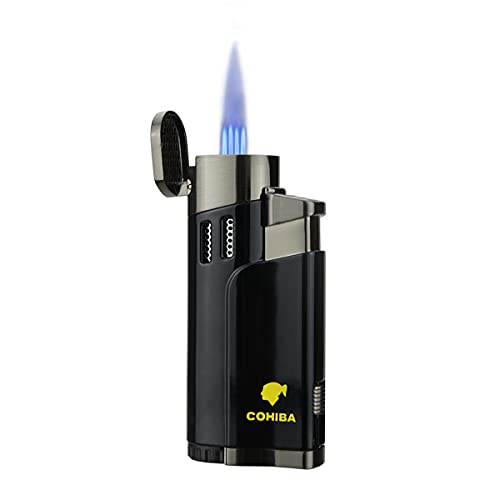


Guevara 4-Jet Torch Lighter with Punch
Good for a wide 4-jet flame with a cigar punch, refillable with butane by the Amazon listing.
Skip it if you want a narrow, precise flame for a stove burner or a lantern wick.
Fire & Lighting · Best-of list
The best torch lighter for camp is a refillable one you fill at home and keep in the fire kit, and this list starts there. It holds refillable torch lighters, as the maker or the Amazon listing states, and sorts them by jet count, most jets first. Right now all ten are four-jet torches. Jet count tells you how wide the flame is, not how good the lighter is. (Renee says I own more lighters than the cabin has candles. The cabin has two candles. I'm not helping my case.)
How this list is builtRefillable torch lighters, as stated by the maker or the Amazon listing, most jets first.
We earn a commission if you buy through our links, at no cost to you. Disclosure
| Model | Amazon |
|---|---|
Guevara 4-Jet Torch Lighter with PunchLighter More specs
| Check price |
Guevara 4-Jet Torch Lighter with PunchLighter More specs
| Check price |
Scotte 4 Jet Flame Cigar LighterLighter More specs
| Check price |
Tomolo Quad Jet Torch LighterLighter More specs
| Check price |
Tomolo Quad Flame Cigar Torch LighterLighter More specs
| Check price |
Visol Rhino Quad TorchLighter More specs
| Check price |
Visol Redferno Quad FlameLighter More specs
| Check price |
Xifei 4 Jet Cigar Lighter with HolderLighter More specs
| Check price |
Xifei 6-in-1 Desktop Cigar LighterLighter More specs
| Check price |
Xikar HP4 Quad JetLighter More specs
| Check price |
Good for a wide 4-jet flame with a cigar punch, refillable with butane by the Amazon listing.
Skip it if you want a narrow, precise flame for a stove burner or a lantern wick.
Good for the same Guevara 4-jet with a cigar punch on a second listing, refillable with butane.
Skip it if you only need a single focused jet; every lighter on this list has four.
Good for a Scotte 4-jet butane lighter with a cigar punch, refillable by the listing.
Skip it if you want a single focused jet for a stove or lantern.
Good for the only lighter here whose data states a body material, zinc alloy, with 4 jets, a cigar punch and a refillable butane tank.
Skip it if you want a narrow single-jet flame.
Good for a second Tomolo 4-jet, the Quad Flame, with a cigar punch, refillable with butane.
Skip it if you want a stated body material; the data gives one only for the Tomolo Quad Jet.
Good for the Visol Rhino, a refillable 4-jet butane torch for broad heat on tinder.
Skip it if you want a cigar punch; the data doesn't list one.
Good for the Visol Redferno, a second refillable 4-jet butane torch from the brand.
Skip it if you want a cigar punch; the data doesn't list one.
Good for a Xifei 4-jet refillable butane lighter that the listing says comes with a holder.
Skip it if you want a cigar punch; the data doesn't list one.
Good for a 4-jet desktop lighter with a cigar punch, refillable with butane, for the cabin table.
Skip it if you want a lighter for the pocket or the fire kit; the listing calls it a desktop lighter.
Good for the Xikar HP4, a refillable 4-jet butane torch, the one lighter on this list in the higher price tier.
Skip it if you want a cigar punch; the data doesn't list one.
This list runs by jet count, most jets first. This week that sort has nothing to separate: every lighter on it lists four jets, so the whole table ties at the top. That order is a description, not a ranking. A four-jet flame isn't better than a single jet. It's wider.
Every lighter here is a refillable butane torch, by its maker or its Amazon listing. Refillable matters at camp for a plain reason: you can top it off before every trip instead of finding out it's empty at the fire ring. The rule also caps each brand at two listings, so one maker can't fill the table. Ten listings come from six brands: Guevara, Tomolo, Visol and Xifei with two each, Scotte and Xikar with one.
With jet count tied, the useful differences are the other fields in the table. Six listings state a cigar punch and four don't. One states a body material. One is a desktop lighter by its name. And one sits in a higher price tier than the rest.
Two Guevara listings for the same 4-Jet Torch Lighter with Punch sit on the list. Both list 4 jets, butane fuel, a refillable tank and a cigar punch by the Amazon listing. For camp, four jets means a wide flame, useful for warming a broad patch of tinder or a fat fire starter. It's less handy for a lantern wick, where a narrow flame puts heat exactly where you aim. The punch is for cigars; at the fire ring it's a small tool you won't miss if you don't smoke.
The Scotte 4 Jet Flame Cigar Lighter lists 4 jets, butane, a refillable tank and a cigar punch. It's the one Scotte listing on the page, and on the data it matches the Guevara pair field for field.
The Tomolo Quad Jet Torch Lighter lists 4 jets, butane, a refillable tank, a cigar punch and a zinc alloy body. That makes it the only lighter on the list whose data states what the body is made of. The Tomolo Quad Flame Cigar Torch Lighter lists the same jets, fuel, refill and punch, with no stated body material. A blank there means the data doesn't say, not that the body is anything in particular.
The Visol Rhino Quad Torch and the Visol Redferno Quad Flame both list 4 jets, butane and a refillable tank. Neither lists a cigar punch. For a fire kit that never sees a cigar, that's no loss at all; for the hunter who ends the day with one on the porch, the Guevara, Scotte, Tomolo and Xifei desktop listings are the ones that state a punch.
The Xifei 4 Jet Cigar Lighter with Holder lists 4 jets, butane and a refillable tank, and its name says it comes with a holder. The data doesn't list a punch. The Xifei 6-in-1 Desktop Cigar Lighter lists the same jets, fuel and refill plus a cigar punch, and its name says desktop. A desktop lighter lives on the cabin table, not in a pocket or a fire kit, so read that listing as a table piece first and a camp tool second.
The Xikar HP4 Quad Jet lists 4 jets, butane and a refillable tank. It's the only lighter on the list in the higher price tier, and the data doesn't list a cigar punch. This page also cites Xikar's own guides on flame types, fuel and troubleshooting; those are general how-to pages, not a claim about the HP4.
Here's the way I think about it. A single jet is a pencil. Three or four jets is a paint roller.
Xikar's lighter guide says torch flames suit outdoor use and windy conditions in general. That's a category note, not a claim about any lighter on this list. Wind is still wind, and you still block it with your body or a log.
A refillable lighter is only as good as the butane in it. Colibri's instructions recommend its own butane and warn that fuel of unknown purity can clog the feed. Xikar's troubleshooting page covers cleaning a clogged burner with alcohol and letting it dry 2 to 3 minutes before lighting. So the fuel can matters. If you own lighters from two makers, read both manuals before you assume one can fits both.
Check whether the listing says the lighter ships with fuel, and buy a can if it doesn't. The fire ring is a bad place to find out.
The steps vary by maker, so follow the manual. Colibri's go like this:
Zippo's insert instructions say to refill in a well-ventilated area away from open flames, and to wait at least 2 minutes before lighting.
My one opinion on this page: fill your torch lighter at home, not at the fire ring. The reason is on the NOAA butane datasheet. Butane vapor is heavier than air, spreads along the ground, and is extremely flammable. A fire ring is the exact wrong place to let any of it out.
NOAA lists butane's boiling point at about 31°F. Near freezing, the fuel turns to gas slowly and the flame struggles. Colibri says to let a lighter reach room temperature before lighting, and Xikar warns against keeping butane or lighters in extreme heat or cold.
So in November, the lighter rides in an inside pocket. Renee asks why my lighter lives in my shirt pocket from November to March. Because that's where the warm is. She says that's also where my reading glasses go missing.
Most refillable torches have a flame adjuster, and it's worth learning before the trip. Colibri's instructions say to turn the adjuster to its lowest setting before refilling, then a quarter turn toward the plus side after, light it, and set the height from there. A flame that flickers in normal use, per Colibri, is the lighter asking for fuel.
If the flame won't come down or come up, Xikar's troubleshooting page walks through turning the internal regulator in quarter-turn steps and warns against overtightening the screw. Small moves. This is not a job for the big screwdriver from the truck. (The valve and I have made our peace.)
A torch lighter at the fire ring has one job: get the tinder going. Smokey Bear's fire-building steps start with small, dry wood off the ground, then tinder, then kindling under about an inch thick, then bigger logs. A four-jet flame held against a split log for a minute uses a lot of butane to warm a lot of wood that wasn't ready. Hold it on the tinder, let the kindling catch, and put the lighter back in your pocket.
The same steps say to pick a spot at least 15 feet from tents and brush and to clear a 10-foot circle. Do the site work first, then reach for the lighter.
Xikar's FAQ says a can of butane can last up to 5 years in a controlled-temperature space, and it warns against storing butane or a lighter in extreme heat, cold or direct sunlight. For long storage, Colibri says to turn the flame adjuster to its maximum setting. A shelf in the house beats the glove box. The glove box in August is not a controlled-temperature space, no matter what the truck's air conditioning thinks.
At Hemlock Run, the fire kit gets a torch lighter and a backup that doesn't use butane, like a ferro rod or matches. Walt thinks this is overpacking. Walt also asks to borrow a lighter every night. (He has never once put it back in the kit. I check.)
Butane containers may explode when heated, per NOAA. Don't leave a lighter or a butane can on a dashboard, near a stove or by the fire.
Keep lighters locked up and out of children's reach, and don't use them as a toy in front of kids, per the U.S. Fire Administration. The federal child-resistance rule, per the CPSC, covers disposable and novelty cigarette lighters and multi-purpose lighters; it doesn't cover every refillable lighter, so don't count on one being hard for a child to work.
TSA doesn't allow torch lighters in carry-on or checked bags.
At the fire ring, follow Smokey Bear's basics: water and a shovel nearby, never leave the fire alone, and drown, stir and feel the ashes before you walk away. Check fire restrictions before you light anything.
If all you light is a gas grill or the cabin's pilot light, skip it. A torch lighter is more flame than that job needs, and the long lighter page has reach without the jet. If you don't want to deal with butane at all, look at the electric lighter page or a ferro rod. And if you fly to hunt, skip buying one before the trip; TSA won't let it on the plane.
A lighter makes this list when its maker or its Amazon listing states two things: it has a torch or jet flame, and it's refillable. The list then sorts by jet count, most jets first. Lighters with no stated jet count go last. No brand gets more than two listings.
Values come from the maker's own pages first. Where the maker is silent, the Amazon listing fills in, and the table marks those values. On this list, every value comes from the Amazon listings. A blank in the table means neither source states it.
The list is checked again every week. Listings come and go and the order can change. Nothing here is ranked by ratings, and price shows only as a tier, never a number.
Pick the jet count for the job, fill it at home, and keep it in a warm pocket. The fire still needs dry tinder. No lighter has ever fixed wet wood, and I've watched a few try.
One that refills, that you fill at home, and that rides in your fire kit with a backup way to light. Every lighter on this list right now is a four-jet, so the differences are a cigar punch, a stated body material and pocket versus desktop. A wide four-jet flame heats a bigger patch of tinder. Pair any of them with dry tinder and kindling.
No. TSA's list says torch lighters are not allowed in carry-on or checked bags, and Xikar's FAQ says the same and adds that TSA will take them. Soft-flame lighters are a different category. If you fly to a hunt, plan to buy fuel and a lighter at your destination, and check TSA's page before you pack.
Butane boils at about 31°F, according to NOAA's chemical datasheet, so near freezing it turns to gas slowly and the flame struggles. Colibri's instructions say to let a lighter reach room temperature before you light it. Keep it in an inside pocket in November, not on the outside of the pack.
Colibri says to warm the lighter in your hand for 10 seconds, then wait 2 minutes before you light it, so extra butane can evaporate. Zippo's instructions also say to wait at least 2 minutes and not to light it until escaping butane has cleared. Refill in a well-ventilated area away from flames.
Xikar describes single jet lighters as the most common type, with a focused flame for precise lighting indoors and outdoors. That narrow flame is handy for a stove burner, a lantern wick or one spot on a fire starter. No lighter on this list is a single jet right now; all ten list four. The torch lighters page covers the wider field.