Camp Gear · Gear type
10x20 Canopy
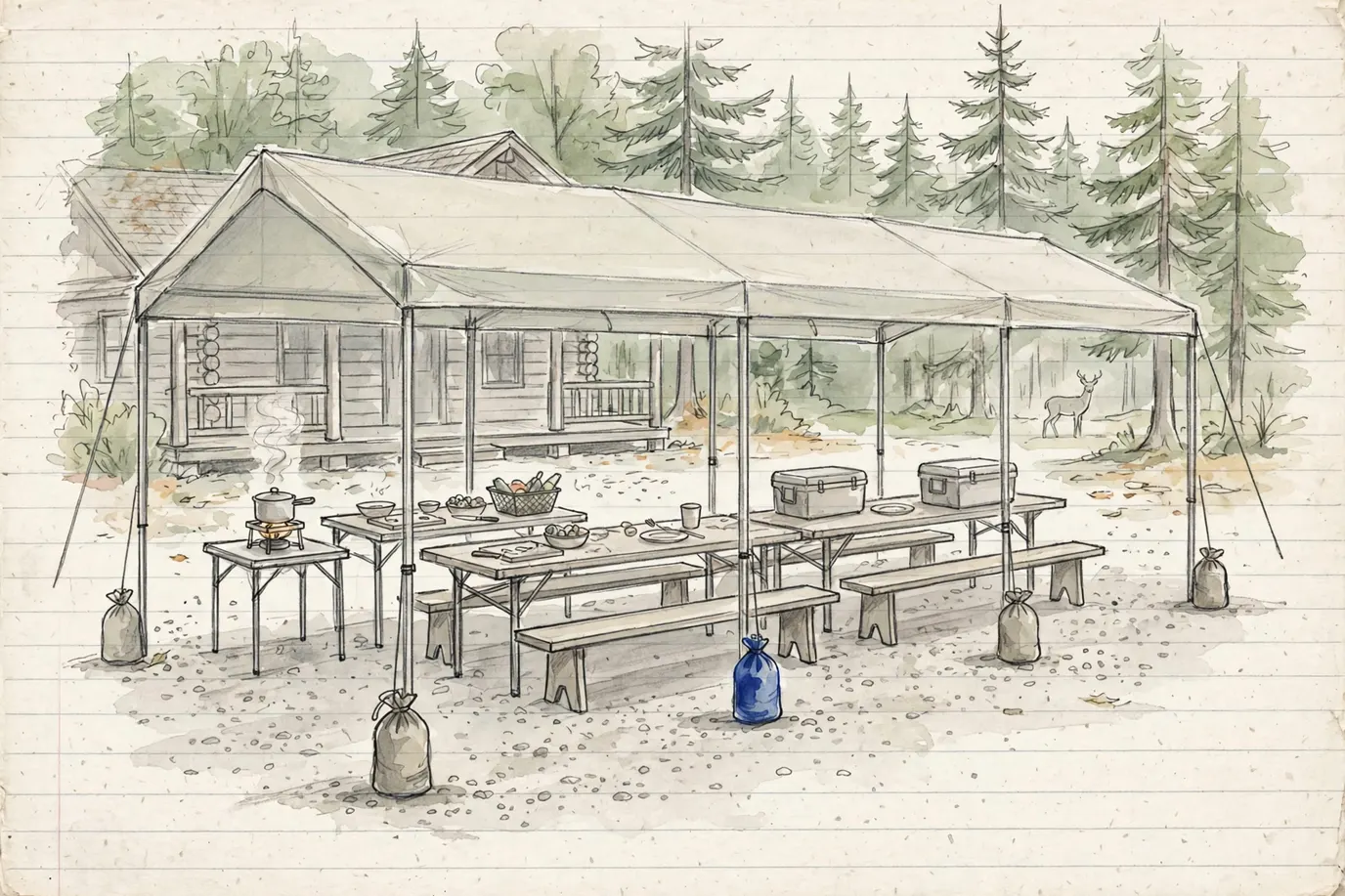
A 10x20 canopy stands on a 10 by 20 foot footprint, 200 square feet, on six legs instead of four. It's the roof for a whole camp kitchen: stove, prep table and the table where everybody eats, in one long run. It's also a two-person job from the bag to the bag, by the maker's own instructions. If you can name your second person, read on. (A 10x20 is a 10x10 that brought its brother-in-law, and the brother-in-law is the middle legs.)
We earn a commission if you buy through our links, at no cost to you. Disclosure
| Model | Frame | Shade area | Peak height | Top fabric | Amazon |
|---|---|---|---|---|---|
Abccanopy Patio Pop Up Canopy with Curtain 10x20Canopy More specs
| — | — | — | — | Check price |
Aoxun Pop Up Canopy 10x20 with 6 SidewallsCanopy More specs
| — | — | — | 210D polyester PUlisting | Check price |
Aoxun Pop Up Canopy 10x20 with Roller BagCanopy More specs
| Steellisting | — | — | 420D Oxfordlisting | Check price |
Aoxun Pop Up Canopy 10x20 with Mesh WindowsCanopy More specs
| — | — | — | 420D Oxfordlisting | Check price |
Cobizi 10x20 Heavy Duty Pop Up Canopy with SidewallsCanopy More specs
| — | — | — | 420D Oxfordlisting | Check price |
Cobizi 10x20 Pop Up Canopy with 6 SidewallsCanopy More specs
| Steellisting | — | — | — | Check price |
Cobizi 10x20 Pop Up Canopy with 6 SidewallsCanopy More specs
| — | — | — | — | Check price |
Cobizi 10x20 Pop Up Canopy with 6 SidewallsCanopy More specs
| — | — | — | 210D Oxfordlisting | Check price |
Cobizi 10x20 Pop Up Canopy with SidewallsCanopy More specs
| Steellisting | — | — | — | Check price |
Eurmax 10x20 Commercial Pop Up CanopyCanopy More specs
| — | — | 132 inlisting | — | Check price |
Eurmax 10x20 Commercial Pop Up CanopyCanopy More specs
| — | — | 132 inlisting | — | Check price |
Hoteel 10x20 Pop-Up Canopy with SidewallsCanopy More specs
| — | — | — | — | Check price |
Hoteel 10x20 Pop-Up Canopy with 6 SidewallsCanopy More specs
| Steellisting | — | — | 420D oxfordlisting | Check price |
Hoteel 10x20 Pop-Up Canopy Hexagonal FrameCanopy More specs
| Steellisting | 200 sq ftlisting | — | 420D Oxfordlisting | Check price |
Impact Steel Frame Pop Up Canopy 10x20Canopy More specs
| Steellisting | — | — | 500D polyesterlisting | Check price |
Impact TL Kit 10x20 Recreation Steel CanopyCanopy More specs
| Steellisting | — | — | — | Check price |
Mastercanopy Pop Up Canopy with Church Windows 10x20Canopy More specs
| — | — | — | — | Check price |
Outsunny 10 x 20 ft Heavy Duty Party Tent with Removable SidewallsCanopy More specs
| Steellisting | — | — | — | Check price |
Outsunny Pop Up Canopy with 4 Sidewalls 10x20Canopy More specs
| — | 186.24 sq ftlisting | — | — | Check price |
Quictent Pop Up Canopy 10x20 Open DesignCanopy More specs
| — | — | — | 420Dlisting | Check price |
Quictent Heavy Duty Pop up Canopy 10x20Canopy More specs
| — | — | — | 500D silver coatedlisting | Check price |
Quictent 10x20ft Party Tent with Removable Mesh SidewallsCanopy More specs
| Steellisting | — | — | — | Check price |
Quictent Pop Up Canopy with Sidewalls 10x20Canopy More specs
| — | — | — | — | Check price |
Quictent Heavy Duty Pop up Canopy 10x20 with 3 SidewallsCanopy More specs
| — | — | — | 600D PU coatedlisting | Check price |
Quictent Pop Up Canopy with 6 Cathedral Sidewalls 10x20Canopy More specs
| — | 200 sq ftlisting | — | 420D Oxford, silver coatedlisting | Check price |
ShelterLogic MaxAP 8-Leg Canopy and Enclosure Kit 10x20Canopy More specs
| Steellisting | — | — | — | Check price |
ShelterLogic MaxAP 8-Leg Canopy 10x20Canopy More specs
| Steellisting | — | — | — | Check price |
Tangkula Pop Up Canopy with Sidewalls 10x20Canopy More specs
| — | — | — | — | Check price |
Tangkula Party Tent with 4 Sidewalls 10x20Canopy More specs
| — | — | — | — | Check price |
Vingli Pop Up Canopy with Nettings 10x20Canopy More specs
| — | — | — | — | Check price |
Vingli Pop Up Canopy Tent 10x20Canopy More specs
| — | — | — | — | Check price |
Vingli Pop Up Canopy with Sidewalls 10x20Canopy More specs
| Steellisting | — | — | — | Check price |


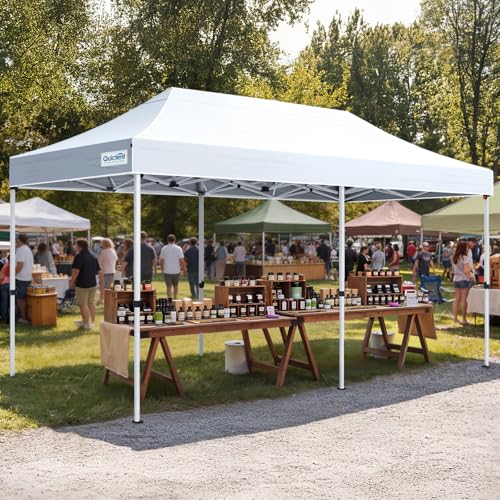


What’s in this listCanopies with a 10 x 20 ft footprint, as stated by the maker or the Amazon listing. “—” means neither the maker nor the Amazon listing states it.
What changes when the canopy is twice as long
A 10x20 is not just a bigger 10x10. It's a longer frame with a different set of rules, and most of them come from the extra pair of legs.
Here's what's different, per one maker's 10x20 instructions:
- Six legs: four corners plus a middle leg on each 20-foot side
- Six top attachment points: one on each 10-foot end, two on each 20-foot side
- A partner at every step: opening, raising legs, folding
- A storage rule: the side with three legs goes on the wheel side of the roller bag
That maker lists 10x20 as one of its common sizes, next to 10x10 and 12x12. It's the long roof you see over a camp kitchen, a church picnic or a vendor booth. How a scissor frame works in general is covered on the main canopy tent page. This one sticks to the long model.
Danny wanted a 10x20 the day he first saw one. His reason was that it's the only canopy that fits both of his coolers and a table under one roof. That's a real reason, which surprised everybody, including Danny.
Only canopies with a 10 by 20 ft footprint stated by the maker or the listing make the table below. Its columns run from shade area and peak height through top fabric, UPF, the sidewall count, vent and fire rating to the frame, each as the maker states it or, where the maker is silent, the Amazon listing does (marked as listing values). UPF and fire rating appear only when the maker states them. A dash means nobody states it.
Who a 10x20 canopy tent is for at deer camp
A 10x20 earns its weight when a camp works under it all day. Here's where that happens:
- A full camp kitchen: stove table, prep table and eating table in one line, out of the rain
- A processing station: Penn State Extension says to keep a deer carcass out of direct sunlight, chill it to 35 to 40°F, and clean knives and boards often; a long roof gives you shade and room for a clean table, but it isn't a cooler
- Opening weekend crowds: when the cabin fills up and supper moves outside
- Off-season jobs: graduation parties, the family reunion, the youth hunt sign-in table
If your camp is two people and a dog, it's more roof than you need. More on that at the bottom.
What to look at in a canopy tent 10 x 20
The size is fixed by the table's rule. These are the things that still change from one 10x20 to the next.
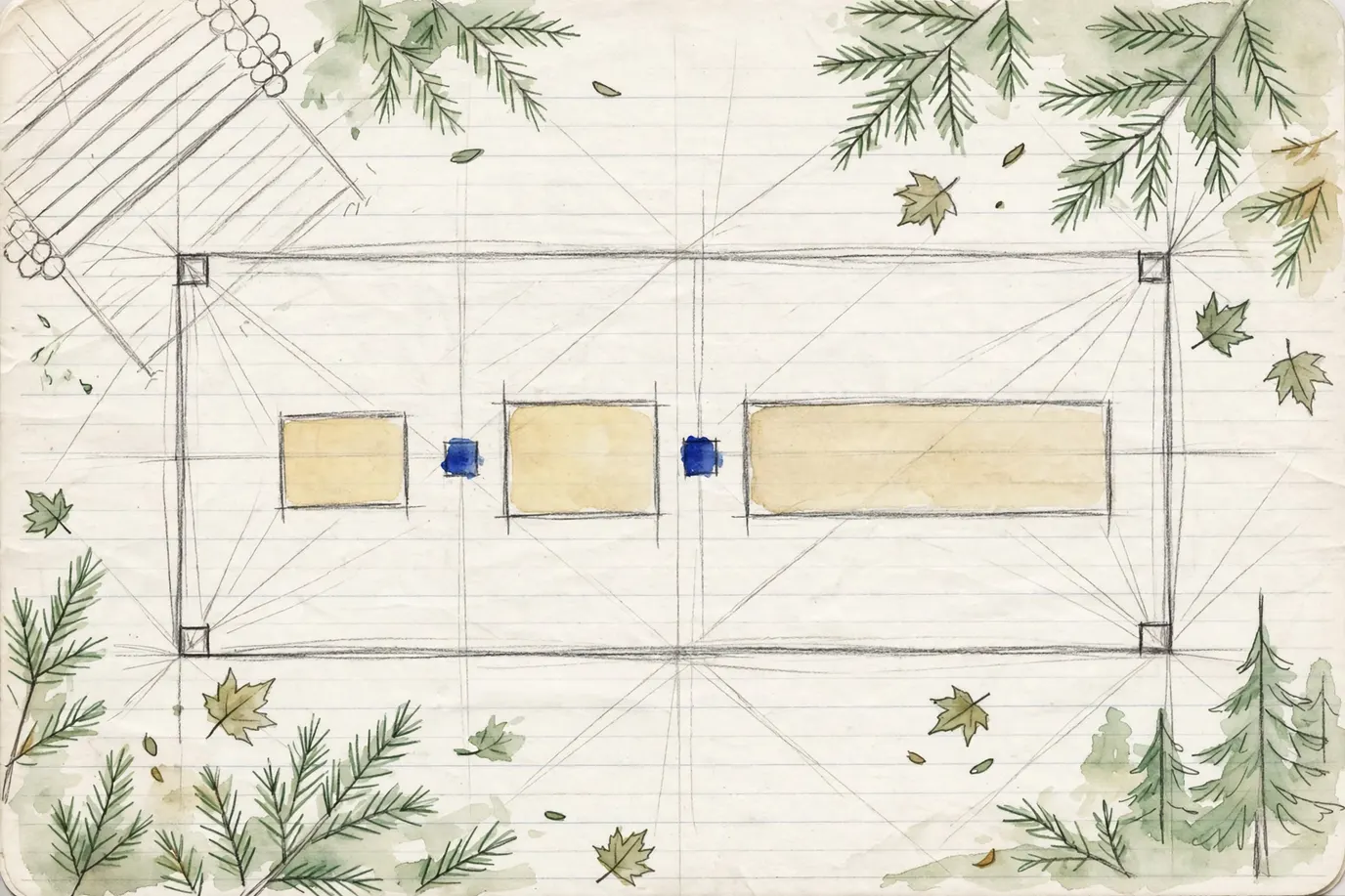
Plan the layout around the middle legs
The middle legs stand halfway down each long side. That splits the 20-foot length into two 10-foot bays. A table up to about 10 feet long fits between a corner and a middle leg; anything longer has to run down the center, clear of both.
Draw it on paper first. A 10x20 has room for three tables, but only if they're where the legs aren't. The middle leg is also the one you'll walk into at 5 a.m. on the way to the coffee. I taught high-school shop for a long time. I know what happens to a man who doesn't respect a post.
Shade area on a long roof
On a straight-leg 10x20, the roof matches the footprint and shades 200 square feet. A slant-leg frame of the same footprint has a smaller roof, because the legs angle out. The table sorts by stated shade area, so you can see the difference without doing the math.
For a camp kitchen, the edges matter. The stove usually ends up near an end of the canopy, and an end is exactly where a smaller roof loses its shade first.
Frame, weight and how it travels
The table lists frame material, and weight only where the maker states it. A 10x20 frame is long when folded and heavy enough that most come in a wheeled roller bag. One maker's 10x20 ships with a roller bag and a six-piece stake kit, one stake per leg.
Think about the trip from the truck. UC Irvine's safety office suggests carts or wheeled platforms for moving canopy weights, and breaking weights into 10 or 20 lb pieces so they're easier to lift. Six legs means six of everything you carry.
Top fabric over a 20-foot span
Tops are listed by denier and coating. One canopy maker's fabric guide ties higher denier to tear and abrasion resistance, and says to look for double-layer or reinforced stitching at corners and stress points. A long top has more of both.
On one maker's 10x20, the top bolts to the frame at its six attachment points with a nut and grommet. Its instructions say to tighten each nut until snug, with the top still able to rotate, and not to over-tighten. That's a shop rule I'd underline: snug is a measurement, not a feeling.
Vents, sidewalls and a lot of wall
The table marks a vented top and counts sidewalls included. On a 10x20, a full set of walls means 60 feet of fabric around the edge: two 20-foot sides and two 10-foot ends.
That's a lot of sail. Walls trap wind instead of letting it through, which one canopy maker's wind guide counts as extra pressure on the whole frame. Its advice for windy days: walls open, or walls off. On a long canopy, I'd hang walls only on the side the weather comes from, and only on a calm day.
Fire rating if it goes to an event
Any fire rating the maker publishes shows up in the table. If your 10x20 does double duty at a school event or a fundraiser, the organizer may ask about it. UC Irvine's safety office reviews canopy setups once their area adds up to 200 square feet, which is exactly what one 10x20 covers. Other campuses, towns and event sites set their own rules, so ask before you show up.
A 10x20 or two 10x10s
My one opinion on this page: if you can't name your second person, buy two 10x10s instead of one 10x20. Look at the maker's own instructions and you'll see why. Opening, raising legs and folding a 10x20 are each written for two people working opposite sides. A 10x10 is far more forgiving of a short-handed morning.
Here's the trade, both ways:
- One 10x20: one continuous roof with no gap, six legs instead of eight, one bag, one setup
- Two 10x10 canopies: two lighter bags, can stand apart or together, and if one is damaged you still have shade
If you go with two, buy straight legs. A canopy maker's leg comparison says straight legs are the design that lets you set canopies right next to each other.
How to set up a 10x20 canopy
This follows one maker's 10x20 instructions. Yours may differ, so keep the sheet in the bag.
- Stand the folded frame where the middle of the roof should be. Each person takes one 10-foot end.
- Grab the outer trusses where the maker marks them, lift slightly, and step backward until the frame is almost fully open. Shake it gently as it opens.
- At each corner, fold the top back and lock the slider pin by pushing up on the side trusses while holding the leg down.
- With your partner, lift two neighboring corner legs to about waist height and slide the inner legs out until the buttons lock. That frame has five height settings.
- Lower the middle leg on that side until its button locks. Repeat on the other side.
- Weight or stake all six feet, then carry in the tables.
Watch your fingers as the trusses close and open. The instructions say so twice, and they're right twice.
How to anchor six legs in wind
A long roof has a long side, and wind finds it. Every leg gets an anchor, middle legs included.
One canopy maker's wind guide gives the ranges. Around 24 lb per leg works in light wind; 40 to 50 lb per leg is safer in moderate wind. Quick math for a 10x20: six legs at 40 lb is 240 lb, and at 50 lb it's 300. That same guide says to push stakes in deep and angle them away from the canopy, use spiral stakes in sand, and run guy lines outward from the top corners. On concrete or asphalt, weights do the whole job.
UC Irvine's safety office lists tables, coolers and vehicles as anchors to avoid. They trip people and usually don't hold enough. Same guide, last word: if the wind keeps climbing, fold early. By 35 to 40 mph, it says, the canopy should come down.
Taking down and storing a 10x20
Takedown has an order on a six-leg frame. One maker's sheet goes like this:
- Press the button on one middle leg and slide it in, then do the other.
- With your partner, lift two corner legs on the same side and collapse them together; repeat on the other side.
- Release each corner slider pin, pushing up on the truss to take the pressure off first.
- Each person grabs the center trusses on a long side, lifts slightly and steps toward the other while shaking the frame, until it's about three-quarters closed.
- Push the outer legs together to finish, then bag it with the three-leg side toward the wheels.
The same instructions ask you to dry the top and frame completely before storage to avoid mildew, clean the top with mild soap and plenty of water, and use silicone spray on the frame in damp weather. If the frame gets loose, slightly tighten the bolts. A 10x20 has a lot of bolts. Bring the wrench.
Safety under a long canopy
That maker's instructions say not to use its shelter in a lightning storm, and the National Weather Service says tents and open shelters offer no protection. Get in a vehicle or building and wait 30 minutes after the last thunder.
Don't build fires inside the shelter enclosure. If you hang walls and bring a heater or a stove under the roof, the CPSC warns that carbon monoxide from camp heaters, stoves and lanterns kills people inside tents, campers and vehicles every year. Cook at the open end, with the walls off.
Who should skip a 10x20 canopy
- Solo campers: by the instructions, this is a two-person frame from start to finish
- Small or wooded sites: you need a flat, open 10 by 20 patch plus room to walk around it and run guy lines
- Windy, exposed camps: one maker says not to use its shelters in potentially windy or rainy weather, and a long roof feels wind first
- Camps of two or three: a 10x10 canopy covers one table, which may be all you need
For everybody else, it's the best seat in camp for supper. Just say hello to the middle leg on your way past.
Brands in this list
Related
Questions people ask
How big is a 10x20 canopy?
The 10 by 20 feet is the footprint at the legs, so it stands on 200 square feet of ground. On straight legs the roof matches the footprint and shades all 200. Slant-leg frames splay their legs outward, so the roof is smaller than the base. Check the shade area the maker lists, not just the size.
How many legs does a 10x20 canopy have?
Six on a typical pop-up frame: one at each corner and one in the middle of each 20-foot side. One maker's 10x20 instructions call those the middle legs and have you set them after the corners. The middle legs are the reason a long roof stays flat, and the reason you'll plan your table layout around them.
Can one person set up a 10x20 canopy tent?
Not by the instructions I've read. One maker's 10x20 setup has a partner on the opposite 10-foot side to open the frame, and two people lift adjacent legs together to raise them. Takedown is written for two people as well. If you usually camp alone, two 10x10s are easier to handle.
How much weight does a 10x20 canopy need?
Use the maker's guidance first, and anchor all six legs. One canopy maker's wind guide says around 24 lb per leg works in light wind and 40 to 50 lb per leg is safer in moderate wind. Six legs at 40 lb is 240 lb. Add guy lines from the top corners when the wind picks up, and take the canopy down if it keeps building.
Sources
- E-Z UP: Vantage 10' x 20' instructions (setup, takedown, storage, care, important information) — accessed 2026-10-22
- E-Z UP: Frequently asked questions — accessed 2026-10-22
- E-Z UP: How to secure a canopy tent in high winds — accessed 2026-10-22
- E-Z UP: Which is better, straight leg or slant leg pop-up tent? — accessed 2026-10-22
- E-Z UP: What does 500D mean in canopy tent fabric? — accessed 2026-10-22
- UC Irvine Environmental Health & Safety: Canopy safety reference guide — accessed 2026-10-22
- Penn State Extension: Proper care and handling of venison from field to table — accessed 2026-10-22
- National Weather Service: Lightning safety outdoors — accessed 2026-10-22
- CPSC: Portable heaters and camping equipment (carbon monoxide) — accessed 2026-10-22