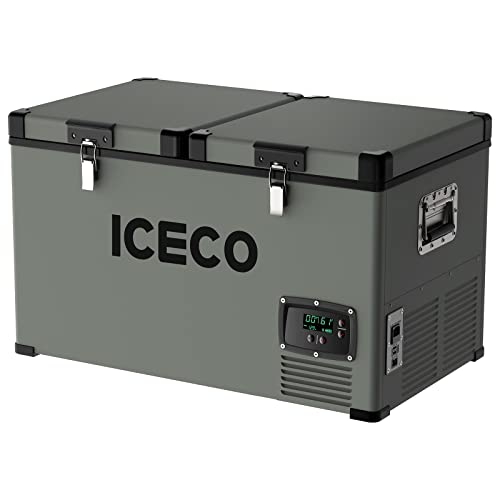
What Iceco makes for hunters and campers
On this site, Iceco covers one product type: powered coolers. Every Iceco in the grid above is a compressor fridge, which works like the fridge in your kitchen, only it runs on your vehicle's 12V outlet. No ice, no meltwater, no Saturday-morning drain plug.
The grid splits into six series:
- VL: the biggest group, single and dual zone, from mid-size to large
- JP Pro: wheeled fridges with a cover, single and dual zone
- APL: aluminum-bodied fridges, from small to large
- GO: the GO20, a small dual-zone fridge
- GOPACK: the smallest, a 13-quart pack, one version with a built-in battery
- BF: the BF65, a dual-zone fridge in the mid-60-quart range
Iceco's own site also sells batteries, solar panels, covers and slide mounts. This site doesn't list those, so look on the maker's site for them.
The grid changes as listings come and go, so I'll write about the series and what separates them, not about how many are listed this week. All the Iceco specs here come from Amazon listings, and the grid marks those values. The maker's pages confirm the series names, sizes and zone layouts.
How to read an Iceco model name
Real talk: the model names do half the work for you once you know the code.
- The letters are the series: VL, JP, APL, GO, BF
- The number matches the size in liters on the listings that name one, like the APL55 55 Liter and the VL35 ProS 35 Liters
- ProS and ProD: the maker's VL page lists the ProS models as single zone and the ProD as dual zone
So a VL45 is about 45 liters, which the listing gives as about 47 quarts. An APL55 is 55 liters, listed at 58 quarts. A quart is a quarter gallon, and a liter is a bit more than a quart, which is why the quart number always comes out a little higher. I've watched Walt read "45" on a lid and pack it like 45 quarts. It held. It just held more than he thought.
Iceco fridge lineup notes by series
VL series: the Iceco VL45 and its siblings
The VL series is where most of the Iceco grid lives. The listings run from the VL35 ProS at about 37 quarts up to the VL75 ProD at about 79 quarts. In between sit the VL45, VL45 ProS, VL45 PLUS and several VL60 versions.
What separates them, per the listings and the maker's VL page:
- Single zone: the VL35 ProS, VL45, VL45 ProS and VL60 ProS
- Dual zone: the VL60 Dual Zone and the VL75 ProD
- Low setting: 0°F on the VL listings that give one
- Power: 12/24V DC plus an AC adapter on most
- Battery versions: a VL60 Dual Zone and a VL75 ProD sold with a battery
The maker's VL collection page describes the VL45 and VL60 as metal. The VL45 PLUS is listed separately at about 44 quarts, and the maker markets it with what it calls three-way access. The page doesn't explain that, so I won't guess.
A couple of VL listings name battery protection. That's the setting that shuts the fridge off before it drains your vehicle battery. More on that below.
JP Pro series: the Iceco JP50 and JP40
The maker describes the JP Pro series as wheeled fridges sold with a cover. In the grid, the JP40 Pro and JP50 Pro are single zone, and the JP40 ProD and JP50 ProD are the dual-zone versions. The JP50 listings give about 51 to 52 quarts. Every JP listing that gives a low setting says -4°F, a little colder than the VL series.
Wheels matter more than people think. A loaded fridge in the 50-quart range is not a one-hand carry, and unlike an ice cooler it doesn't get lighter as the weekend goes on. The cover helps too: it's one more layer between the box and a sunny truck bed.
APL series: the Iceco APL55, APL35 and APL20
The maker calls the APL fridges aluminum. Its APL page lists the APL20 as a 21-quart single zone, the APL35 as a 37-quart dual zone it calls ultralight, and the APL55 as a 58-quart dual-zone fridge it lists as app controlled.
In the grid:
- APL20: about 21 quarts, -4°F low, and its listing names solar input
- APL35: about 37 quarts, -4°F low
- APL55: about 58 quarts, dual zone, -4°F on the Bluetooth listings and 0°F on the other
"Ultralight" is the maker's word, and the maker doesn't give a weight on the collection page. So I'm not giving one either. If weight is the deciding spec for you, find it on the maker's product page for that exact model.
GO20 and the GOPACK12
The GO20 is the small dual-zone one: about 21 quarts, 0°F low, 12/24V DC plus AC. The maker's GO page describes it as working as a freezer or a fridge.
The GOPACK12 is the smallest Iceco in the grid at 13 quarts. Its listing gives a 21°F low, which is fridge territory, not deep-freeze territory. One version runs off your 12V outlet. The other lists a built-in 250Wh battery, so it can run away from the truck for a while. Think lunch for two, not a weekend of venison.
BF65
The BF65 is listed at about 66 quarts with dual zones and 12/24V DC. Its listing gives fewer specs than the others, so the grid shows some dashes. Read the listing for the low setting before you plan on freezing anything in it.
How to choose within the Iceco lineup
Pick the size by what goes in, not the number on the lid
My one opinion on this page: buy for the longest trip you take, not the average one. The reason is that a compressor fridge doesn't shrink as the ice melts, because there's no ice. You get the whole box every day, so a slightly smaller fridge often holds what a bigger ice cooler did. But you can't add a second fridge halfway through deer week the way you can add a bag of ice.
Rough guide from the grid:
- 13 to 21 quarts: GOPACK12, GO20, APL20, for lunches, drinks and a day trip
- 37 to 52 quarts: VL35, VL45, APL35, JP40, JP50, for a weekend for two or three
- 58 to 79 quarts: APL55, VL60, BF65, VL75, for a full camp
Sizes across brands are on the car fridge page and the portable fridge page.
Then one zone or two
A dual-zone fridge splits the box so one side can freeze while the other side stays cold. That's useful if you bring frozen meals and fresh food, or if you want a freezer side for meat. A single zone is simpler and gives one big space. The JP, VL and APL series all come both ways in the grid. The portable freezer page covers freezer use across brands.
Then the low setting you need
CDC's food safety guidance is to keep a refrigerator at 40°F or below and a freezer at 0°F or below. Every Iceco in the grid except the GOPACK lists a low setting of 0°F or -4°F, so they can all reach freezer temperature on paper. The GOPACK's 21°F low is a fridge, plain and simple.
Then the power plan
Most Iceco listings name 12/24V DC plus an AC adapter: truck outlet on the road, wall outlet at the cabin. Iceco's FAQ adds three things:
- Battery protection: three levels, low, medium and high, that shut the fridge off when voltage drops below a set point
- External power banks: the FAQ says to set protection to low
- AC and DC together: don't connect both at once, or you may burn out a module
Some listings add a built-in battery, a magnetic battery or solar input. The FAQ says solar panels must charge a battery and can't run the fridge directly. Electrician's note: that's how every solar setup works. The panel feeds the battery, the battery feeds the load. More on that is on the solar cooler page and the battery powered cooler page.
If you're comparing a compressor fridge to the cheaper plug-in kind, the thermoelectric cooler page explains the difference.
Setup and use notes that apply to the whole lineup
Iceco's FAQ has a few rules worth following on every model:
- Shipped upside down? Set it upright and wait at least 12 hours before plugging it in.
- Cold weather: turn on the low-temperature compensation switch so the compressor runs enough to keep the freezer side cold.
- One zone not showing on a dual-zone model: the FAQ says to long-press the down arrow to restart the right zone.
Dometic's portable fridge article has general advice that applies to any compressor fridge. Run it for a few hours before you load food, fill empty space so there's less air to cool, pack the last day's food on the bottom, and keep it out of direct sun or under a cover. Every lid opening lets the cold out. Decide what you want before you open it. (Walt opens a fridge the way he opens a tackle box: slowly, and then he stares.)
Perishable food shouldn't sit out of the fridge for more than 2 hours, or 1 hour above 90°F, per CDC. That's true at a tailgate in October too.
Iceco vs Dometic
Both make 12V compressor fridges in single- and dual-zone sizes, and both show up in the same searches. On this site, the difference is in the mix:
- Iceco's grid: all powered fridges, low settings of 0°F on most VL listings and -4°F on the JP and APL series
- Dometic's grid: CFX2 and CFX5 fridges listing -7°F, plus ice chests, soft coolers and backpack coolers
Iceco's FAQ names Secop compressors, with a 5-year compressor warranty and 1 year on other parts. If you want a fridge and a hard cooler from the same brand, that's Dometic's side of the grid. Compare capacity, zones and power options model by model. The Dometic brand page has its lineup.
Iceco vs Bodega
Both sell 12V compressor fridges from small to large, and many on both sides list dual zones, 12/24V DC and an AC adapter. Most Bodega listings on this site give -4°F as the low setting. Iceco's run from -4°F on the JP and APL series to 0°F on the VL series. Iceco's grid also includes the small GOPACK models, one with a built-in battery. Compare the exact listings for capacity, zones and battery protection. The Bodega brand page has its lineup.
Iceco facts
Here's what I could verify from the maker's own site:
- North America: Iceco says it entered North America in 2019
- Background: the maker says there's more than two decades of refrigeration know-how behind the brand
- Compressor and warranty: Secop compressors, 5 years on the compressor and 1 year on other parts, per Iceco's FAQ
- Contact: a US phone line with Pacific-time hours, listed on its site
I couldn't verify a founding year, a parent company or where the fridges are made, so those are left out.
Size by the longest trip, zones by what you freeze, power by where you park. Then plug it in the night before, so the drinks are cold before you are.