Camp Gear · Gear type
Solar Cooler
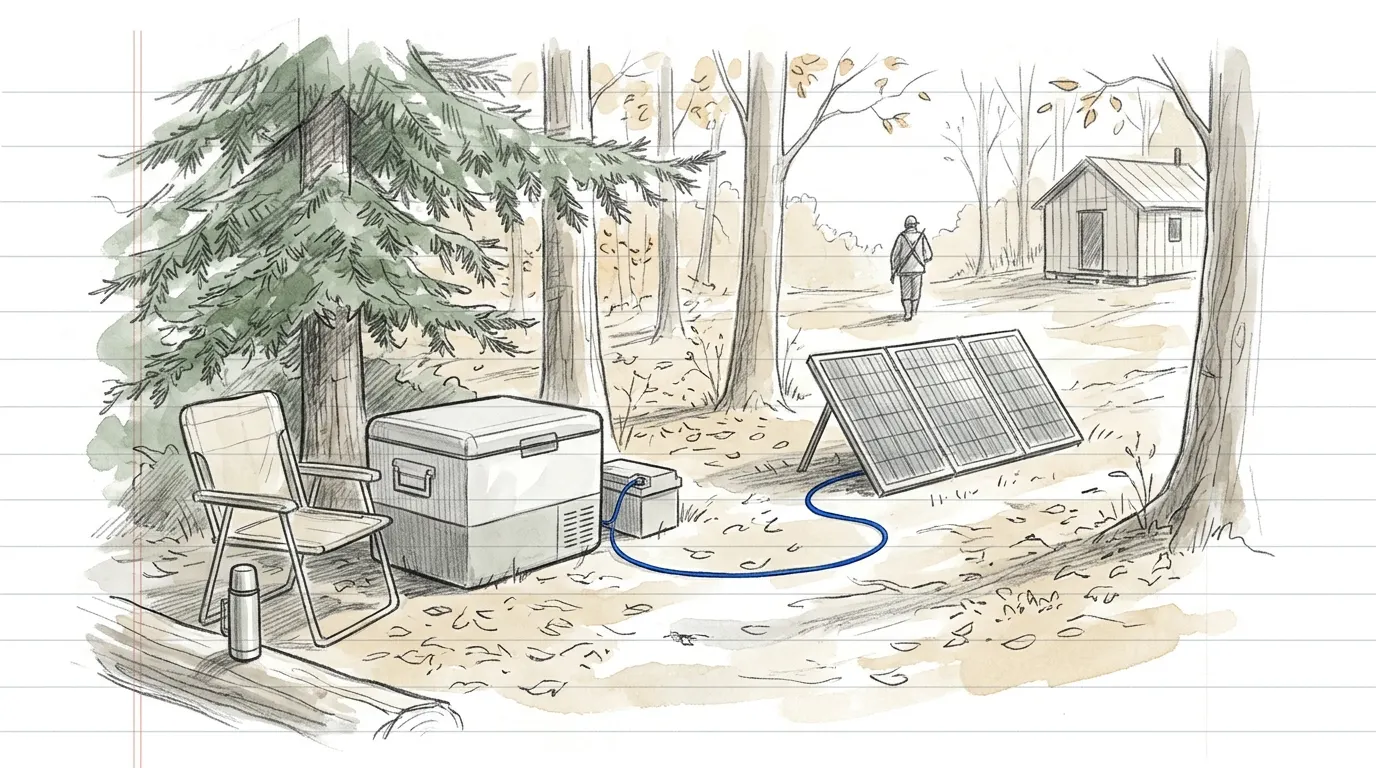
A solar cooler is an electric cooler or 12V fridge that its maker says can charge or run from a solar panel. In practice it's three parts working together: an efficient fridge, a panel and, nearly always, a battery that carries the cold through the night. Get the fridge's daily power use and the panel's real output to line up and you can keep food cold for days with no outlet. Walt asked if it works at night. Short answer: that's what the battery is for.
We earn a commission if you buy through our links, at no cost to you. Disclosure
| Model | Capacity | Exterior (L x W x H) | Cooling | Lowest temp | Zones | Amazon |
|---|---|---|---|---|---|---|
Alpicool C15Electric cooler More specs
| 16 qtlisting | 22.4 x 12.6 x 10.2listing | — | -4 Flisting | — | Check price |
Alpicool CF55Electric cooler More specs
| 52 qtlisting | 27.2 x 13.6 x 20.6listing | — | -4 Flisting | — | Check price |
Alpicool CF45Electric cooler More specs
| 42 qtlisting | 27.2 x 13.6 x 18.2listing | — | -4 Flisting | — | Check price |
Alpicool C12Electric cooler More specs
| 13 qtlisting | — | — | -4 Flisting | — | Check price |
Anker SOLIX EverFrost 2 40 LElectric cooler More specs
| 42 qtlisting | — | — | -4 Flisting | — | Check price |
Dometic CFX5 55L with Ice MakerElectric cooler More specs
| 58.1 qtlisting | — | — | -7 Flisting | — | Check price |
Dometic CFX5 95L Dual ZoneElectric cooler More specs
| 100.4 qtlisting | — | — | -7 Flisting | Duallisting | Check price |
Dometic CFX5 25LElectric cooler More specs
| 26.4 qtlisting | — | — | -7 Flisting | — | Check price |
Dometic CFX5 35LElectric cooler More specs
| 37 qtlisting | — | — | -7 Flisting | — | Check price |
Dometic CFX5 75L Dual ZoneElectric cooler More specs
| 79.3 qtlisting | — | — | -7 Flisting | Duallisting | Check price |
Iceco APL20Electric cooler More specs
| 21 qtlisting | — | Compressorlisting | -4 Flisting | — | Check price |


What’s in this listPowered coolers whose maker or listing states they can charge or run from a solar panel. “—” means neither the maker nor the Amazon listing states it.
Why a solar cooler is really a power plan
A solar cooler isn't a special kind of cold. It's an electric cooler that a maker states can be charged or run from a solar panel. What sets it apart from the rest of the group is the power plan: no outlet, no running truck, just a panel in the sun and a fridge efficient enough to live on what the panel makes.
For the shared basics of plug-in coolers (the three cooling types, wall and car power, sizing the box), see the electric cooler page. This page is about making the sun do the work.
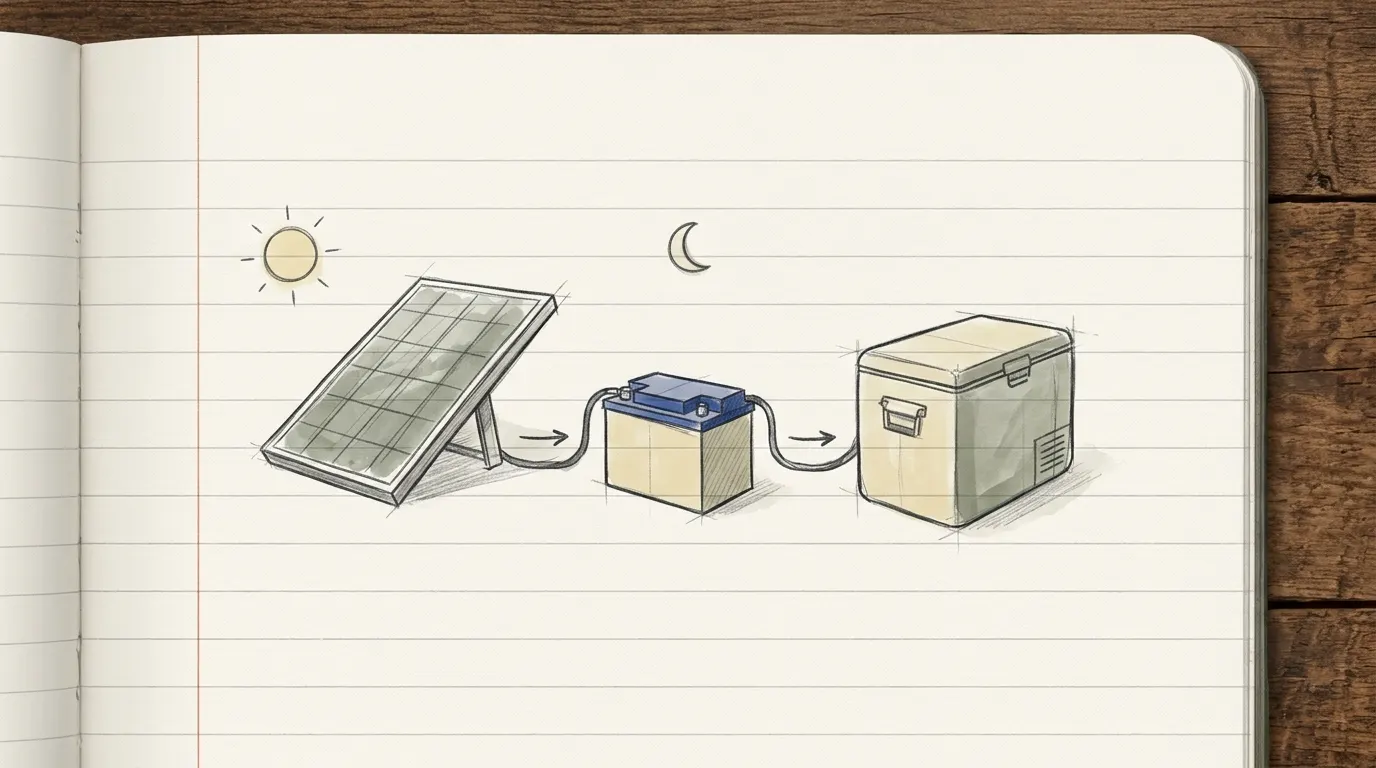
Here's the part the photos skip. The sun shows up for part of the day. The fridge needs power all day and all night. So nearly every working solar cooler setup has a battery in the middle, either built into the cooler or sitting next to it. The panel fills the battery; the battery runs the fridge.
The table on this page lists powered coolers whose maker or listing states they can charge or run from a solar panel. It shows the solar input and built-in battery columns alongside cooling type, lowest temperature, capacity and DC input. Panels themselves aren't in the table; this is a fridge page, not a power-system page.
Choosing a solar cooler: the numbers that matter
Real talk: you're matching two numbers, what the fridge uses in a day and what the panel makes in a day. Everything else follows from that.
Start with the fridge's daily draw, not the panel
Solar works only with an efficient fridge, and that means a compressor. A cooler maker that sells both kinds compared them on 12V. By that page's math, the module that never rests burns through about 94 amp-hours in a day, while the compressor that cycles stays under 24. A small panel can keep up with the second one. It can't come close to the first.
The maker's US FAQ for its smallest compressor model gives a measured average: 0.92 amp-hours per hour at 12V, in 90°F air with the inside at 39°F. Multiply by 24 and that's about 22 amp-hours a day on a hot day.
Solar input: yes or no, and at what voltage
The solar input column reads yes only where the maker puts it in writing. That matters, because "solar compatible" on a box can mean several things.
On a cooler with a built-in battery, the solar input is a port on the cooler, and that port has a window. One maker lists 100W of input on its battery coolers; its newer line takes 12 to 30V from a panel and refuses a solar charge without a battery in place. Outside the stated range, a panel is just a very flat paperweight.
On a fridge without its own battery, the panel goes to a battery first. One maker's guidance is a 100W or larger panel and at least a 40 amp-hour battery. The battery stores the panel's energy and regulates the voltage the fridge sees.
Panel watts are a lab number, so plan below it
A panel's watt rating comes from standard test conditions. The U.S. Department of Energy spells them out: 1,000 watts of sunlight per square meter and a 25°C (77°F) cell temperature. In practice, it says, sunlight is usually weaker than that and the cells run hotter, and both cut the output.
So a 100W panel is a 100W panel the way a 6-person tent sleeps six. (Ask Walt about the 6-person tent. Actually, don't.) One maker puts a typical panel's output at 4 to 8 amps at most, depending on the panel, and says to plan on roughly 6 hours of sun a day.
Do the sun math before you buy
Quick math with those numbers. At the low end, 4 amps for 6 hours is 24 amp-hours a day. The small compressor fridge above uses about 22 on a hot day. That's a match, barely, on a clear day. At 8 amps it's 48 amp-hours, comfortable room.
Now the honest part. The DOE report says the sun's output follows time of day, time of year and the angle the light hits the panel, with clouds as the wild card. It also lists shading, snow cover and soiling, which is dirt on the panel, as losses that show up in the real world. A short gray November day at deer camp is a low-end day. That's why the battery size matters more than the brochure suggests.
Battery size carries the night and the cloudy day
The built-in battery column tells you whether the cooler has its own. If it does, check the maker's capacity and runtime. One maker's smallest battery cooler is rated at 42 hours at 39°F inside, tested at 77°F outside. That's close to two days of fridge on one full battery, before the sun adds anything back.
If it doesn't, you're picking the battery. The same FAQ that gave the draw also says how much of a battery you can use: about 50% for lead-acid, about 80% for lithium NMC and nearly 100% for lithium iron phosphate. Two cloudy days in a row are a battery problem, not a panel problem. More on cordless coolers is on the battery-powered cooler page.
Charge time from the sun, compared with the wall
One maker publishes refill times for its battery coolers by input, and they're worth a look. Its numbers put a 100W panel, at 3.6 hours to full, a little ahead of the wall outlet and the car socket at 4 hours each, with 60W USB-C last at 5.8. To 80%, the panel needs about 2.3 hours.
Read that as a best case. The panel time assumes the panel is actually delivering its rated input, which the DOE numbers above say is the exception. Still, it tells you something useful. On a good day, one 100W panel can refill a battery cooler about as fast as a wall outlet. The last 20% is the slow part with every input, so a battery that's topped up to 80% by early afternoon is a win, not a failure.
Cooling range and zones work like any compressor fridge
The lowest temperature and zones columns read the same as on any compressor model. A colder set point and a freezer zone cost more power every hour. On solar, that's the dial you can actually turn. Food-safety targets from the FDA are 40°F or below in the fridge and 0°F in the freezer. Set it where the food needs it and no colder; the extra degrees come out of tomorrow's sun.
DC input is your backup plan
The DC input column still matters on a solar setup. When the sky stays gray, the 12V socket in the truck is the backup charger. Pick a fridge or battery that takes car power as well as solar, so a cloudy weekend means a drive, not a spoiled cooler.
Which kind of solar cooler fits which camp
Battery cooler plus a folding panel
A cooler with a built-in battery and a stated solar input is the simplest kit: one panel, one cable, one box. Good for weekend camps, the beach and a truck that won't run all day.
12V compressor fridge, battery and panel
A regular compressor fridge wired to a separate battery, with a panel feeding the battery, is the flexible setup. The battery can also run lights and charge phones, and you can grow the panel or the battery later.
Solar powered fridge with no battery
There's a third design, mostly for fixed cabins. NASA's spinoff report describes a refrigerator that connects the panel straight to a variable-speed compressor, with no battery. It stores cold in a phase-change material, a water-based solution the report credits with "exceptional freezing properties," built into a well-insulated cabinet. The compressor runs longer while the sun is up, and the report says it was designed for places with at least 5 sun-hours a day. Clever, and heavy. Not something you carry to a blind.
Thermoelectric with a panel
Possible on paper. With the steady draw on a thermoelectric module, a single small panel won't keep up, so expect it to work as a daytime-only cooler. If solar is the plan, the thermoelectric cooler page is mostly a list of reasons to pick a compressor instead.
Setting up a solar cooler at camp
- Cooler in the shade, panel in the sun. They want opposite things.
- Face the panel toward the sun and move it as the sun moves, if you're around.
- Keep the panel clear of leaves, snow and that one hemlock branch.
- Use the shortest cable that reaches; don't add splitters.
- Start the trip with the battery full and the fridge already cold.
- Check the battery level at sundown, not at breakfast.
Battery safety stays plain. Lithium batteries should be charged inside the temperature limits in the maker's manual; the NFPA's general advice is not to charge below 32°F or above 105°F. Use the maker's charge cable and stop using any battery that swells, smells or gets very hot.
Who doesn't need a solar cooler
If you camp where you can plug in, skip the panel; it's a lot of gear to replace an outlet. If your trips are one day long, any electric cooler on the car socket does it. If your camp sits under heavy tree cover, like ours, the panel spends the day in the shade and you'll be charging from the truck anyway.
My one opinion on this page: for a solar cooler, buy the battery before you upgrade the panel. The maker guidance above explains it. The battery is what stores the panel's energy and runs the fridge at night, the panel makes nothing after dark, and one maker's cooler won't even take a solar charge without a battery installed. A bigger panel fills a battery faster. It can't fill one that isn't big enough.
Walt still asks if it works at night. I tell him the sun does the day shift and the battery does the night shift. He says that sounds like a union job. It is.
Brands in this list
Related
Questions people ask
Can a solar fridge run without a battery?
A few can. NASA's spinoff report describes a battery-free design that connects the solar panel straight to a variable-speed compressor and stores cold in a phase-change material inside the cabinet. It was built for places with at least 5 sun-hours a day. Most portable solar coolers still use a battery to carry the night and cloudy hours.
What size solar panel do I need for a solar powered fridge?
Start from the fridge's daily draw. One maker recommends a 100W or larger panel with at least a 40 amp-hour battery for its compressor fridges, and to plan on about 6 hours of sun. Its smallest model averages 0.92 amp-hours per hour in 90°F heat, about 22 a day. A 100W panel at 4 amps for 6 hours makes 24.
Can I plug a solar panel straight into a 12V fridge?
Not unless the maker says so. One maker's guidance runs the panel into a battery, which stores the energy and regulates the voltage the fridge sees. Coolers with a built-in battery and a stated solar input take the panel directly, but only inside their listed voltage range, such as 12 to 30V on one model.
Does a solar cooler work at a late-fall deer camp?
It can, with a bigger battery and lower expectations of the panel. The DOE notes that the sun's output follows the time of year and the angle of the light, and clouds add the rest. Short, gray days fill a battery slowly. Keep the truck's 12V socket as the backup charger and follow the battery maker's charging temperature limits in the cold.
Is a solar cooler the same as a cooler with a solar panel on the lid?
Not on this page. Here a solar cooler means a powered cooler whose maker states it can charge or run from a solar panel. Some passive ice chests and novelty coolers carry a small panel for a radio, a light or a phone charger; that panel doesn't cool anything. Read what the solar input actually feeds.
Sources
- Dometic: CFX3 25 product page and FAQ (solar setup and run time) — accessed 2026-10-22
- Dometic: What is the most energy efficient cooler? — accessed 2026-10-22
- Anker SOLIX: EverFrost powered cooler (battery life and recharge tables) — accessed 2026-10-22
- Anker SOLIX: EverFrost 2 40L electric cooler (product page and FAQ) — accessed 2026-10-22
- NASA Spinoff: Keeping cool with solar-powered refrigeration — accessed 2026-10-22
- U.S. Department of Energy: Understanding solar photovoltaic system performance — accessed 2026-10-22
- NFPA: Lithium-ion battery safety tip sheet — accessed 2026-10-22
- FDA: Are you storing food safely? — accessed 2026-10-22