Brand · Trail Cameras & Optics
Maven Binoculars and Rangefinders
Maven binoculars come in two series: the B Series, which the maker calls its premium glass, and the C Series, its mid-range line. Both run from pocket compacts to big 56mm tripod binoculars. Maven also makes three hunting rangefinders: the RF.1, the zoom RFZ.1 and the compact CRF.1. The short version: pick the size you'll carry, then the magnification, then the series. (Uncle Walt's binoculars live in the truck's door pocket. He calls that "carried.")
We earn a commission if you buy through our links, at no cost to you. Disclosure
Maven on Amazon US
15 models- Binoculars
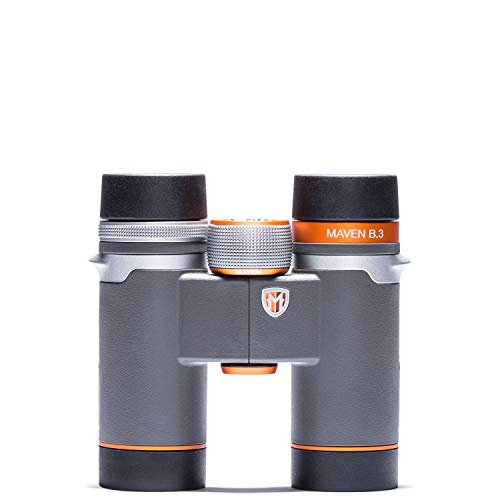
Maven B.3 6x30
- Objective
- 30 mm
- Magnification
- 6 x
- Binoculars
Maven B2 11x45 ED
- Objective
- 45 mm
- Magnification
- 11 x
- Binoculars
Maven C1 8x42 ED
- Objective
- 42 mm
- Magnification
- 8 x
- Binoculars
Maven C1 10x42 ED
- Objective
- 42 mm
- Magnification
- 10 x
- Binoculars
Maven C.2 Compact
- Objective
- 28 mm
- Binoculars
Maven C.3 10x50 ED
- Objective
- 50 mm
- Magnification
- 10 x
- Binoculars
Maven B5 18x56 FL
- Objective
- 56 mm
- Magnification
- 18 x
- Binoculars
Maven C.4 18x56 ED
- Objective
- 56 mm
- Magnification
- 18 x
- Binoculars
Maven B1.2 8x42 ED
- Objective
- 42 mm
- Magnification
- 8 x
- Binoculars
Maven B6 10x50 ED
- Objective
- 50 mm
- Magnification
- 10 x
- Binoculars
Maven B.7 8x25 ED
- Objective
- 25 mm
- Magnification
- 8 x
- Binoculars
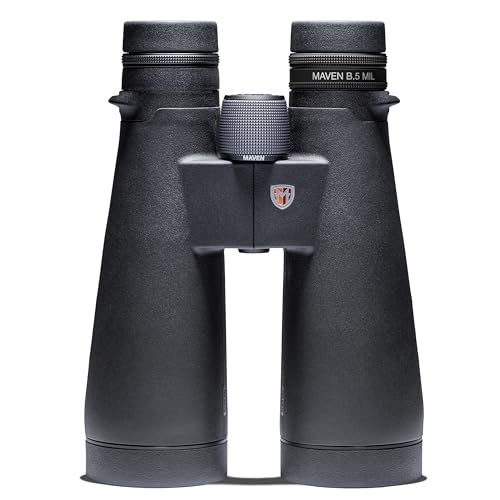
Maven B.5 56mm FL Reticle
- Objective
- 56 mm
- Rangefinder
Maven RF.1
- Max range (reflective)
- 4,500 yd
- Rangefinder
Maven CRF.1
Check price - Rangefinder
Maven RFZ.1 6-12x21
- Max range (reflective)
- 4,500 yd
- Angle compensation
- Yes





What Maven makes for hunters
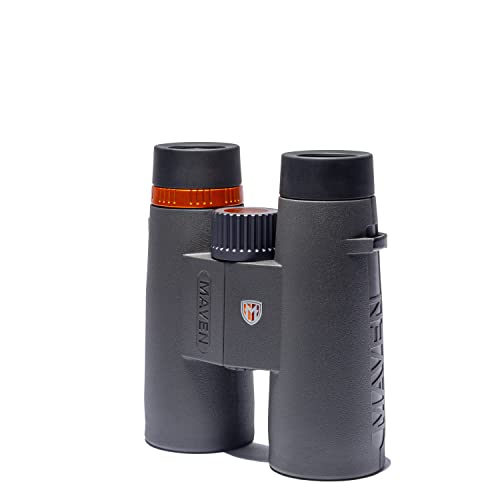
On this site, Maven covers two product types: binoculars and laser rangefinders. Maven binoculars make up most of the grid above, from small 25mm and 28mm compacts to 56mm binoculars built for a tripod. The rangefinders are three handheld hunting models.
Maven's own site also lists spotting scopes, monoculars and golf rangefinders, which this site doesn't list.
The grid changes as listings come and go, so I'll write about the series and what separates them, not about how many are listed this week. Most specs in the grid come from Amazon listings and are marked that way. The details below (glass, prisms, weights, where each line is assembled) come from Maven's own product pages.
One naming note before we start. Maven's site writes model names with a dot: B.2, B.6, C.1. Some Amazon titles drop the dot (B2, B6, C1). Match a listing to the maker's page by the numbers after the name, like 10x50.
How to read a Maven binocular name
Each name has a series letter, a model number, and the size:
- B or C: the series. Maven calls B its premium glass and C its mid-range line.
- The number: the model within the series (B.3, B.7, C.4).
- The size: magnification x objective, like 8x42.
Here's what actually changes with those last two numbers. Magnification is how much closer things look. The objective is the front lens diameter in millimeters. Nikon's binocular guide explains the trade: at the same magnification, a bigger objective gathers more light, and also makes the binocular heavier and larger.
Quick math: the exit pupil is the objective divided by the magnification. Nikon notes that a bigger exit pupil gives a brighter image at dawn and dusk.
- 8x42: 5.25mm
- 10x50: 5mm
- 6x30: 5mm
- 7x28: 4mm
- 8x25 or 18x56: about 3.1mm
That's why a small 6x30 can look as bright at first light as a full-size 10x50 on paper. (In practice, the glass matters too. Paper is just where I start.)
Lineup notes: Maven binoculars by series
B Series: the maker's premium line
Across the B pages, Maven lists magnesium frames on most models, ED glass in the objectives, dielectric-coated prisms, and "Japanese components assembled in the US." The B.3 is the exception on the frame: polymer.
- B1.2 (8x42, 10x42): the full-size all-rounder. Wide-angle Schmidt-Pechan prisms, 26.8 oz, and a field of view the maker lists at 420 ft at 1,000 yards for the 8x.
- B.2 (9x45, 11x45): Abbe-Koenig prisms, a different prism design from the rest of the B line. The maker lists 33.25 oz.
- B.3 (6x30, 8x30, 10x30): a light polymer-frame compact, 16.1 to 16.8 oz depending on power. The 6x lists the widest field in the lineup at 446 ft at 1,000 yards.
- B.5 (10x56 to 18x56): fluorite glass, which Maven says is the same glass as its spotting scopes, Abbe-Koenig prisms, 45 oz, tripod adaptable.
- B.5 with reticle (18x56): the same body with an MOA or MIL reticle, which Maven says is for ranging known targets and judging distances in the field.
- B.6 (10x50, 12x50): a larger Schmidt-Pechan prism than the B.1, per the maker, and 30.7 oz. Maven pitches it for low-light glassing. Tripod adaptable.
- B.7 (8x25, 10x25): the smallest B, 12.4 oz, folding, magnesium frame.
Uncle Walt asked if "Abbe-Koenig" was a law firm. It's a prism, Uncle Walt. It bends light, not rules.
C Series: the mid-range line
The C pages list polymer frames, ED glass and Schmidt-Pechan prisms with dielectric coatings; the C.1, C.2 and C.3 add phase correction coatings. The C.1, C.2 and C.3 say "Japanese and Chinese components assembled in the Philippines." The C.4 page says China.
- C.1 (8x42, 10x42, 12x42): the full-size option, 24 to 24.5 oz by power, with eye relief from 19.5mm on the 8x down to 15mm on the 12x.
- C.2 (7x28, 10x28): a compact at 12.4 to 12.6 oz.
- C.3 (10x50, 12x50): 28 oz, tripod adaptable.
- C.4 (15x56, 18x56): the big tripod binocular of the C line, about 45 oz.
The pattern across both series: the same sizes show up in B and C (42mm, 50mm, 56mm, compacts), with the B side listing magnesium frames and US assembly on most models, and the C side listing polymer frames and assembly abroad.
Maven rangefinder lineup
All three of Maven's hunting rangefinders list a 5-yard minimum, line-of-sight and angle-compensated modes with an accelerometer the maker rates at ±0.5°, a Field/Forest obstruction filter, a CR2 battery and an IPX7 rating. What separates them, per the maker:
- RF.1: 7x25, 4,500 yards on reflective targets, 3,000 on trees, 2,700 on deer. 10 oz with battery. Five brightness levels and five reticle choices.
- RFZ.1: the same range figures, with a 6x to 12x optical zoom and a 21mm objective. 10.6 oz with battery.
- CRF.1: 6x22, 2,400 yards reflective, 1,300 on trees, 650 on deer. 8 oz with battery, with an auto red/black display.
All three list made in the Philippines.
Battery life is listed in range cycles, not hours: more than 3,500 on the RF.1 and more than 2,000 on the RFZ.1 and CRF.1, per the maker. All three run on one CR2. A spare CR2 weighs next to nothing, and it's the cheapest insurance in the pack against a blank screen on opening morning.
For a bow, every one of these reaches far past any shot you'd take. The numbers that matter more for a stand are the deer figure, the minimum range, how the display reads in timber, and how it handles angles. The zoom on the RFZ.1 matters most if you also use the rangefinder to look things over. More background is on the hunting rangefinder page.
How to choose within the Maven lineup
Pick magnification by where you glass
My one opinion on this page: pick the magnification for the distance you actually look, not for the biggest number on the box. Nikon's guide gives the checkable reason. Higher magnification narrows the view and makes a hand-held image shakier, and Nikon recommends up to 12x for general hand-held use.
In the Pennsylvania hardwoods, most of what I glass is inside a hundred yards. An 8x keeps more woods in view, which helps when a deer is moving through brush. A 10x shows more detail at the far edge of a field. The 15x and 18x models belong on a tripod, and Maven lists the big 56mm models as tripod adaptable for that reason.
Then pick the size you'll carry
The lineup splits into three carry sizes:
- Compacts (25mm to 30mm): about 12 to 17 oz, a coat pocket or a small chest pack
- Full-size (42mm to 50mm): about 24 to 31 oz, a chest harness
- Big 56mm: about 45 oz, a tripod and a pack
Binoculars do the most good on your chest, not in the truck. The binocular harness page covers the carry side.
Then B or C
Once the size and power are set, the series is the remaining choice. On the maker's pages, the differences are frame material (magnesium on most B models, polymer on C), prism type on a few B models (Abbe-Koenig on the B.2 and B.5), fluorite glass on the B.5, and where each is assembled. Both series list the same IPX7 rating, and ED glass everywhere except the fluorite B.5.
Compare field of view, not just power
Field of view is how wide a slice of the world you see without moving the binocular. Nikon's guide says a wider field helps when you're following something that moves fast. Maven lists it per model as feet at 1,000 yards, and the spread across the lineup is wide:
- B.3 6x30: 446 ft, the widest in the lineup
- B1.2 8x42: 420 ft
- C.1 8x42: 341 ft
- B.6 and C.1 at 10x: 341 and 314 ft
- B.5 and C.4 at 18x: 194 ft
Same magnification doesn't mean same view: the 8x42s in the two series differ by about 80 feet at 1,000 yards, per the maker. For a deer slipping through laurel at 60 yards, that extra width is the difference between finding it in the glass and finding a very nice branch. Close focus differs too: the maker lists 4.9 ft on the B1.2 and 5.9 ft on the C.1, which matters mostly for reading a track or a rub up close.
Check the eye relief if you wear glasses
Nikon's guide says models with 15mm or more of eye relief let eyeglass wearers see the full field without taking their glasses off. Maven's spec tables list eye relief per model; the B1.2 lists around 18mm, and the C.1 runs from 19.5mm down to 15mm as the power goes up.
The hunting binoculars page compares these specs across brands.
Maven rangefinder for bowhunting: angles and setup
Bowhunter magazine explains why angle compensation matters from a stand. On uphill and downhill shots, shooting the line-of-sight distance makes the arrow hit high. For typical archery shots of about 40 yards or less, the horizontal distance is the number to use, and an angle-compensating rangefinder calculates it from the distance and the angle. The same article notes the calculation is less exact on long, steep shots, and suggests testing your own setup on slopes.
Each Maven rangefinder switches between line-of-sight and compensated modes, so check which mode it's in before the season. Range a few known marks from your stand: a tree, a fence post, a scrape. Write the yardages down where you'll see them. If you're weighing a binocular with a rangefinder built in, the rangefinder binoculars page covers that type.
Care and warranty basics
Maven states that all its optics carry an unconditional lifetime warranty. It doesn't cover loss, deliberate damage, cosmetic modification, or cosmetic damage that doesn't affect performance. Repairs start with a form on the maker's site. Stock products can be returned within two weeks in new condition; custom units can't be returned for credit.
The binocular pages list scratch- and oil-resistant lens coatings, and every Maven binocular and rangefinder in the lineup lists IPX7, which the binocular pages define as 1 meter for 30 minutes. Keep a lens cloth in the case anyway. Rain on a lens is still rain on a lens.
Who's behind Maven
Maven's About page says the company was founded in 2013 by Brendon Weaver, Mike Lilygren and Cade Maestas, and built around a direct-to-consumer model, selling straight to the user. Its site also links a custom builder.
Size first, power second, series third. And put the binoculars on your chest before you leave the truck. Uncle Walt, this means you.
Where Maven shows up
Questions about Maven
Are Maven binoculars good?
What the maker states is checkable: every binocular page lists ED or fluorite glass in the objective, Schmidt-Pechan or Abbe-Koenig prisms, and an IPX7 rating the maker gives as 1 meter for 30 minutes. Whether a pair suits you depends on the size you'll carry, the magnification your hands can hold steady and the light you hunt in.
Where are Maven binoculars made?
It depends on the series, per Maven's own spec tables. The B Series pages say Japanese components assembled in the US. The C.1, C.2 and C.3 pages say Japanese and Chinese components assembled in the Philippines, and the C.4 page says China. Maven's hunting rangefinder pages say made in the Philippines.
What warranty do Maven optics have?
Maven states that all its optics come with an unconditional lifetime warranty. It doesn't cover loss, deliberate damage, cosmetic modification, or cosmetic damage that doesn't affect performance. Stock products can be returned within two weeks in new condition; custom units can't be returned for credit.
Which Maven rangefinder is best for bowhunting?
There's no single answer, but the specs sort them. All three list line-of-sight and angle-compensated modes and a 5-yard minimum. The CRF.1 is the lightest at 8 ounces and lists 650 yards on deer. The RF.1 lists 7x magnification and 2,700 yards on deer. The RFZ.1 adds a 6x to 12x zoom.
Who owns Maven optics?
Maven's About page says the company was founded in 2013 by Brendon Weaver, Mike Lilygren and Cade Maestas, and that it was built around a direct-to-consumer business model.
Sources
- Maven: Home — accessed 2026-10-28
- Maven: About us — accessed 2026-10-28
- Maven: Warranty and returns — accessed 2026-10-28
- Maven: Binoculars — accessed 2026-10-28
- Maven: B1.2 8x42 and 10x42 binoculars — accessed 2026-10-28
- Maven: B.2 9x45 and 11x45 binoculars — accessed 2026-10-28
- Maven: B.3 6x30, 8x30 and 10x30 binoculars — accessed 2026-10-28
- Maven: B.5 56mm binoculars — accessed 2026-10-28
- Maven: B.5 18x56 MOA/MIL reticle binoculars — accessed 2026-10-28
- Maven: B.6 10x50 and 12x50 binoculars — accessed 2026-10-28
- Maven: B.7 8x25 and 10x25 binoculars — accessed 2026-10-28
- Maven: C.1 8x42, 10x42 and 12x42 binoculars — accessed 2026-10-28
- Maven: C.2 7x28 and 10x28 binoculars — accessed 2026-10-28
- Maven: C.3 10x50 and 12x50 binoculars — accessed 2026-10-28
- Maven: C.4 15x56 and 18x56 binoculars — accessed 2026-10-28
- Maven: Rangefinders — accessed 2026-10-28
- Maven: RF.1 7x25 rangefinder — accessed 2026-10-28
- Maven: RFZ.1 6-12x21 rangefinder — accessed 2026-10-28
- Maven: CRF.1 6x22 rangefinder — accessed 2026-10-28
- Nikon: Choosing binoculars by specifications — accessed 2026-10-28
- Bowhunter: Understanding angle-compensating rangefinders — accessed 2026-10-28