Trail Cameras & Optics · Gear type
Rangefinder Binoculars
Rangefinder binoculars are binoculars with a laser rangefinder built in. You find the deer, press a button and read the yardage without swapping devices. The choice comes down to three things: how far it ranges on a deer, not on a reflective sign; whether it gives angle-compensated yardage for stand shots; and whether you'll carry the extra weight. The glass itself follows the same rules as any hunting binocular. (Uncle Walt calls them binoculars that do homework.)
We earn a commission if you buy through our links, at no cost to you. Disclosure
| Model | Objective | Magnification | Amazon |
|---|---|---|---|
Sig Sauer KILO10K-ABS HD Gen IIBinoculars More specs
| — | — | Check price |
Vortex Talon HD 10K 10x42Binoculars More specs
| 42 mmlisting | 10 xlisting | Check price |
Sig Sauer KILO6K HDX 10x42Binoculars More specs
| 42 mmlisting | 10 xlisting | Check price |
Vortex Fury HD 5000 10x42Binoculars More specs
| 42 mmlisting | 10 xlisting | Check price |
Sig Sauer Canyon 10x42 RangefindingBinoculars More specs
| 42 mmlisting | 10 xlisting | Check price |
Sig Sauer Kilo Canyon Black Edition 10x42Binoculars More specs
| 42 mmlisting | 10 xlisting | Check price |
Leica Geovid Pro 8x56Binoculars More specs
| 56 mmlisting | 8 xlisting | Check price |
Burris SignatureHD LRF 300299Binoculars More specs
| — | — | Check price |
ZEISS Victory RF 10x42Binoculars More specs
| 42 mmlisting | 10 xlisting | Check price |
Leica Geovid R Gen 2022 10x42Binoculars More specs
| 42 mmlisting | 10 xlisting | Check price |
Nikon LaserForce 10x42Binoculars More specs
| 42 mmlisting | 10 xlisting | Check price |
Gogogo Sport Vpro Vpro Rangefinder Binoculars 8x42Binoculars More specs
| 42 mmlisting | 8 xlisting | Check price |
Athlon Optics Cronus UHD 10x50 Rangefinder BinocularsBinoculars More specs
| 50 mmlisting | 10 xlisting | Check price |
Bushnell Fusion X 10x42 RangingBinoculars More specs
| 42 mmlisting | 10 xlisting | Check price |
Halo Optics K2000 Rangefinder Binoculars 10x42Binoculars More specs
| 42 mmlisting | 10 xlisting | Check price |
Leica Geovid Pro 32 8x32Binoculars More specs
| 32 mmlisting | 8 xlisting | Check price |
Leica Geovid Max 10x42Binoculars More specs
| 42 mmlisting | 10 xlisting | Check price |
Leupold BX-4 Range HD TBR/W 10x42Binoculars More specs
| 42 mmlisting | 10 xlisting | Check price |
Swarovski Optik EL Range 10x42Binoculars More specs
| 42 mmlisting | 10 xlisting | Check price |
Swarovski Optik EL Range TA 12x42Binoculars More specs
| 42 mmlisting | 12 xlisting | Check price |


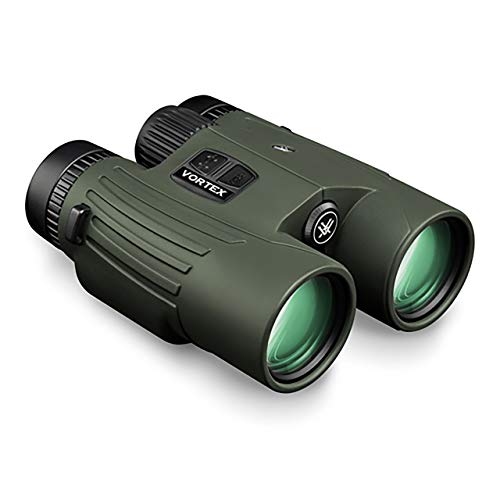

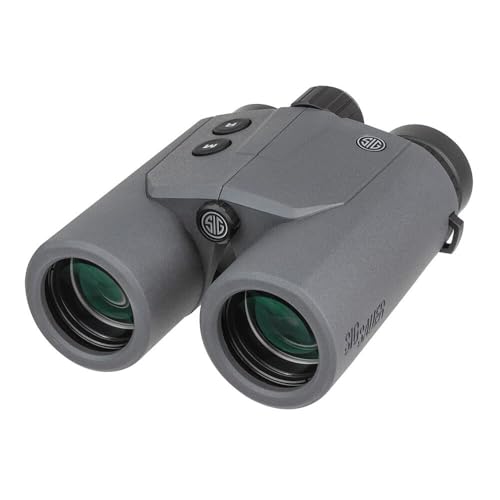


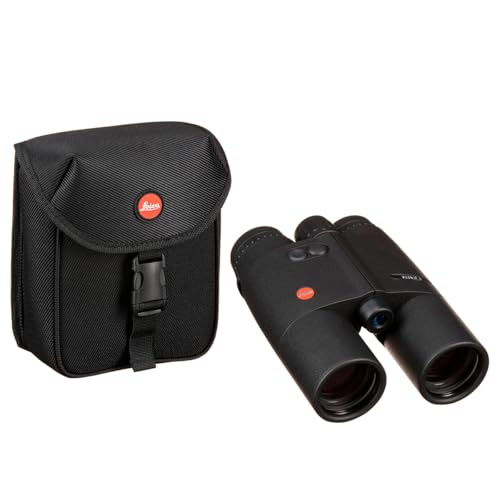


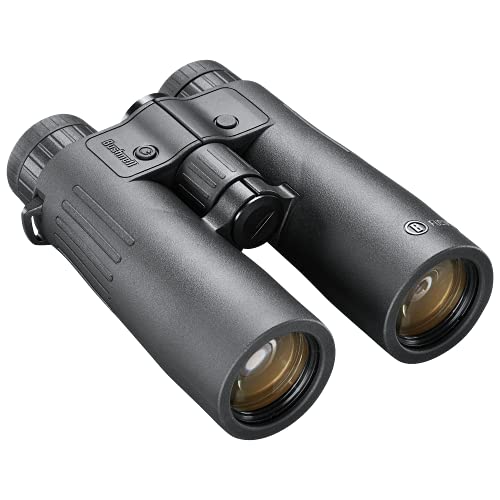
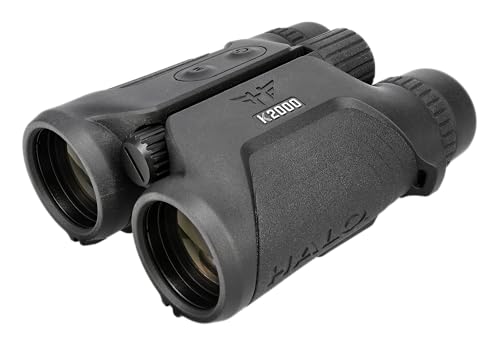


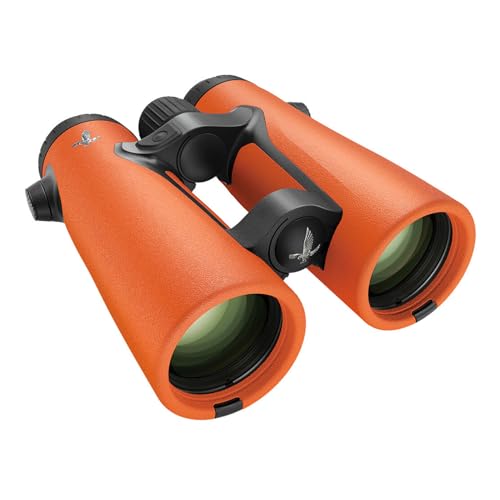
What’s in this listBinoculars with a built-in laser rangefinder, as stated by the maker or the Amazon listing, longest range first. “—” means neither the maker nor the Amazon listing states it.
What rangefinder binoculars are
A rangefinder binocular is a hunting binocular with a laser rangefinder inside it. The glass works like any binocular. Add a button on top, a laser window and a small readout in one eyepiece, and it also tells you how far away the deer is.
One maker's manual lays out the mechanics. Press the button and the unit sends a brief pulse of laser light. The pulse bounces off the target and returns to the laser's internal receiver. The time that round trip takes is the distance, and the yardage shows up in your view.
It's an echo, basically. Shout across the hollow behind the cabin, count until it comes back, and you've built a very slow, very loud rangefinder. (Walt has done this. He got "about far.")
The optics side (magnification, objective, exit pupil, field of view, eye relief, sealing) follows the same rules as every hunting binocular. Those are explained once, on the hunting binoculars page. This page spends its words on the laser half.
The table on this page lists only binoculars whose maker or listing states a built-in laser rangefinder, with the longest stated ranging distance first. Alongside the usual optics columns, it shows the stated ranging maximum and whether it offers angle compensation. Blank cells mean neither the maker nor the Amazon listing states that spec; values read from the listing are marked.
What to look at when you pick rangefinder binoculars
The laser half has its own spec sheet. These are the lines I'd read, top to bottom.
Read the deer number, not the headline number
Makers usually state ranging distance on more than one kind of target. The headline is for a reflective target, like a sign or a light-colored rock face. Deer are matte, brown and not trying to help.
Two makers' specs show the gap:
- One 10x42 unit: 4,000 yards reflective, 2,000 yards on trees, 1,300 yards on deer-sized targets
- Another 10x42 unit: 5,000 yards reflective, 2,400 yards on trees, 1,600 yards on deer
- A separate rangefinder's guide: 2,400 yards reflective, 1,600 yards non-reflective
So the deer line is roughly a third of the headline on those two binoculars. The table's ranging column shows the maximum the maker or the listing states. When you compare units, look up whether that number is for reflective targets.
There's a floor too. The two binoculars above list minimum ranges of 12 yards and 5 yards. For a bowhunter whose deer may come in close, the minimum matters more than the maximum. The rangefinder guide adds that larger, more reflective targets are easier to range. If a deer won't read, range a tree or rock right next to it.
Angle compensation turns a slope into a shot
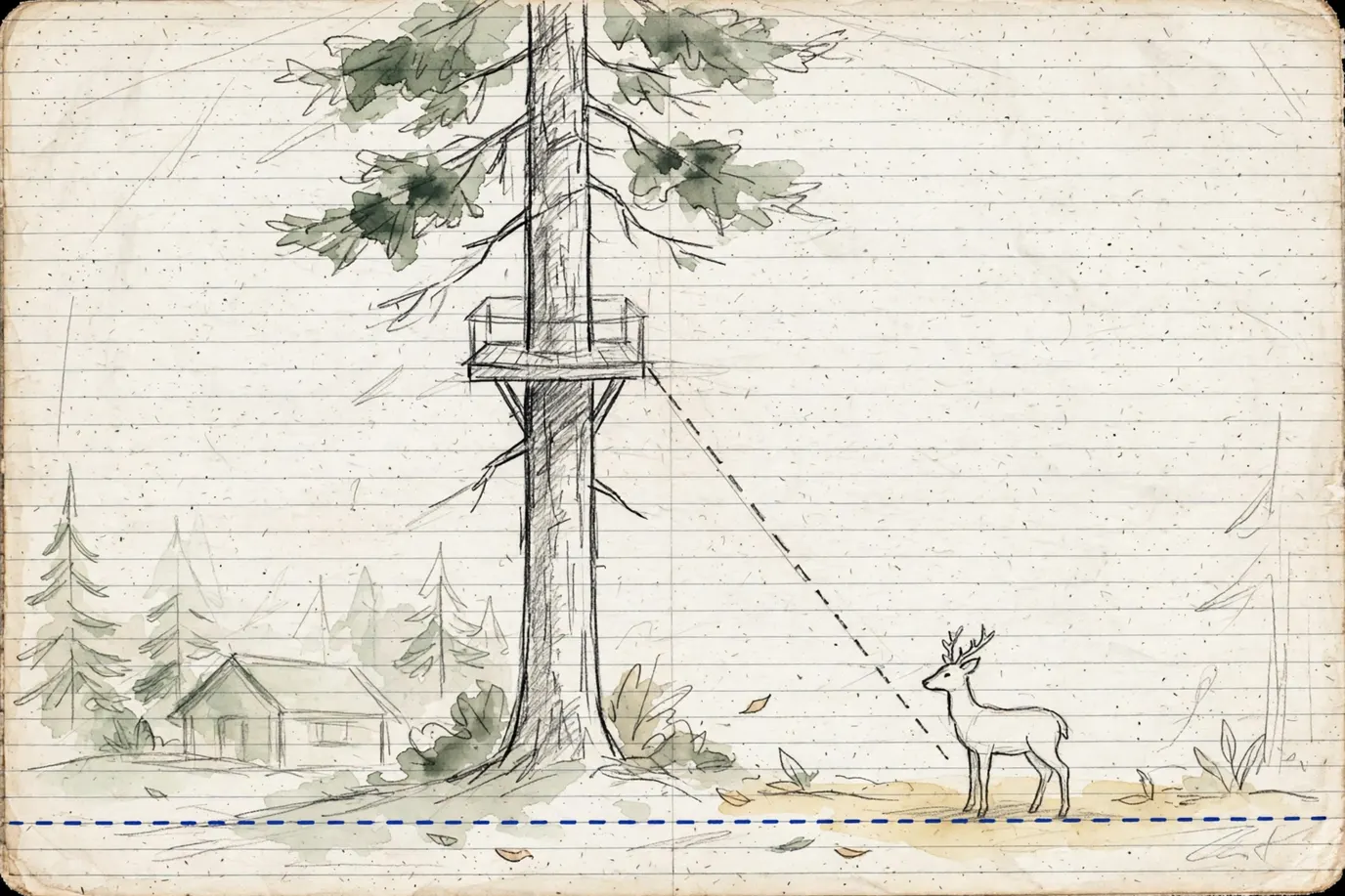
A laser measures the straight line from your eye to the deer. From a tree stand, or on a steep hill, that line is longer than the level distance your arrow actually has to cover. Picture a ladder leaning on the cabin wall. The ladder is always longer than the gap between its feet and the wall.
Angle compensation does the trig for you. It reads the tilt and shows the horizontal distance, which is the one your sight pins are set for. The table marks whether the maker or the listing says it's offered.
Quick math, from one rangefinder's guide: a target 35 yards away along the line of sight, at a 40-degree angle, is 26.8 yards horizontal. Shoot your 35 pin there and you'll sail it over the back. The corrected number is closer to your 25.
Makers name these modes differently. On the units above:
- LOS (line of sight): the straight-line distance, no correction
- HCD (horizontal component distance): one maker's name for slope-corrected yardage
- Bow mode: one maker's simple angle mode for archers, accurate to about 70 yards at angles under 20 degrees
- Rifle ballistic modes: corrections for bullet drop, and on some units wind holds, at long range
One maker's manual says its slope-corrected mode is the one for all archery shooting. Its LOS mode is meant for rifle shooters who use slope-correcting ballistic cards or apps at long range, and it adds that most archers won't need it.
Target modes decide which thing in the beam you get
A laser beam isn't a pencil line. It can hit a twig in front of the deer, or the hillside behind it. Target modes tell the unit which return to show.
- First or best: the closest or strongest return. One maker calls it the standard mode and recommends it for most situations.
- Last or brush: the farthest return. Use it when grass, branches or rocks sit in front of the animal.
- Scan: continuous readings while you hold the button and pan, useful for a moving deer.
One rangefinder's guide adds a detail worth knowing: the display shuts off after 10 seconds to save the battery. In practice, range it again when the deer moves.
Two diopters, one display
A plain binocular has one diopter ring. A rangefinder binocular adds a second adjustment for the display. One maker's manual calls it the reticle focus ring and says that once it's set, you won't have to refocus the display again.
The display is the readout: yardage, mode, battery. One maker uses a red OLED display it says reads crisp in any light. Set the display side so the numbers are sharp, then focus the glass. Setup steps are further down this page.
Weight is the price of one device instead of two
Putting a laser in a binocular adds ounces. The makers' own figures show it:
- One 10x42 rangefinding binocular: 37 oz
- Another 10x42 rangefinding binocular: 32.3 oz
- A plain 10x42 from a third maker, for comparison: 21 oz
The table lists weight in ounces from the maker. The upside is simple: one device instead of two means one less thing on your harness. Whether that's a win depends on what you already carry. If you'd bring a binocular and a separate rangefinder anyway, the combined weight may be close. If you only carry a binocular, going by those figures you're adding roughly 11 to 16 oz for the laser.
At this weight, a chest harness is not optional comfort. It's how your neck survives the walk in. More on that on the binocular harness page.
Battery: carry a spare
Both binocular units above take a single CR2 lithium battery. One maker rates its battery at 3,000 actuations (button presses). When the battery dies, so does the yardage. Keep a spare in the case or the harness pocket, and swap it before the season rather than in the stand.
Optics still matter, and the laser can't fix bad glass
The glass in a rangefinder binocular follows the usual numbers. On both 10x42 units above, the maker states an exit pupil of 4.2 mm. That's the 42 ÷ 10 math from the hunting binoculars page. A dark-adapted eye opens to about 5 to 7 mm, according to one optics maker's knowledge base, so a 10x42 gives up a little at last light compared with an 8x42.
Both makers above state their units are sealed and gas-purged for fogproof, waterproof use. The table repeats the maker's own wording.
Who rangefinder binoculars suit, and who should skip them
Stand and saddle bowhunters
Here's the case for them: you range through the same glass you spotted with, so you keep your eyes on the deer and skip the swap to a second device. That matters in a tree with a deer at 22 yards.
My one opinion on this page: for a stand bowhunter, the angle mode and the deer-range line matter more than the reflective maximum. The reason is on the spec sheets. One maker's bow mode is built for about 70 yards and under 20 degrees, which covers stand shots, while the reflective maximum describes targets you'll never draw on.
Open-country and rifle hunters
This is where the long-range modes, wind holds and ballistic solutions pay off. One maker's 10x42 gives ballistically calculated solutions for rifle hunters at longer distances and steeper angles, plus a hold point for a 10-mph crosswind out to 800 yards. Walt's position on anything with a menu that deep is well documented: "If it needs a manual, it needs a different owner." He is not the target customer.
Who should skip them
If you hunt one ground blind and already know the yardage to every shooting lane, you may not need a laser in your binocular at all. Same if your binocular already works and you own a rangefinder you like. Standalone units are on the hunting rangefinder page and the bow hunting rangefinder page.
Setting up rangefinder binoculars
Do this before the season, in daylight, on a target you know the distance to.
- Set the eyecups: up without glasses, down with them, as on any binocular.
- Focus the display side: one maker's manual says to pick an object about 20 yards away, close your left eye, focus the object with the center wheel, then turn the display ring until the readout is sharp.
- Set the diopter: cover the right side, look with your left eye, and turn the diopter until the object is sharp. From then on, use only the center wheel.
- Pick your modes: angle-compensated for stand hunting, line of sight if you use your own ballistic data. Choose yards, not meters.
- Check it: range something you've already measured. Your 20-yard target is perfect.
- Log it: both diopter settings and the mode go in the logbook, next to the yardage you checked.
For long readings, brace the binocular. The same manual says a tripod, with a binocular tripod adapter, greatly improves your ability to range small targets at longer distances.
Care and laser safety
Clean the lenses gently. One rangefinder's guide says to remove grit first with a lens pen or soft brush, then use a lens cleaner; wiping grit across the glass can damage coatings. Keep the laser window as clean as the lenses, since a dirty objective can stop a reading.
Don't press the range button while aiming at a person's eye or while looking into the front of the unit; one maker's guide states this even for its eye-safe FDA Class 1 laser. Never look at the sun through any binocular. Hunting rules vary by state, so check your state wildlife agency.
That's it: deer range, angle mode, weight. Write the yardage in the logbook. Walt will want to see the battery receipt.
Brands in this list
Related
Questions people ask
How do laser rangefinder binoculars work?
Press the range button and the unit sends out a brief pulse of laser light. It bounces off the target and returns to a receiver inside the unit, and the time the round trip takes gives the distance in yards. The number shows up on a display inside one eyepiece, so you never take your eyes off the animal.
Are hunting binoculars with rangefinder worth it for bowhunting?
They can be. One device replaces two, which frees space on your harness, and you range through the same glass you spotted with. For a stand hunter, look for an angle-compensated mode; one maker's bow mode is accurate to about 70 yards at angles under 20 degrees. The trade is weight and cost.
Why does the deer range differ from the maximum range?
Because a deer is a poor reflector. One maker rates its unit at 4,000 yards on reflective targets, 2,000 on trees and 1,300 on deer-sized targets. Another rangefinder's guide lists 2,400 yards reflective and 1,600 non-reflective. Compare the deer or non-reflective line, since that's what you'll actually range.
Do rangefinder binoculars have two diopters?
Usually, yes. One maker's manual shows a focus ring for the display and a diopter for the glass. Close your left eye, focus the object with the center wheel while looking through the display side, then sharpen the readout with the display ring. Then cover the right side and set the diopter. Write the settings down.
What if my rangefinder binoculars won't give a reading?
Work through the basics. One rangefinder's troubleshooting guide lists them: check for objects in the laser's path, clean the objective lens, check the mode settings, and try a large or nearby object. If brush sits in front of the deer, switch to a last or brush mode so the unit reports the farther return.
Sources
- Leupold: BX-4 Range HD Gen 2 10x42 rangefinding binocular (specs and modes) — accessed 2026-10-22
- Vortex Optics: Fury HD 5000 10x42 laser rangefinder binocular (specs and modes) — accessed 2026-10-22
- Burris: Signature LRF 2000 user guide (PDF) — accessed 2026-10-22
- Athlon Optics: Neos G2 10x42 HD (weight of a plain 10x42) — accessed 2026-10-22
- Vortex Optics: Fury HD 5000 laser rangefinding binocular product manual (PDF) — accessed 2026-10-22
- Celestron: What is exit pupil and eye relief for sport optics? — accessed 2026-10-22