Brand · Trail Cameras & Optics
ZEISS Binoculars for Hunters
ZEISS binoculars come in family lines that the maker ranks from entry to top: Terra ED, Conquest HDX, SFL, and the Victory group (SF, HT, Pocket and the rangefinding RF). The short version: the family sets the glass, the coatings and the body; the two numbers after the name (8x42, 10x54) set what you'll see at first and last light. Pick the size for when you hunt, then the family for how often you'll use it. (Uncle Walt reads binocular names like license plates. He's still looking for the state.)
We earn a commission if you buy through our links, at no cost to you. Disclosure
ZEISS on Amazon US
23 models- Binoculars
ZEISS SFL 50 12x50
- Objective
- 50 mm
- Magnification
- 12 x
- Binoculars
ZEISS Terra ED Pocket 8x25
- Objective
- 25 mm
- Magnification
- 8 x
- Binoculars
ZEISS Terra ED 10x42
- Objective
- 42 mm
- Magnification
- 10 x
- Field of view
- 330 ft@1000yd
- Binoculars
ZEISS Terra ED 8x42
- Objective
- 42 mm
- Magnification
- 8 x
- Binoculars
ZEISS Victory SF 8x42
- Objective
- 42 mm
- Magnification
- 8 x
- Eye relief
- 18 mm
- Binoculars
ZEISS Victory Pocket 8x25
- Objective
- 25 mm
- Magnification
- 8 x
- Binoculars
ZEISS Victory RF 10x42
- Objective
- 42 mm
- Magnification
- 10 x
- Binoculars
ZEISS Terra ED 8x32 Bundle
- Objective
- 32 mm
- Magnification
- 8 x
- Binoculars
ZEISS Terra ED 10x42 Bundle
- Objective
- 42 mm
- Magnification
- 10 x
- Binoculars
ZEISS Terra ED 10x42 Bundle
- Objective
- 42 mm
- Magnification
- 10 x
- Binoculars
ZEISS Terra ED 10x42 Bundle
- Objective
- 42 mm
- Magnification
- 10 x
- Binoculars
ZEISS Victory SF 8x42 Bundle
- Objective
- 42 mm
- Magnification
- 8 x
- Field of view
- 444 ft@1000yd
- Binoculars
ZEISS Victory HT 8x54 Bundle
- Objective
- 54 mm
- Magnification
- 8 x
- Binoculars
ZEISS Victory SF 10x42 Bundle
- Objective
- 42 mm
- Magnification
- 10 x
- Field of view
- 360 ft@1000yd
- Binoculars
ZEISS SFL 8x40
- Objective
- 40 mm
- Magnification
- 8 x
- Binoculars
ZEISS Terra ED 10x42
- Objective
- 42 mm
- Magnification
- 10 x
- Binoculars
ZEISS Terra ED 8x42
- Objective
- 42 mm
- Magnification
- 8 x
- Binoculars
ZEISS Victory SF 10x42 Bundle
- Objective
- 42 mm
- Magnification
- 10 x
- Binoculars
ZEISS Terra ED 8x42 Bundle
- Objective
- 42 mm
- Magnification
- 8 x
- Binoculars
ZEISS Conquest HDX 8x42
- Objective
- 42 mm
- Magnification
- 8 x
- Binoculars
ZEISS Conquest HDX 15x56 LRP
- Objective
- 56 mm
- Magnification
- 15 x
- Binoculars
ZEISS Terra ED 8x42 Bundle
- Objective
- 42 mm
- Magnification
- 8 x
- Binoculars
ZEISS Conquest HDX 10x42 Bundle
- Objective
- 42 mm
- Magnification
- 10 x




What ZEISS makes for hunters
On this site, ZEISS covers one product type: hunting binoculars. That includes one rangefinding model, the Victory RF, which has a laser rangefinder built into the binocular.
The grid above shows the ZEISS binoculars available on Amazon right now, with filters by type. It changes as listings come and go, so I'll write about the families and what separates them, not about which sizes are listed this week. Several listings are bundles: the same binocular packed with extras. The binocular inside is what the specs describe.
ZEISS also makes spotting scopes, thermal devices and trail cameras, per its press release, and riflescopes, which this site doesn't list. The ZEISS listings carried here are binoculars only.
How to read a ZEISS binocular name
Each name has two parts: the family and the size.
- The family (Terra ED, Conquest HDX, SFL, Victory SF and so on) sets the glass, the coatings, the body and the price tier.
- The size (8x42, 10x54) is magnification times objective lens diameter in millimeters.
Here's what actually changes with the size. Magnification makes things bigger and makes your hand shake bigger too. The objective lens is the light bucket. Divide the lens by the magnification and you get the exit pupil, the beam of light that reaches your eye. ZEISS's hunting blog calls a large exit pupil "decisive" for twilight and says that, ideally, it's at least as large as your own pupil.
Quick math, from the sizes on the maker's pages:
- 8x25: about 3.1 mm
- 10x42: 4.2 mm
- 8x42: about 5.3 mm
- 12x50: about 4.2 mm
- 15x56: about 3.7 mm
- 8x54: about 6.8 mm
Lineup notes: ZEISS binoculars by family
Terra ED: the entry family
ZEISS calls the Terra ED "premium quality for beginners." Its page describes a waterproof, nitrogen-filled body reinforced with glass fibers and a large focus wheel. The maker lists 88 percent light transmission and a 100 mbar water resistance rating across the line.
Per the maker's spec sheet:
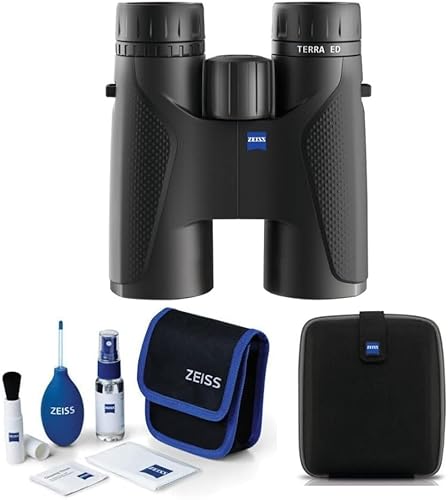
- Terra ED 8x42 and 10x42: 25.6 oz each; 375 ft and 330 ft of view at 1,000 yards
- Terra ED 8x32 and 10x32: 18.0 oz; 405 ft and 336 ft
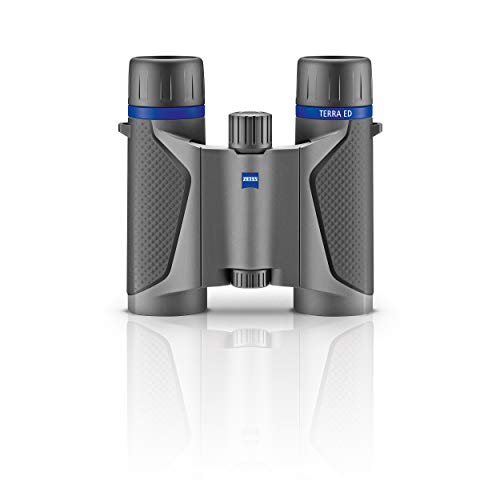
- Terra ED Pocket 8x25 and 10x25: 10.9 oz; 357 ft and 291 ft
Field of view is how wide a slice of the world you see, in feet at 1,000 yards. More feet means less hunting for the deer you just saw with your naked eye. (It's always behind the one tree.)
The grid carries several Terra ED 42 mm bundles and a Pocket 8x25. Many of the listings repeat the same two sizes; read the listing title for what's in the box.
Conquest HDX: the all-rounder
ZEISS calls the Conquest HDX "the ideal premium all-rounder" and places it for rain, cold and poor light. The maker lists 90 percent light transmission and a 400 mbar water resistance rating, with a LotuTec coating that it says sheds water.
The Conquest HDX range runs wider than the Terra ED, from 8x32 to 15x56. Per the maker:
- 8x42: 25.2 oz; 384 ft at 1,000 yards
- 10x42: 25.2 oz; 345 ft
- 15x56: 45.2 oz; 240 ft
The grid carries the 8x42, a 10x42 bundle and a 15x56 that its listing calls "LRP". The maker's page lists that size as the Conquest HDX 15x56. At 15x, your hand shake is magnified as much as the deer is. That's a size for a rest or a tripod.
SFL: the light family
ZEISS calls the SFL its lightweight family and places it for stalking, when you carry more than you sit. The maker says SFL models are up to 30 percent lighter than comparable binoculars and that the focus wheel goes from close focus to infinity in 1.4 turns.
- SFL 8x40: 22.6 oz; 420 ft at 1,000 yards
- SFL 12x50: 30.8 oz; 315 ft
ZEISS announced the 50 mm SFL sizes in April 2025, including the first 12x50 in the line, and describes them as about as compact as a classic 42 mm binocular. The grid lists both an SFL 8x40 and the 12x50.
Victory SF: the top 42 mm family
ZEISS calls the Victory SF "the top model from ZEISS." Its page describes a wide field of view and what the maker calls the ErgoBalance concept, built to keep the binocular steady through long sits.
- Victory SF 8x42: 27.8 oz; 444 ft at 1,000 yards; 92 percent light transmission
- Victory SF 10x42: 27.8 oz; 360 ft; 92 percent
That 444 ft is the widest view of any 42 mm ZEISS on this page. On paper, it's a lot of hillside. In practice, it's fewer minutes spent finding the deer before you start looking at it.
Victory HT: the twilight family
ZEISS positions the Victory HT for blind and night hunting and calls it the brightest binocular it has made. The maker lists 95 percent light transmission, SCHOTT HT glass and a 500 mbar water resistance rating.
- Victory HT 8x54: 36.5 oz; 390 ft at 1,000 yards
- Victory HT 10x54: 37.0 oz; 330 ft
The grid carries an 8x54 bundle. It's a heavy binocular for a long walk and a sensible one for a ground blind, where it sits on the shelf more than on your chest.
Victory Pocket and Terra ED Pocket
Both pocket lines are 8x25 or 10x25. The Victory Pocket lists 10.2 oz, 91 percent light transmission and an asymmetrical bridge that ZEISS says folds very compact. The Terra ED Pocket lists 10.9 oz and 88 percent.
With a 25 mm lens, the exit pupil sits near 3 mm at 8x. By ZEISS's own rule, that's a daylight binocular. It's the one that rides in a jacket pocket when the big one stays home.
Victory RF: binocular and rangefinder in one
The Victory RF puts a laser rangefinder into a Victory binocular. The maker gives a maximum range of 2,500 yards, a minimum of about 10 meters, and a reading in under 0.3 seconds. Accuracy, per ZEISS, is ±1 meter out to 600 meters. It runs on one CR2 battery.
- Victory RF 10x42: 33.9 oz; 345 ft at 1,000 yards
The ballistic profiles and app link on the RF are built for long-range shooters, and this page doesn't cover them. For a bowhunter, the line-of-sight range is the number that matters. Other rangefinding binoculars across brands are on the rangefinder binoculars page.
How to choose within the ZEISS lineup
Work out the exit pupil before the magnification
My one opinion on this page: for a whitetail hunter in the woods, check the exit pupil first. The reason is ZEISS's own: the blog says anything under 4 mm is "unsuitable in the waning light right from the start." Deer move at first and last light. A 10x42 sits right at that 4.2 mm line; an 8x42 clears it with room. A 15x56 lands under it.
If you glass open country in daylight, 10x or 12x has a case. In a hardwood bottom at dusk, 8x usually does. The hunting binoculars page covers sizes across brands.
Then weigh it
Weight is a spec you feel by the third hour. Across the ZEISS families above, the maker's weights run from about 10 oz for the pockets to about 45 oz for the 15x56. A 42 mm ZEISS sits near 25 to 28 oz, the RF heavier. A chest harness moves that weight off your neck; options are on the binocular harness page.
(As a physical therapist: a heavy binocular on a thin neck strap is a neck appointment with a delay. I see the follow-up visits.)
Then pick the family by use
- Terra ED: an entry pair for a few hunts a year
- Conquest HDX: the widest size range, built for weather
- SFL: lighter, for stalking
- Victory SF: widest view in a 42 mm
- Victory HT: twilight from a blind
- Victory RF: binocular and rangefinder in one
Water ratings, read plainly
ZEISS lists water resistance in mbar, a pressure rating. Across these families, the maker gives 100 mbar (Terra ED, Victory Pocket), 400 mbar (Conquest HDX, SFL, Victory SF) and 500 mbar (Victory HT). A higher number is a higher pressure rating. The maker calls the Terra ED waterproof; the number tells you how its rating compares.
Setting up and caring for ZEISS binoculars
Two adjustments make most binoculars sharper than they looked in the box: the eye distance (fold the barrels until you see one circle, not two) and the diopter (the ring that evens out a difference between your eyes). Set them once at home, then mark the diopter with a dot of paint.
ZEISS says its LotuTec coating, listed on the Conquest HDX, Victory HT and Victory Pocket, makes water bead off and dirt wipe away more easily. Blow or brush grit off the lenses before you wipe them. Grit plus cloth is sandpaper.
ZEISS binocular warranty in the US
ZEISS's US warranty document covers the optical system of its sports optics against defects for the life of the product, and the warranty transfers to a new owner. It applies only to products bought in the USA or Canada from authorized ZEISS dealers. Electronic components, such as the rangefinder in the Victory RF, are covered for five years from purchase. Straps, lens caps, rubber armoring and similar parts are covered for one year.
The document excludes accidental damage, normal wear, loss and theft, and damage from misuse or unauthorized repair. Proof of purchase isn't required for the lifetime coverage; without it, the date of manufacture starts the clock. Claims begin online or by phone through ZEISS Sports Optics customer service.
Who's behind ZEISS hunting optics
Per a ZEISS press release, since October 1, 2026 the ZEISS hunting, nature observation and birding business operates as VALYRA GmbH, an independent company headquartered in Aalen, Germany. ZEISS and the Munich investment company palero signed the agreement in February 2026. ZEISS licenses its brand to VALYRA long term, and the release says the products continue to be sold worldwide under the ZEISS name, with the existing team moving to the new company.
Family, size, exit pupil. Write the three on the case tag, and the next pair you look at will take five minutes instead of an afternoon.
Where ZEISS shows up
Questions about ZEISS
Are ZEISS binoculars good?
What the maker states is checkable: ZEISS lists light transmission from 88 percent on the Terra ED to 95 percent on the Victory HT, publishes field of view, weight and close focus for every size, and covers the optical system of binoculars bought in the US or Canada from authorized dealers with a limited lifetime warranty. Which one suits you depends on the size and weight you'll carry.
What is the difference between ZEISS Terra ED and Conquest HDX?
ZEISS calls the Terra ED premium quality for beginners and the Conquest HDX a premium all-rounder for tough conditions. On the maker's spec sheets, the Terra ED lists 88 percent light transmission and a 100 mbar water resistance rating; the Conquest HDX lists 90 percent and 400 mbar. The Conquest HDX range also runs to 56 mm sizes.
Which ZEISS binoculars are best for low light?
ZEISS positions the Victory HT for blind and night hunting, at 95 percent light transmission with 54 mm lenses. The maker's own rule is exit pupil: lens size divided by magnification, ideally as large as your eye's pupil, and under 4 mm is unsuitable in fading light by its account. An 8x54 gives about 6.8 mm.
Who owns ZEISS hunting optics?
Per a ZEISS press release, since October 1, 2026 the ZEISS hunting, nature observation and birding business has run as VALYRA GmbH, an independent company in Aalen, Germany. ZEISS licenses its brand to VALYRA long term, and the products continue to be sold under the ZEISS name.
What warranty do ZEISS binoculars have in the US?
ZEISS's US warranty document covers the optical system for the life of the product, transferable, for binoculars bought in the USA or Canada from authorized ZEISS dealers. Electronic parts are covered for five years and straps, caps and armoring for one. Accidental damage and normal wear aren't covered. Claims start online or by phone.
Sources
- ZEISS: Hunting binoculars — accessed 2026-10-28
- ZEISS: Terra ED binoculars — accessed 2026-10-28
- ZEISS: Conquest HDX binoculars — accessed 2026-10-28
- ZEISS: SFL binoculars — accessed 2026-10-28
- ZEISS: ZEISS expands its SFL binocular family with the SFL 50 (2025) — accessed 2026-10-28
- ZEISS: Victory SF binoculars — accessed 2026-10-28
- ZEISS: Victory HT binoculars — accessed 2026-10-28
- ZEISS: Victory Pocket binoculars — accessed 2026-10-28
- ZEISS: Victory RF rangefinding binoculars — accessed 2026-10-28
- ZEISS Hunting blog: Twilight factor — accessed 2026-10-28
- ZEISS Sports Optics: Limited Lifetime Transferable Warranty (USA and Canada) — accessed 2026-10-28
- ZEISS: Press release on VALYRA GmbH (2026) — accessed 2026-10-28