Brand · Trail Cameras & Optics
Nikon Rangefinders and Hunting Binoculars
A Nikon rangefinder is a small laser unit that tells you how far away a deer or a tree is, and Nikon sells several for hunting, from the PROSTAFF 1000 to the LASER 30 and LASER 50. Next to them sits a long binocular lineup: Monarch, PROSTAFF, Action, compacts and stabilized models, plus one binocular with a rangefinder built in. The short version: pick the job first, then the series, then the size numbers. (Uncle Walt calls every rangefinder "the laser pointer". Half right, as usual.)
We earn a commission if you buy through our links, at no cost to you. Disclosure
Nikon on Amazon US
46 models- Binoculars
Nikon Travelite EX 8x25
- Objective
- 25 mm
- Magnification
- 8 x
- Binoculars
Nikon ACULON A30 10x25
- Objective
- 25 mm
- Magnification
- 10 x
- Binoculars
Nikon Monarch HG 8x42
- Objective
- 42 mm
- Magnification
- 8 x
- Binoculars
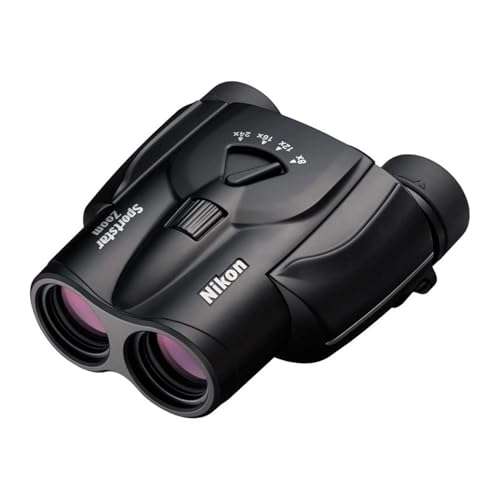
Nikon Sportstar Zoom 8-24x25
- Objective
- 25 mm
- Binoculars
Nikon ACULON T02 8x21
- Objective
- 21 mm
- Magnification
- 8 x
- Binoculars
Nikon LaserForce 10x42
- Objective
- 42 mm
- Magnification
- 10 x
- Binoculars
Nikon Monarch M7 8x42
- Objective
- 42 mm
- Magnification
- 8 x
- Field of view
- 435 ft@1000yd
- Binoculars
Nikon Monarch M5 8x42
- Objective
- 42 mm
- Magnification
- 8 x
- Binoculars
Nikon Monarch M7 10x30 Bundle
- Objective
- 30 mm
- Magnification
- 10 x
- Field of view
- 351 ft@1000yd
- Binoculars
Nikon Monarch M5 12x42 Bundle
- Objective
- 42 mm
- Magnification
- 12 x
- Field of view
- 267 ft@1000yd
- Binoculars
Nikon PROSTAFF P7 8x42
- Objective
- 42 mm
- Magnification
- 8 x
- Field of view
- 377 ft@1000yd
- Binoculars
Nikon PROSTAFF P3 10x30
- Objective
- 30 mm
- Magnification
- 10 x
- Binoculars
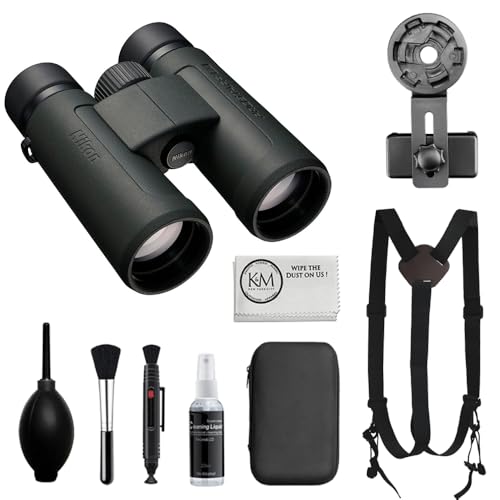
Nikon PROSTAFF P3 8x42 Bundle
- Objective
- 42 mm
- Magnification
- 8 x
- Binoculars
Nikon PROSTAFF P3 8x30 Bundle
- Objective
- 30 mm
- Magnification
- 8 x
- Eye relief
- 15.4 mm
- Binoculars
Nikon PROSTAFF P7 8x30 Kit
- Objective
- 30 mm
- Magnification
- 8 x
- Binoculars
Nikon Monarch M5 10x42 Bundle
- Objective
- 42 mm
- Magnification
- 10 x
- Binoculars
Nikon Monarch M5 8x42 Bundle
- Objective
- 42 mm
- Magnification
- 8 x
- Field of view
- 335 ft@1000yd
- Binoculars
Nikon PROSTAFF P3 8x42 Bundle
- Objective
- 42 mm
- Magnification
- 8 x
- Field of view
- 377 ft@1000yd
- Binoculars
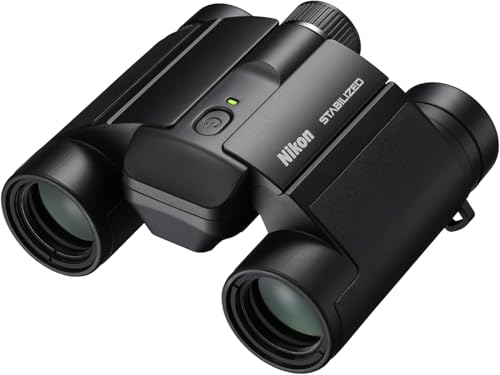
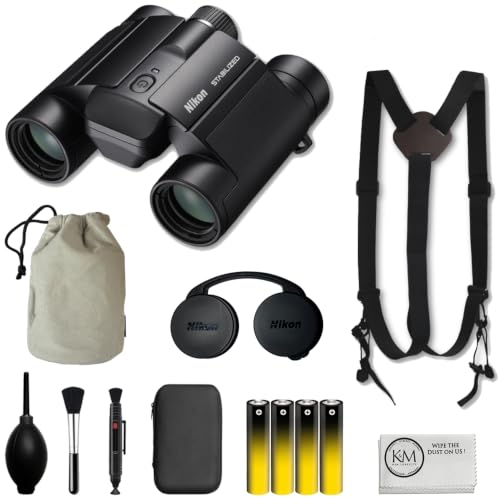
Nikon Stabilized 12x25
- Objective
- 25 mm
- Magnification
- 12 x
- Binoculars
Nikon 10x25 S Stabilized
- Objective
- 25 mm
- Magnification
- 10 x
- Binoculars
Nikon PROSTAFF P7 10x42 Bundle
- Objective
- 42 mm
- Magnification
- 10 x
- Binoculars
Nikon PROSTAFF P3 10x42 Bundle
- Objective
- 42 mm
- Magnification
- 10 x
- Field of view
- 367 ft@1000yd
- Binoculars
Nikon Action Zoom 10-22x50
- Objective
- 50 mm
- Binoculars
Nikon Action 10x42
- Objective
- 42 mm
- Magnification
- 10 x
- Binoculars
Nikon Action 10x50
- Objective
- 50 mm
- Magnification
- 10 x
- Binoculars
Nikon Action 8x42
- Objective
- 42 mm
- Magnification
- 8 x
- Binoculars
Nikon Action 12x50
- Objective
- 50 mm
- Magnification
- 12 x
- Binoculars
Nikon Trailblazer II 10x25
- Objective
- 25 mm
- Magnification
- 10 x
- Binoculars
Nikon Trailblazer II 8x25
- Objective
- 25 mm
- Magnification
- 8 x
- Binoculars
Nikon PROSTAFF P7 12x50
- Objective
- 50 mm
- Magnification
- 12 x
- Binoculars
Nikon PROSTAFF P7 10x50 Bundle
- Objective
- 50 mm
- Magnification
- 10 x
- Field of view
- 367 ft@1000yd
- Binoculars
Nikon PROSTAFF P7 8x30 Bundle
- Objective
- 30 mm
- Magnification
- 8 x
- Field of view
- 456 ft@1000yd
- Binoculars
Nikon PROSTAFF P7 8x30 Bundle
- Objective
- 30 mm
- Magnification
- 8 x
- Field of view
- 456 ft@1000yd
- Binoculars
Nikon Monarch M5 10x42 Bundle
- Objective
- 42 mm
- Magnification
- 10 x
- Binoculars
Nikon Monarch M7 8x30 Bundle
- Objective
- 30 mm
- Magnification
- 8 x
- Binoculars
Nikon Monarch 5 20x56 Bundle
- Objective
- 56 mm
- Magnification
- 20 x
- Binoculars
Nikon Aculon T02 10x21 Bundle
- Objective
- 21 mm
- Magnification
- 10 x
- Binoculars
Nikon Monarch HG 8x30 Bundle
- Objective
- 30 mm
- Magnification
- 8 x
- Rangefinder
Nikon PROSTAFF 1000i 6x20
- Size
- 3.6 x 2.9 x 1.5
- Max range (reflective)
- 1,000 yd
- Magnification
- 6 x
- Rangefinder
Nikon Forestry Pro II 16703
- Max range (reflective)
- 1,750 yd
- Rangefinder
Nikon Forestry Pro II 6x21
- Max range (reflective)
- 1,750 yd
- Magnification
- 6 x
- Angle compensation
- Yes
- Rangefinder
Nikon Laser 30
- Max range (reflective)
- 1,600 yd
- Magnification
- 6 x
- Angle compensation
- Yes
- Rangefinder
Nikon Laser 50
- Max range (reflective)
- 2,000 yd
- Magnification
- 6 x
- Angle compensation
- Yes
- Rangefinder
Nikon Laser 50 16754 Bundle
- Max range (reflective)
- 2,000 yd
- Magnification
- 6 x
- Angle compensation
- Yes
- Rangefinder
Nikon PROSTAFF 1000 6x20 Bundle
- Max range (reflective)
- 1,000 yd
- Magnification
- 6 x
- Bino harness
Nikon PROSTAFF 6121 Bino Harness
- Style
- Strap only











What Nikon makes for hunters
On this site, Nikon covers three product types: laser rangefinders, binoculars and a binocular harness. The binoculars are the biggest group, and one of them, the LaserForce, has a rangefinder built in. Nikon also makes cameras and lenses, and this site doesn't list those.
Here's how the lineup splits:
- Hunting rangefinders: PROSTAFF 1000 and 1000i, LASER 30, LASER 50
- A forestry rangefinder: Forestry Pro II, which also measures tree height
- Rangefinder binocular: LaserForce 10x42
- Full-size binoculars: Monarch HG, M7, M5 and Monarch 5, PROSTAFF P7 and P3, Action
- Compact and travel binoculars: ACULON, Trailblazer II, Travelite, Sportstar Zoom
- Stabilized binoculars: 10x25 S and 12x25
- Harness: the PROSTAFF bino harness
The grid above filters by type and changes as listings come and go, so I'll write about the series and what separates them, not about how many of each are up this week. Most grid values come from Amazon listings and are marked. The series facts below come from Nikon's own pages and announcements.
Nikon rangefinder lineup
A laser rangefinder reads the distance, in yards, to whatever you aim it at. Every hunting model in this grid is listed at 6x magnification.
PROSTAFF 1000 and PROSTAFF 1000i
The PROSTAFF 1000 is the compact one. Nikon's 2019 announcement lists 6 to 1,000 yards on reflective targets, 800 yards on trees and 600 yards on deer. It has two target modes:
- First Target Priority: shows the closest object, for a deer standing in front of a background
- Distant Target Priority: shows the farthest, for ranging past branches in the woods
Nikon lists it as rainproof to an IPX4-equivalent standard, about 4.6 oz without the battery, running on one CR2 lithium cell. Readings come in 1-yard steps, and holding the button gives continuous readings for about 8 seconds.
The PROSTAFF 1000i's listing adds angle compensation. Its listing names Nikon's ID (incline/decline) technology, which shows a distance adjusted for uphill and downhill shots. Its listing gives the body as about 3.6 by 2.9 by 1.5 inches.
LASER 30 and LASER 50
These are the step-up hunting rangefinders. Per Nikon's 2020 announcement:
- LASER 30: 8 to 1,600 yards
- LASER 50: 10 to 2,000 yards, magnesium alloy body
- Both: red OLED display with automatic brightness, results in about 0.3 seconds (Nikon calls it HYPER READ), waterproof to 1 meter for 10 minutes and fogproof
Both also have four display modes: horizontal distance and angle, actual distance and angle, horizontal distance and height, and actual distance and height. Nikon's LASER 50 page lists 1,100 yards on deer and angle compensation. The LASER 30 listing marks a CR2 battery.
Quick math on why the numbers look silly for bowhunting: a 2,000-yard rangefinder and a 1,000-yard one both read 27 yards to the same doe. The extra reach is for far fields and long glassing. It doesn't change your bow shot.
Forestry Pro II
The Forestry Pro II is a surveying tool. Nikon's 2019 announcement calls it a laser rangefinder and hypsometer (a tree-height meter) with an 8-to-1,750-yard range. It measures actual and horizontal distance, height, angle and vertical separation, plus a three-point height reading between two points. It has an internal display and a backlit external display, and it stores up to 250 readings.
For hunting, it ranges like any other unit, and its listing marks angle compensation. You're paying for the forestry functions, though. If you don't measure trees for work, the hunting models above cover the job.
LaserForce rangefinder binocular
The LaserForce 10x42 puts a rangefinder inside a full-size binocular. Its listing gives 1,900 yards of range with angle compensation. Deer & Deer Hunting's 2017 write-up describes ED glass, multilayer-coated lenses and prisms, an OLED display with four brightness steps, readings in 0.1-yard steps to 100 yards, and a nitrogen-purged, rubber-armored body. One tool instead of two in the pocket. The rangefinder binoculars page compares the type.
Nikon hunting binoculars by series
The two numbers on a binocular mean the same thing everywhere. Nikon's own explainer puts it simply: in 8x42, the 8 means the subject looks 8 times closer, and 42 is the front lens width in millimeters. A bigger front lens gathers more light and adds weight.
Monarch binoculars: M7, M5, HG and Monarch 5
The Monarch series is where Nikon puts ED glass, which it says reduces color fringing. Per Nikon's 2021 announcement:
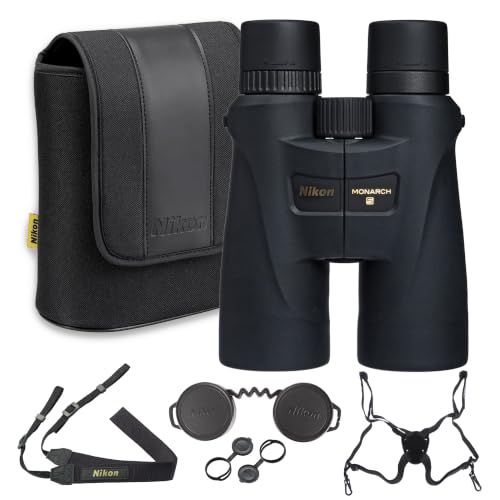
- Monarch M7: 8x30, 10x30, 8x42 and 10x42, ED glass, oil- and water-repellent lens coating, a locking diopter, and a wide view (435 ft at 1,000 yards on the 8x models)
- Monarch M5: 8x42, 10x42 and 12x42, ED glass, dielectric and phase-correction prism coatings, and long eye relief (the 8x42 lists 19.5 mm)
Both are listed as waterproof to 1 meter for 10 minutes and nitrogen-filled against fogging. The M7 has the wider field of view. The M5 has more eye relief, which helps if you wear glasses.
The grid also lists the Monarch HG in 8x42 and 8x30 and a Monarch 5 in 20x56. Their values come from the listings. A 20x56 is a binocular for a tripod, not for a neck strap.
PROSTAFF P7 and P3 binoculars
The PROSTAFF series sits below the Monarch. Nikon's 2022 announcement lays out the difference:
- PROSTAFF P7: roof prisms with dielectric high-reflective coatings and phase correction, oil- and water-repellent lens coating, and a locking diopter
- PROSTAFF P3: roof prisms with silver-alloy mirror coatings and multilayer-coated lenses
Both have fiberglass-reinforced polycarbonate bodies with rubber armor, lead- and arsenic-free glass, and the same waterproof and fogproof rating as the Monarchs. The grid lists the P7 in 8x30, 8x42, 10x42 and two 50 mm sizes, and the P3 in 8x30, 10x30, 8x42 and 10x42. Several are bundles with a harness or a lens pen. The bundle doesn't change the binocular.
Action and Action Zoom
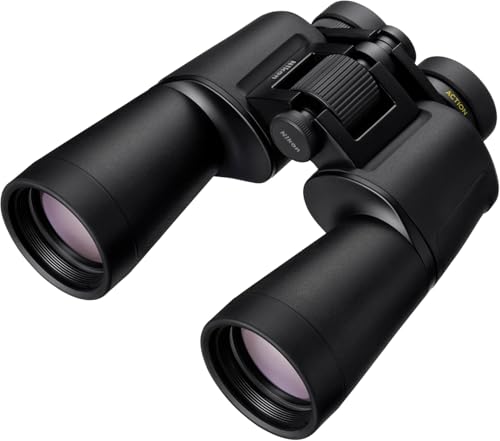
The Action series is Nikon's newest Porro-prism line. Nikon's 2026 announcement says it replaces the ACULON A211, with an aluminum alloy body under rubber armor and multilayer-coated lenses. The grid lists the 8x42, 10x42, 10x50, 12x50 and the 10-22x50 zoom.
Nikon's explainer says Porro models generally give a wider field and a more three-dimensional view, but they're bulkier. Think of a roof prism as a stick of butter and a Porro as the butter dish. Same butter, different shape in the bag.
Compact, travel and stabilized binoculars
The ACULON A30 and T02, Trailblazer II, Travelite EX and Sportstar Zoom are small binoculars with 21 mm or 25 mm front lenses, per their listings. They're for a coat pocket, a truck console or a kid's first pair.
The STABILIZED 10x25 S and 12x25 S are different. Nikon says its stabilization reduces hand shake by about 80%, running on two AA batteries for about 12 hours. Nikon also lists them as non-waterproof. That matters in a November drizzle, so keep them in the truck when it rains.
How to choose within the Nikon lineup
Pick 8x for the woods, 10x for fields
My one opinion on this page: for whitetails in Pennsylvania-style hardwoods, start with an 8x binocular. The reason is in Nikon's own numbers. The Monarch M7 8x42 shows 435 feet at 1,000 yards, and the 10x42 shows 362. In thick cover, you need to find the deer before you need it bigger. Nikon's explainer says the same thing in general terms: higher magnification narrows the field of view. Glassing big fields or a far ridge is where 10x and 12x pull ahead. The hunting binoculars page covers this across brands.
Then pick the front lens
A 42 mm lens is the common hunting size. Nikon's explainer suggests 8x42 or 10x42 for low light and 8x30 for compact travel. A 30 mm Monarch M7 or PROSTAFF is a fair middle ground if you carry it all day on a stand.
For a rangefinder: angle first, then range
If you hunt from a tree stand or a hillside, look for angle compensation. The PROSTAFF 1000i, LASER 30, LASER 50, Forestry Pro II and LaserForce listings all mark it. Then pick the range you'd use for anything else you do (rifle season, scouting the far edge of a field). For bow distances, every model in the grid is plenty. The hunting rangefinder page compares across brands.
Then decide one tool or two
A separate rangefinder plus a binocular means two things to carry and two things to grab at the wrong moment. The LaserForce puts both in one body. It's also one full-size binocular you have to lift for every reading. Neither is wrong. It depends on whether your hands are already full.
Setup and care notes
Set the diopter once
Nikon's setup steps are short. Cover the right lens and focus with the center wheel using your left eye. Then cover the left lens and turn the diopter until your right eye sees the same subject sharply. Don't touch the diopter again unless someone else borrows them. If you wear glasses, twist the eyecups down. If you don't, twist them up. On the M7 and P7, lock the diopter ring once it's set.
(Walt borrows my binoculars, turns the diopter, and hands them back as "fixed". This is why I like a locking ring.)
Carry them so they don't bounce
A binocular on a neck strap swings into everything when you climb or draw. A chest harness holds it flat. The PROSTAFF bino harness in the grid is a strap-only harness, per its listing. The binocular harness page covers the styles.
Clean the glass gently
The Monarch M7 and PROSTAFF P7 have an oil- and water-repellent coating on the outer lenses, which Nikon says makes smudges easier to wipe off. Blow off grit before you wipe anything. A lens pen comes in several of the bundles in the grid.
Warranty basics
Nikon's US warranty card for binoculars, rangefinding binoculars and fieldscopes lists a lifetime limited warranty on optical system parts, seven years on non-optical parts and one year on electronic parts. It's for the original buyer from a Nikon authorized dealer, it needs the purchase receipt, and batteries aren't covered. Damage from misuse, accidents or unauthorized repair isn't covered either. Rangefinders carry their own terms on Nikon's site.
Who's behind Nikon sport optics
Nikon's binoculars and rangefinders are announced by Nikon Vision Co., Ltd., a subsidiary of Nikon Corporation, per Nikon's global announcements. In the US, Nikon Inc., based in Melville, New York, distributes Nikon sport optics along with Nikon cameras, lenses and accessories, according to its press releases.
Job, then series, then numbers. Everything after that is a strap, a case and a lens pen.
Where Nikon shows up
Questions about Nikon
Is a Nikon rangefinder good for bow hunting?
What the specs show is checkable. The PROSTAFF 1000i, LASER 30, LASER 50 and Forestry Pro II listings mark angle compensation, which matters for shots from a stand. Nikon's PROSTAFF 1000 announcement describes a first-target mode for a deer in front of brush. Whether one suits you depends on your shot distances and whether you hunt from height.
What is the difference between the Nikon PROSTAFF 1000 and 1000i?
Both are 6x laser rangefinders listed to 1,000 yards. The 1000i's listing marks angle compensation, and its listing names Nikon's ID (incline/decline) technology, which gives a distance adjusted for uphill or downhill shots. Nikon's PROSTAFF 1000 announcement describes first and distant target modes and an IPX4-equivalent rainproof rating.
Nikon Monarch or PROSTAFF binoculars: what's the difference?
Nikon's announcements give the difference. The Monarch M5 and M7 use ED glass, which reduces color fringing, and phase-correction-coated roof prisms. The PROSTAFF P7 uses dielectric prism coatings and a locking diopter, and the P3 uses silver-alloy prism coatings. All four are listed as waterproof to 1 meter for 10 minutes and fogproof.
Are Nikon hunting binoculars waterproof?
Many are, per the maker. Nikon lists the Monarch M5, Monarch M7, PROSTAFF P7 and PROSTAFF P3 as waterproof to 1 meter for 10 minutes and fogproof, not made for underwater use. The STABILIZED 10x25 S and 12x25 S are listed as non-waterproof. Check the exact model's listing.
What warranty do Nikon binoculars have?
Nikon's US warranty card for binoculars, rangefinding binoculars and fieldscopes lists a lifetime limited warranty on optical system parts, seven years on non-optical parts and one year on electronics, for the original buyer from a Nikon authorized dealer. Batteries aren't covered. Keep the receipt, since a claim needs it.
Sources
- Nikon: Nikon introduces the PROSTAFF 1000 laser rangefinder (2019) — accessed 2026-10-28
- Nikon USA: Nikon announces new LASER 50 and LASER 30 multi-purpose laser rangefinders (2020) — accessed 2026-10-28
- Nikon USA: LASER 50 laser rangefinder — accessed 2026-10-28
- Nikon: Nikon introduces the Forestry Pro II laser rangefinder (2019) — accessed 2026-10-28
- Deer & Deer Hunting: Hot gear, spotlight shines on new Nikon LaserForce (2017) — accessed 2026-10-28
- Nikon USA: MONARCH M5 and M7 binoculars announcement (2021) — accessed 2026-10-28
- Nikon USA: MONARCH M7 binoculars — accessed 2026-10-28
- Nikon USA: PROSTAFF P7 and P3 binoculars announcement (2022) — accessed 2026-10-28
- Nikon USA: ACTION and ACTION ZOOM binoculars announcement (2026) — accessed 2026-10-28
- Nikon USA: STABILIZED binocular series announcement (2024) — accessed 2026-10-28
- Nikon USA: How to choose the right binoculars for you — accessed 2026-10-28
- Nikon USA: Adjusting binoculars to set up properly — accessed 2026-10-28
- Nikon USA: Binocular, rangefinding binocular and fieldscope lifetime limited warranty — accessed 2026-10-28