Brand · Trail Cameras & Optics
SIG Sauer Rangefinders and Binoculars
SIG rangefinders are the KILO and Buckmasters handheld units, plus rangefinding binoculars (the Canyon and the bigger KILO models); around them sit plain and image-stabilized Zulu binoculars and one thermal unit. The short version: the number in a KILO name is roughly its maximum range in yards on a reflective target, and for a bowhunter it's the least useful number on the box. Read the archery mode and the target mode first. (Uncle Walt thinks KILO is a weight class. He's been asked not to bring it up at dinner.)
We earn a commission if you buy through our links, at no cost to you. Disclosure
Sig Sauer on Amazon US
23 models- Binoculars
Sig Sauer KILO6K HDX 10x42
- Objective
- 42 mm
- Magnification
- 10 x
- Binoculars
Sig Sauer Buckmasters 10x42
- Objective
- 42 mm
- Magnification
- 10 x
- Binoculars
Sig Sauer Zulu6 HDX OIS 16x42
- Objective
- 42 mm
- Magnification
- 16 x
- Binoculars
Sig Sauer Zulu10 HDX 10x42
- Objective
- 42 mm
- Magnification
- 10 x
- Binoculars
Sig Sauer Canyon 10x42 Rangefinding
- Objective
- 42 mm
- Magnification
- 10 x
- Binoculars
Sig Sauer Zulu8 HDX 10x42
- Objective
- 42 mm
- Magnification
- 10 x
- Binoculars
Sig Sauer Canyon HD 10x42
- Objective
- 42 mm
- Magnification
- 10 x
- Binoculars
Sig Sauer KILO10K-ABS HD Gen II
Check price - Binoculars
Sig Sauer Zulu6 HDX PRO 18x50
- Objective
- 50 mm
- Magnification
- 18 x
- Binoculars
Sig Sauer Kilo Canyon Black Edition 10x42
- Objective
- 42 mm
- Magnification
- 10 x
- Binoculars
Sig Sauer Zulu4 HD 10x42
- Objective
- 42 mm
- Magnification
- 10 x
- Binoculars
Sig Sauer Zulu6 HDX PRO 18x50 Marine
- Objective
- 50 mm
- Magnification
- 18 x
- Binoculars
Sig Sauer Zulu6 HDX 10x30 Marine
- Objective
- 30 mm
- Magnification
- 10 x
- Binoculars
Sig Sauer Zulu6 HDX PRO 14x42
- Objective
- 42 mm
- Magnification
- 14 x
- Rangefinder
Sig Sauer Buckmasters 1500
- Magnification
- 6 x
- Rangefinder
Sig Sauer Kilo Canyon 6x22
- Max range (reflective)
- 3,000 yd
- Magnification
- 6 x
- Rangefinder
Sig Sauer KILO8K-ABS 7x25
- Max range (reflective)
- 8,000 yd
- Magnification
- 7 x
- Rangefinder
Sig Sauer KILO5K 7x25
- Max range (reflective)
- 5,000 yd
- Magnification
- 7 x
- Rangefinder
Sig Sauer Buckmasters 1800
- Max range (reflective)
- 1,800 yd
- Magnification
- 6 x
- Rangefinder
Sig Sauer KILO4K 6x22
- Max range (reflective)
- 4,000 yd
- Magnification
- 6 x
- Rangefinder
Sig Sauer KILO3K 6x22
- Magnification
- 6 x
- Rangefinder
Sig Sauer Kilo2200 6x22
- Magnification
- 6 x
- Thermal binoculars
Sig Sauer Echo MV50-LRF
- Thermal sensor
- 640x512
- Pixel pitch
- 12 um
- Magnification
- 3-24




What SIG Sauer makes for hunters
On this site, SIG Sauer covers three kinds of optics:
- Handheld laser rangefinders: the KILO line and the Buckmasters line
- Binoculars: plain roof-prism binoculars, image-stabilized Zulu6 models and rangefinding binoculars
- One thermal binocular: the Echo MV50-LRF
The grid above shows the SIG listings available on Amazon right now, with filters by type. It changes as listings come and go, so I'll write about the lines and what separates them, not about how many of each are listed this week.
SIG Sauer also makes firearms and riflescopes; this site doesn't list them. Several SIG rangefinders carry ballistic features (BDX or ABS in the name) built for long-range shooting; this page covers those units only as rangefinders.
How to read a SIG rangefinder name
Here's what actually changes from one name to the next. Most KILO names carry a number: 2200, 3K, 4K, 5K, 8K. On the listings in the grid, that number lines up with the maximum range in yards: the KILO4K listing gives 4,000, the KILO5K 5,000 and the KILO8K-ABS 8,000.
That maximum is measured on a reflective target. The KILO3K manual lists three numbers for the same unit: up to 3,000 yards on reflective targets, 1,800 on trees and 1,500 on deer. A deer is a worse mirror than a road sign. (It's also less patient.)
The second part of the name is the optic size. Most handheld SIG units are 6x22 (6x magnification, 22 mm lens); the KILO5K and KILO8K-ABS are 7x25.
For a bowhunter, every one of these reaches far past any shot you'll take. The features that matter at bow range sit lower on the spec sheet.
Lineup notes: SIG Sauer rangefinders
The KILO handheld line
The KILO handheld units in the grid run from the KILO2200 and KILO3K through the KILO4K and KILO5K to the KILO8K-ABS, plus a Kilo Canyon 6x22 whose listing gives 3,000 yards.
The KILO3K manual is the clearest picture of what a mid-line KILO does. Per SIG:
- Five range modes: line of sight (LOS), angle modified range (AMR), archery, and two ballistic modes
- Five target modes: First, Best, Last, Extended Range and Fog
- Accuracy: ±1 yard out to 500 yards; range shown to 0.1 yard
- Scan: 4 range updates per second when you hold the button
- Display: a transparent OLED that adjusts its own brightness to the light
- Power: one CR2 lithium battery
The KILO3K listing marks a bow mode and a red OLED display. Bow mode on other KILO listings varies, so read the listing for the unit you're looking at.
Buckmasters rangefinders
SIG also makes a Buckmasters-branded line. The Buckmasters 1500 and 1800 listings give 6x magnification and a red LED display; the 1800 listing gives an 1,800-yard maximum. The listings don't name an archery mode, so if bow mode matters to you, confirm it in the listing before you order.
Archery mode, in the maker's own example
The KILO3K manual explains archery mode with a worked example, and it's worth reading. You enter your arrow speed in fps (feet per second). On a 60-yard line-of-sight shot at a 40-degree angle with a 250 fps arrow, plain AMR (the flat-ground distance) reads 46.0 yards. Archery mode returns 47.4 yards, because an arrow drops more than the simple triangle assumes. SIG says aiming for 46.0 would have hit about 6 inches low.
Quick math: that's 1.4 yards of difference at a steep angle. On flat ground, the gap disappears. From a tree stand at 20 yards, it's small. Past 200 yards, SIG says the unit stops doing arrow math and returns AMR, which is fair; no arrow is going there.
Lineup notes: SIG rangefinding binoculars
Canyon rangefinding binoculars
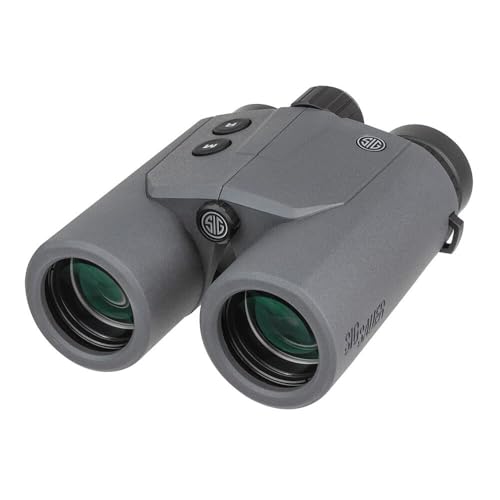
The Canyon 10x42 manual lists the most complete set of numbers in SIG's binocular lineup:
- Range: up to 4,000 yards on reflective targets, 2,000 on trees, 1,500 on deer
- Exit pupil: 4.2 mm; eye relief 14.7 mm
- Weight: 26.7 oz without the battery
- Archery mode: arrow speed from 200 to 350 fps, in 5 fps steps
- Two diopters: one for the display, one for the view
The Canyon ships set to AMR mode with Last target selected, per the manual. The grid carries the Canyon 10x42 Rangefinding and a Kilo Canyon Black Edition 10x42; both listings give a 4,000-yard maximum.
KILO6K HDX and KILO10K-ABS
The bigger KILO binoculars sit above the Canyon. The KILO6K HDX 10x42 listing gives a 6,000-yard maximum and marks angle compensation. The KILO10K-ABS HD Gen II listing gives 10,000 yards. Both carry the ballistic features described above, which this page doesn't cover. As binoculars with a rangefinder built in, they do the same job as the Canyon, with more reach than any bow needs.
The rangefinder binoculars page compares rangefinding binoculars across brands.
Lineup notes: SIG binoculars
Buckmasters and Zulu roof-prism binoculars
The plain binoculars in the grid are all 10x42: the Buckmasters, the Canyon HD, the Zulu4 HD, the Zulu8 HDX and the Zulu10 HDX. Their listings give little beyond the size and, on some, a roof prism.
The Buckmasters 10x42 manual gives a full spec sheet: 315 ft of view at 1,000 yards, a 4.2 mm exit pupil, 15 mm eye relief and close focus at 8.2 ft. SIG lists BAK-4 prisms, a closed bridge, a tripod mount and an IPX-7 rating, which the manual defines as protection against immersion for 30 minutes at up to 1 meter. A binocular harness strap comes in the box, per the manual.
Zulu6 image-stabilized binoculars
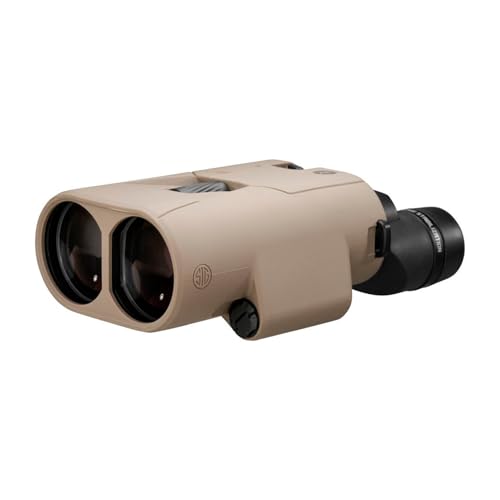
The Zulu6 models are the unusual ones. They use battery-powered optical image stabilization, which SIG says electronically cancels out shaking and vibration. The Zulu6 HDX quick guide describes two modes: Scan mode for working over terrain, and Target mode, which SIG says adds up to 50 percent more stability once you've found something. The binoculars shut off on their own after 10 minutes to save the battery.
The Zulu6 HDX PRO guide describes the next step, which SIG calls OmniScan: a digital accelerometer that reads your movement and sets the level of stabilization by itself. The PRO 50 mm models take two batteries.
The grid carries Zulu6 models from a 10x30 Marine to 14x42, 16x42 and 18x50 sizes, including an 18x50 Marine. Here's the thing about stabilization: it's what makes 14x to 18x usable in your hands. Without it, at 18x, your pulse is part of the picture. (Nobody's pulse holds still. Mine included.)
Sizes across brands are on the hunting binoculars page.
The Echo MV50-LRF thermal binocular
The Echo MV50-LRF is a thermal binocular with a laser rangefinder. Its listing gives a 50 mm lens, 3-24x magnification, a 640x512 thermal sensor, 12-micron pixel pitch, ranging to 1,000 yards and recording. This site doesn't have a thermal optics page, so the listing is the full story here. Rules on using thermal optics while hunting vary by state; check your state wildlife agency.
How to choose within the SIG lineup
Set the target mode to Last for the woods
My one opinion on this page: in the eastern woods, set the target mode to Last and leave it. The reason is in SIG's own manuals. The KILO3K manual says Best works for most situations but recommends Last when hunting through foliage or high grass. The Canyon manual calls Last ideal for ranging through foliage. Last returns the farthest thing the laser hits, which is the deer behind the branch instead of the branch.
Then check archery mode
If you hunt from a tree stand or in steep country, look for an archery mode that takes arrow speed. The KILO3K and Canyon manuals both describe one. You'll need your real arrow speed in fps, so chronograph your setup or use the speed your shop measured.
Then pick one device or two
- Handheld rangefinder: small, light, rides in a pocket
- Rangefinding binocular: one device on the chest, heavier
- Binocular plus handheld: two devices, more flexibility
The hunting rangefinder page covers bow-mode rangefinders across brands, and a chest harness for either is on the binocular harness page.
Batteries, care and setup
SIG's rangefinders and the Canyon run on CR2 lithium batteries. The KILO3K manual says most rangefinders give over 4,000 readings on a fresh CR2 and that the KILO exceeds that, but heavy scan use drains it faster. SIG suggests a spare CR2 for remote trips. The KILO3K also has a Battery Saver setting that caps readings at 2,000 yards and, per SIG, doubles the runtime.
The Buckmasters manual's cleaning steps apply to any glass:
- Wipe the armored body to clean it
- Clean lenses only when needed
- Use a lens brush or blower first
- Never wipe the lenses with a cloth
- Put alcohol, glass cleaner or pure water on a cotton swab, not on the lens
For setup, SIG's binocular guides give the same order: set the eye distance until you see one circle, then focus your left eye with the center wheel on something about 100 yards away, then your right eye with the diopter ring.
SIG Sauer optics warranty
SIG's manuals describe an Infinite Guarantee on its electro-optics: unlimited lifetime, fully transferable, no warranty card or receipt, no charge. It excludes intentional damage, misuse, cosmetic damage that doesn't affect performance, loss, theft and unauthorized repair. It also excludes electronic components. Those carry a separate limited five-year warranty from the date of manufacture.
For a claim, SIG asks you to get a return merchandise authorization (RMA) number from customer service first. Per the manual, the guarantee applies to commercial (civilian) customers; buyers outside the US need to buy through an authorized SIG dealer in their own country.
Target mode on Last, arrow speed in the archery menu, a spare CR2 in the pack. That's the setup; the big number on the box can stay on the box.
Where Sig Sauer shows up
Often compared
Questions about Sig Sauer
Is a SIG rangefinder good for bowhunting?
What the maker states is checkable: SIG's KILO3K and Canyon manuals describe an archery mode that takes your arrow speed in fps and returns a flat-ground shoot-to distance for steep up or down shots. The Canyon takes arrow speeds from 200 to 350 fps in 5 fps steps. Check each listing in the grid for bow mode.
What is a SIG Sauer rangefinder binocular?
It's a binocular with a laser rangefinder built in, so you glass and range with one device. SIG's Canyon 10x42 manual lists ranging up to 4,000 yards on reflective targets, 2,000 on trees and 1,500 on deer, an archery mode and a weight of 26.7 ounces without the battery. The grid also carries KILO6K HDX and KILO10K-ABS models.
Is the SIG KILO2400ABS on this page?
No. The KILO2400ABS isn't among the SIG listings this site carries right now, so the grid has no specs for it. The SIG handheld rangefinders listed here run from the Buckmasters 1500 and KILO2200 up to the KILO8K-ABS; compare magnification, display and bow mode in the grid.
Is the SIG KILO1400BDX on this page?
No. The KILO1400BDX isn't among the SIG listings carried here, so there are no specs for it on this page. For a compact 6x22 SIG with an archery mode in its manual, the KILO3K is in the grid. The hunting rangefinder page compares bow-mode units across brands.
What warranty do SIG Sauer rangefinders have?
SIG's manuals describe an Infinite Guarantee on its electro-optics: lifetime, transferable, no warranty card or receipt required, excluding intentional damage, misuse, loss and theft. Electronic components are excluded from it and carry a separate limited five-year warranty from the date of manufacture. Claims need a return authorization number from SIG customer service first.
Sources
- SIG SAUER: KILO3K 6x22 mm laser rangefinder operator's manual — accessed 2026-10-28
- SIG SAUER: Canyon 10x42 mm rangefinding binocular owner's manual — accessed 2026-10-28
- SIG SAUER: Buckmasters 10x42 mm binoculars operator's manual — accessed 2026-10-28
- SIG SAUER: Zulu6 HDX image stabilized binocular quick reference guide — accessed 2026-10-28
- SIG SAUER: Zulu6 HDX PRO image stabilized binocular quick reference guide — accessed 2026-10-28