What Moultrie makes for deer hunters
On this site, Moultrie covers one product type: trail cameras. Nearly all of them are Moultrie Mobile cellular cameras from the Edge family, which send photos through a phone app. One is a plain SD-card camera, the A900, sold as a bundle with batteries and a card. The grid above filters by type and changes as listings come and go, so I'll write about the lines and what separates them, not about how many of each are up this week.
This site lists only Moultrie's trail cameras. Any other Moultrie gear isn't in the grid and isn't covered on this page.
All the camera specs in the grid come from Amazon listings, and the grid marks them that way. Where a listing doesn't state a value, the grid shows a dash.
What "Moultrie Mobile" means on a listing
Moultrie Mobile is the cellular side of the brand: the Edge cameras and the app they report to. Deer & Deer Hunting describes the Edge's auto-connect as linking the camera to the strongest cell signal in the area. The Edge listings in the grid back that up in their own words: "multi-carrier," "4-carrier auto-connect," or, on the Edge Pro, "all four major US networks." Several listings also say the camera keeps photos in built-in memory and cloud storage instead of on a card.
Here's what actually changes for you. With an SD-card camera, you walk in, swap the card and walk out. With a cellular camera, the photos come to your phone and you stay out of the woods. Cellular cameras send photos over a data plan, and the listings in the grid don't state plan terms. Read those on Moultrie's own pages before you buy two.
Lineup notes: the Moultrie Edge cameras by generation
The Edge family in the grid runs from the original Edge to the Edge 4. Model names carry the generation and a suffix, and the grid's values follow a clear pattern. Quick math on the naming: generation number for the sensor and video, suffix for the special feature.
Original Edge: 33 megapixels, the base model
The original Edge listings state 33 megapixel photos, 720p video, an 80-ft flash range and multi-carrier connection. They sell as single cameras and as 2-packs and 3-packs. The listing titles mention built-in memory and cloud storage.
The Edge PowerMag is the same 33 megapixel camera with a different power plan: its listing names a 3350 mAh PowerMag lithium-ion battery pack instead of a tray of AAs. That's the whole difference on paper, and it's a real one if your camera hangs a long walk from the truck.
Edge Pro: 36 megapixels and 1080p
The Edge Pro listings step up to 36 megapixel photos and 1080p video, and they name all four major US networks. The titles also mention false trigger elimination, and the 2-pack listing states live view.
Edge 2 and Edge 2 Pro: low-glow and no-glow
The Edge 2 listings state 36 megapixels, 1080p video and a low-glow flash with a 100-ft range. One Edge 2 listing comes bundled with a Code Blue Scrape Mate, per its title. Its trigger speed is stated at 0.4 second.
The Edge 2 Pro listing moves to 40 megapixels and 1440p (2K) video, with a no-glow flash and AI detection in the title, plus live view. It sells as a 2-pack.
Edge 3, Edge 3 Pro and Edge Solar
The Edge 3 here comes as a Solar Power Pack: 40 megapixels, 1080p, a low-glow flash and a separate 3.4-watt solar panel, per the title. Its stated trigger speed is 0.5 second.
The Edge 3 Pro sits at the top of the grid on paper: 50 megapixels, 1440p video, a 0.3-second trigger, a no-glow flash, and GPS and AI detection in the title.
The Edge Solar cameras (one in standard finish, one in Mossy Oak camo) put the panel on the camera itself. Their listings state integrated solar, 40 megapixels, 1080p, a low-glow flash and a removable lithium-ion battery.
Edge 4 and Edge 4 Solar
The newest generation in the grid. The Edge 4 listing states 40 megapixels, 1080p video, a 0.4-second trigger, a 100-ft low-glow flash and live view, with GPS and AI detection in the title. The Edge 4 Solar adds integrated solar and a removable lithium-ion battery. Its listing states live view too.
The Moultrie A900: an SD-card camera
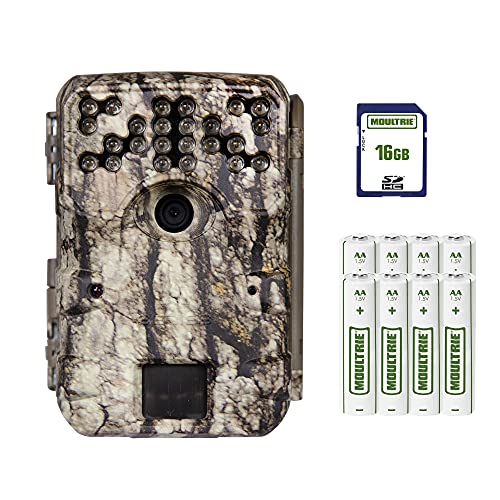
The A900 is the odd one out, and that's useful to know. It has no cellular connection. Its bundle listing states 30 megapixels, a 0.4-second trigger, a 70-ft flash range and 8 AA batteries, and the title says the bundle includes batteries and an SD card. If your stand sits in a cell dead zone, this is the Moultrie that doesn't care. The general case for card cameras is on the trail camera page.
How to choose within the Moultrie lineup
Pick the power plan first
My one opinion on this page: decide how you'll power the camera before you compare megapixels. The reason is cold. Outdoor Life notes that standard alkaline batteries fail when temperatures drop below freezing, while lithium batteries hold their voltage in the cold and last longer. A camera with dead batteries in December takes zero megapixel photos.
The Moultrie grid gives you three answers:
- AA trays: the original Edge, Edge Pro, Edge 2 and the A900
- A lithium-ion pack: the Edge PowerMag
- Solar with a lithium-ion battery: Edge Solar, Edge 3 Solar Power Pack, Edge 4 Solar
Solar only helps where the panel sees sky. A camera under thick hemlock gets the same sun as my basement.
Then check the flash type
Browning's guide to night photos explains the trade cleanly. Low-glow infrared flash runs near 850 nanometers and shows a faint red glow when it fires. No-glow runs near 950 nanometers and is invisible, but it lights the deer less. Less light means slower shutter speeds, so no-glow night photos come out grainier and blur more on a moving deer.
In the Moultrie grid, most Edge cameras that state a flash type list low-glow. The Edge 2 Pro and Edge 3 Pro list no-glow. Pick by whether you'd rather have sharper night photos or a flash nobody can see.
Read megapixels and trigger speed with care
Outdoor Life calls a trigger speed of 0.5 second or less acceptable. Every Moultrie camera in the grid that states one falls between 0.3 and 0.5 second.
The same article notes that the sensors in most trail cameras have a native resolution far below the number on the box, and that cranking up the resolution setting makes bigger files without adding detail. So treat the jump from 36 to 50 megapixels as a spec, not a promise. The cellular page covers this across brands: cellular trail cameras.
Decide whether you need video, and how much
Video resolution in the grid runs from 720p on the original Edge, through 1080p on most models, to 1440p (2K) on the Edge 2 Pro and Edge 3 Pro. On a cellular camera, bigger video is also a bigger upload. If what you want is a daily list of which bucks walked the scrape, photos do that job. If you want to watch how a deer works a licking branch, look at the 1080p and 1440p listings and expect to think harder about your data settings. (I want the video. My spreadsheet wants the photos. The spreadsheet usually wins.)
Singles, 2-packs and 3-packs
Several Edge models come in multi-packs. Same camera, more trees. If you want cameras on a field edge, a scrape and a pinch point, a pack keeps settings and menus identical across all of them. (Walt bought three different brands one year. He now owns three manuals and reads none of them.)
Setup notes for cellular cameras
Field & Stream's mounting advice works for any brand, Moultrie included:
- Aim north or south to keep the rising and setting sun out of the lens
- Angle the camera diagonally or nearly parallel to the trail, not straight across it
- Use a mounting post when no tree points the right way
- Mock scrapes from mid-October through December, which the article calls the best spot for a cellular camera
The same article suggests ways to save data and batteries on a cellular camera: once-a-day uploads, fewer multi-shot photos and a capture delay of 30 seconds or longer. A camera that uploads every squirrel will tell you a lot about squirrels.
On signal: auto-connect picks the strongest network the camera can reach, but it can't invent one. Check your phone's bars at the actual tree, not at the truck. Rules on trail cameras, especially cellular ones, differ by state and on public land. Check your state wildlife agency before you hang one.
Moultrie vs SPYPOINT
Both brands sell cellular trail cameras and SD-card cameras. The split on this site is different, though.
The Moultrie grid is mostly Edge cellular cameras, with listings stating multi-carrier or 4-carrier auto-connect, plus the A900 SD-card camera. SPYPOINT's grid splits more evenly: Flex cellular cameras, whose listings mention dual-SIM or multi-network connection and, on several, a free plan of up to 100 photos a month; and Force SD-card cameras, some with 4K video. Both brands list built-in solar on at least one cellular model.
Compare plan terms, connection and power on the exact models you're looking at. The SPYPOINT brand page has its lineup.
Who's behind Moultrie
Moultrie is one of the hunting brands of PRADCO Outdoor Brands. EBSCO Industries' careers page describes PRADCO as a subsidiary of EBSCO Industries and lists PRADCO's headquarters in Birmingham, Alabama. This page doesn't cover a founding year, where the cameras are made or warranty terms.
Power, flash, then megapixels. Write the generation and the flash type on a strip of tape inside the camera door, and next November you won't have to guess which tree has the no-glow.