Brand · Archery & Bowhunting
Tru-Fire Release Aids for Compound Bows
A Tru-Fire release is a mechanical release aid for a compound bow: the thing that holds the string at full draw and lets it go when you fire it. The lineup covers all three main styles, wrist-strap index releases, handheld thumb releases and handheld back tension releases, plus two youth models. The short version: pick the style first, then the strap or handle, then fit it to your hand. (Uncle Walt still shoots with fingers. He calls a release "the gadget" and asks to borrow mine every August.)
We earn a commission if you buy through our links, at no cost to you. Disclosure
Tru-Fire on Amazon US
14 models- Bow release
Tru-Fire Patriot
- Hand
- Ambidextrous
- Type
- Wrist strap index
- Adjustable trigger
- Yes
- Bow release
Tru-Fire Patriot Flex
- Type
- Wrist strap index
- Jaw / hook
- Dual caliper
- Bow release
Tru-Fire Spark Youth Foldback
- Hand
- Ambidextrous
- Type
- Wrist strap index
- Adjustable trigger
- Yes
- Bow release
Tru-Fire Bulldog BDBF
- Hand
- Ambidextrous
- Type
- Wrist strap index
- Adjustable trigger
- Yes
- Bow release
Tru-Fire Sear Hinge
- Type
- Hinge back tension
- Jaw / hook
- Sear
- Adjustable trigger
- Yes
- Bow release
Tru-Fire Spark Extreme Youth
- Type
- Wrist strap index
- Adjustable trigger
- Yes
- Bow release
Tru-Fire Synapse Thumb Release
- Type
- Handheld thumb
- Adjustable trigger
- Yes
- Bow release
Tru-Fire Sear-X
- Hand
- Ambidextrous
- Type
- Hinge back tension
- Jaw / hook
- Sear
- Bow release
Tru-Fire ThruFire
- Type
- Wrist strap index
- Adjustable trigger
- Yes
- Bow release
Tru-Fire Synapse Dual Sear
- Type
- Handheld thumb
- Jaw / hook
- Sear
- Adjustable trigger
- Yes
- Bow release
Tru-Fire Edge FT
- Type
- Wrist strap index
- Adjustable trigger
- Yes
- Bow release
Tru-Fire Hardcore 2.0 Extreme
- Type
- Wrist strap index
- Jaw / hook
- Hook
- Adjustable trigger
- Yes
- Bow release
Tru-Fire Rivet
- Fingers
- 3/4
- Bow release
Tru-Fire Edge Buckle
- Hand
- Ambidextrous
- Type
- Wrist strap index
- Adjustable trigger
- Yes


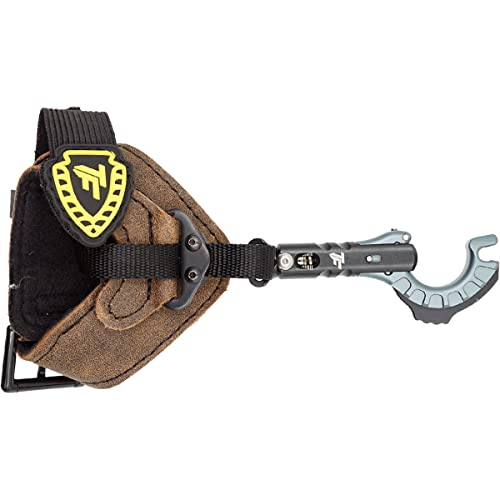


What Tru-Fire makes for bowhunters
On this site, Tru-Fire covers one product type: release aids for compound bows. A release clips onto the D-loop (the small string loop tied onto your bowstring), holds it at full draw, and lets it go when you fire it.
The Tru-Fire releases in the grid fall into three styles:
- Wrist-strap index releases: Patriot, Patriot Flex, Bulldog, Edge, Hardcore and ThruFire, plus two Spark youth models
- Handheld thumb releases: the Synapse models
- Handheld back tension releases: the Sear models, plus the Rivet, a handheld the maker calls link style
The grid filters by these and changes as listings come and go. So I'll write about the families and what separates them, not about how many of each are up this week. Most specs in the grid come from Amazon listings, and the grid marks them. The rest of what's below comes from the maker's own product pages.
The three release styles, in plain words
Archery 360, the Archery Trade Association's site, splits release aids by how you fire them. Here's what actually changes from one style to the next.
Wrist strap (index finger). A strap goes around your wrist, a stem runs to a head with jaws, and you squeeze a trigger with your index finger. Archery 360 points out that the strap carries most of the draw weight, so your finger can stay relaxed. It also notes the release stays attached to you, so you can't drop it out of a tree stand.
Handheld thumb button. You hold the release in your fingers and fire it with your thumb. Archery 360 says it lets more of the back of your hand touch your face at anchor, which helps consistency.
Back tension or hinge. No trigger to push. You rotate the release by pulling through the shot until it goes off. Archery 360 says top target archers favor this style for its consistency. The shot surprises you, which is the point.
Kitchen version: a wrist strap is a pot with a handle, a thumb release is a mug you grip, and a back tension release is a jar lid that pops when you've turned it far enough. All three hold coffee. They just feel different in the hand.
Lineup notes: Tru-Fire wrist-strap releases
This is the biggest group in the grid and the one most bowhunters start with.
Patriot and Patriot Flex
The Patriot's listing marks an ambidextrous release on a hook-and-loop strap with an adjustable trigger. The Patriot Flex adds what the maker calls a dual caliper head on a nylon webbing strap, with the length set at the webbing. These are the plain, adjustable-strap models of the lineup.
Bulldog and ThruFire
Both list buckle straps and adjustable triggers. The Bulldog's model code, BDBF, reads as buckle foldback, and its listing marks it ambidextrous. The ThruFire's values come from its listing, and the grid shows them.
Edge FT and Edge Buckle
The Edge releases step up in adjustment. Per the maker:
- Edge FT: leather buckle strap with FoldBack, auto-closing jaws on what the maker calls a closed-bias dual-caliper head about the size of a dime, more than 1 inch of lockable length adjustment, and adjustable travel and tension
- Edge Buckle: leather FoldBack strap, more than 1 inch of length adjustment with a lockdown set screw, and adjustable travel on a linear bearing
The maker says the Edge FT's forward trigger adds nearly 1 inch of draw length compared with the original Edge. Quick math: if your bow is already set to your draw length, a release that's an inch longer changes your anchor. Check it before you hunt.
Hardcore 2.0 Extreme
The Hardcore 2.0 Extreme is the open-hook model. Per the maker, the hook clips onto a D-loop quickly, the head rotates 360 degrees, length adjusts by almost an inch, and the hook has a nickel boron coating to reduce friction. It uses a suede buckle strap with FoldBack and a TrapTab that keeps the strap from pulling back through the buckle. Trigger travel and pressure both adjust.
Hook or caliper? A caliper has jaws that close around the loop. A hook is a single open hook that the loop sits on. The bow release page explains both across brands.
Spark youth releases
The Spark Youth Foldback and Spark Extreme Youth are the small-wrist models. The listings mark adjustable triggers, and the Foldback lists a buckle strap. The maker's FAQ gives the Spark lineup up to 2 inches of length adjustment. Its current Spark buckle page describes a fit made for smaller hands and wrists, a shorter starting length and stainless steel jaws. If you're setting up a kid, pair it with the youth compound bow page.
Lineup notes: Tru-Fire handheld releases
Synapse thumb releases
The grid lists the Synapse Thumb Release and the Synapse Dual Sear. Per the maker's Synapse page:
- Firing: true double-sear operation
- Adjustment: trigger travel and pressure, both lockable, with pressure from about 1.25 to 20 ounces without changing springs
- Fingers: a hook that wraps the ring finger for three-finger use, or a fourth-finger extension
- Handle: weighted brass with an anodized aluminum cover, and a multi-position thumb button
Sear and Sear-X back tension releases
The Sear Hinge and the Sear-X are back tension releases with sear-type mechanisms. The Sear-X listing marks it ambidextrous and convertible between three and four fingers. The maker's Sear page lists a heavy brass handle, fully machined parts, a four-sided sear with several click options, an adjustable hot and cold setting, adjustable fourth-finger position and three thumb positions.
Hot and cold, in plain words, is how far you have to rotate before the shot goes. Hotter fires sooner. Colder takes more rotation. The click is a small bump you feel as you approach the firing point.
Rivet
The Rivet is the maker's link-style handheld. Per its page, it ships as a three-finger release with a fourth-finger attachment and closes fully around the D-loop. You push the thumb barrel forward to close it. Tension adjusts from 1.75 to 50 ounces, and trigger travel, the thumb post and the thumb barrel position adjust too. The handle is machined aluminum, and the maker says it works with its Wrist Assist strap. The grid's listing marks three- and four-finger use.
How to choose within the Tru-Fire lineup
Pick the style before the model
Here's what actually changes your shooting: the style, not the name. Decide wrist strap, thumb or back tension first. Then the model choice narrows to a handful.
For a wrist strap: strap, then head
Strap options in the grid run from hook-and-loop (Patriot) to nylon webbing (Patriot Flex) to buckle, leather buckle and suede buckle (Bulldog, Edge, Hardcore). A buckle sets the same fit every time. Hook-and-loop is quicker to adjust over a heavy glove. Then pick the head: dual caliper jaws (Patriot Flex, Edge) or an open hook (Hardcore).
For a handheld: thumb or rotation
If you like to choose the moment the shot goes, look at the Synapse. If you want the shot to surprise you, look at the Sear models. The Rivet sits in between with a thumb barrel and a wide tension range. Archery 360's advice is to try several at a local pro shop before you buy, because preference is the main factor.
Fit the length to your hand
Bowhunter's release how-to, by Larry Wise, says to set the stem or strap short enough that you can curl your whole index finger around the trigger, not touch it with the fingertip. For a thumb release, he says to set the trigger so it sits against the base of your thumb. He also recommends a medium-heavy trigger, never light. Every Tru-Fire wrist strap in the grid lists some length adjustment, so use it.
My one opinion on this page
For a bowhunter buying a first release, I'd start with a wrist strap. The reason is the one Archery 360 gives: a strap release stays on your arm, so it can't fall out of a tree stand or get left on a stump. Handhelds are great. They're also the easiest thing to drop in the leaves at 6 a.m. (I've watched one go down a ladder rung by rung. It was quieter than you'd think.)
Setup, safety and care
Safety at the bow
Keep your finger off the trigger or release until you're ready to shoot, as Wisconsin DNR's archery safety tips put it. Point the bow only in a safe direction and know what's beyond your target. Check that the jaws or hook are fully closed on the D-loop before every draw. Never dry-fire a bow.
Learning a new release
Practice up close. Bowhunter's article suggests a blank bale at short range, or a rope loop set to your draw length, until the new release feels normal. A rope loop is a cheap way to learn a back tension release without launching arrows across the yard. Bowhunting rules vary by state, so check your state wildlife agency before the season.
Care and the warranty
The maker's warranty covers mechanical components against defects for the lifetime of the release, for the original owner. Straps get one year with proof of purchase. Discontinued items get one year from purchase. It doesn't cover normal wear, misuse or poor maintenance, and it's void if the release has been taken apart, modified, abused, or shows dents, bent parts, rust or non-original parts. To claim, you get an RMA number first, send a photo of the whole release and include proof of purchase where required.
Two practical notes come straight out of that. Don't take a release apart to see how it works. And keep it dry, since rust voids the coverage. A wet release goes on a towel by the woodstove, not back in the pack.
Who's behind Tru-Fire
Tru-Fire is sold on the site of FeraDyne Outdoors, which lists an address in Superior, Wisconsin. Grand View Outdoors reported in December 2013 that FeraDyne had acquired Tru-Fire, then based in Fond du Lac, Wisconsin. A 2012 Grand View Outdoors profile named Steve Tentler and his wife, Cheri, as the owners at that time. The maker's brand page says it designs its releases for years of trouble-free use and uses the same metal and hardness for all its release firing components.
Style, strap or handle, then length. Write the setting on a strip of tape inside your release case, because in August you won't remember which screw you turned in March.
Where Tru-Fire shows up
Questions about Tru-Fire
Are Tru-Fire releases good?
What the maker states is checkable. It says it uses the same metal and hardness for all its release firing components, lists adjustable trigger travel and tension on many models, and gives its mechanical components a limited lifetime warranty. Whether one suits you depends on the style you shoot, your hand size and how you hunt. The grid lists the style, strap and adjustments per model.
Can left-handed archers use a Tru-Fire bow release?
The maker's FAQ says its releases can be used by left- or right-handed shooters. Several listings in the grid also mark the release as ambidextrous. For a handheld thumb or back tension model, check the thumb post or barrel positions on the exact model, since those set where your thumb lands.
What warranty do Trufire releases have?
The maker lists a limited warranty on mechanical components for the lifetime of the release, for the original owner. Wrist straps are covered for one year with proof of purchase, and discontinued items for one year from purchase. Taking the release apart, modifying it, rust or damage from misuse voids it. A claim needs an RMA number and a photo of the whole release.
Who makes Tru-Fire releases?
Tru-Fire is a brand of FeraDyne Outdoors, which sells it on its own site and lists an address in Superior, Wisconsin. Grand View Outdoors reported in December 2013 that FeraDyne had acquired Tru-Fire, which was based in Fond du Lac, Wisconsin, at the time.
What does FoldBack mean on a Trufire release?
FoldBack is the maker's name for its buckle-strap design that lets the release head fold back out of the way when you're not shooting. The maker's Edge page pitches it for glassing, rattling or climbing into a tree stand. In the grid, the Bulldog, Edge, Hardcore and Spark Youth listings use buckle foldback straps.
Sources
- TruFire (FeraDyne Outdoors): Brand page and FAQ — accessed 2026-10-28
- FeraDyne Outdoors: Brand warranty information (TruFire) — accessed 2026-10-28
- TruFire (FeraDyne): Synapse handheld thumb release — accessed 2026-10-28
- TruFire (FeraDyne): SEAR back tension handheld release — accessed 2026-10-28
- TruFire (FeraDyne): Rivet handheld release — accessed 2026-10-28
- TruFire (FeraDyne): Hardcore 2.0 Extreme buckle release — accessed 2026-10-28
- TruFire (FeraDyne): Edge FT release — accessed 2026-10-28
- TruFire (FeraDyne): Edge buckle foldback release — accessed 2026-10-28
- TruFire (FeraDyne): Patriot Flex release — accessed 2026-10-28
- TruFire (FeraDyne): Spark 2.0 buckle youth release — accessed 2026-10-28
- Grand View Outdoors: FeraDyne Outdoors acquires Tru-Fire (2013) — accessed 2026-10-28
- Grand View Outdoors: Company profile, Tru-Fire (2012) — accessed 2026-10-28
- Archery 360 (Archery Trade Association): Which release aid is right for you? — accessed 2026-10-28
- Archery 360 (Archery Trade Association): Release aids — accessed 2026-10-28
- Bowhunter: Proper archery release aid technique (2020) — accessed 2026-10-28
- Wisconsin DNR: Archery and crossbow safety tips — accessed 2026-10-28