Camp Gear · Gear type
Beach Canopy
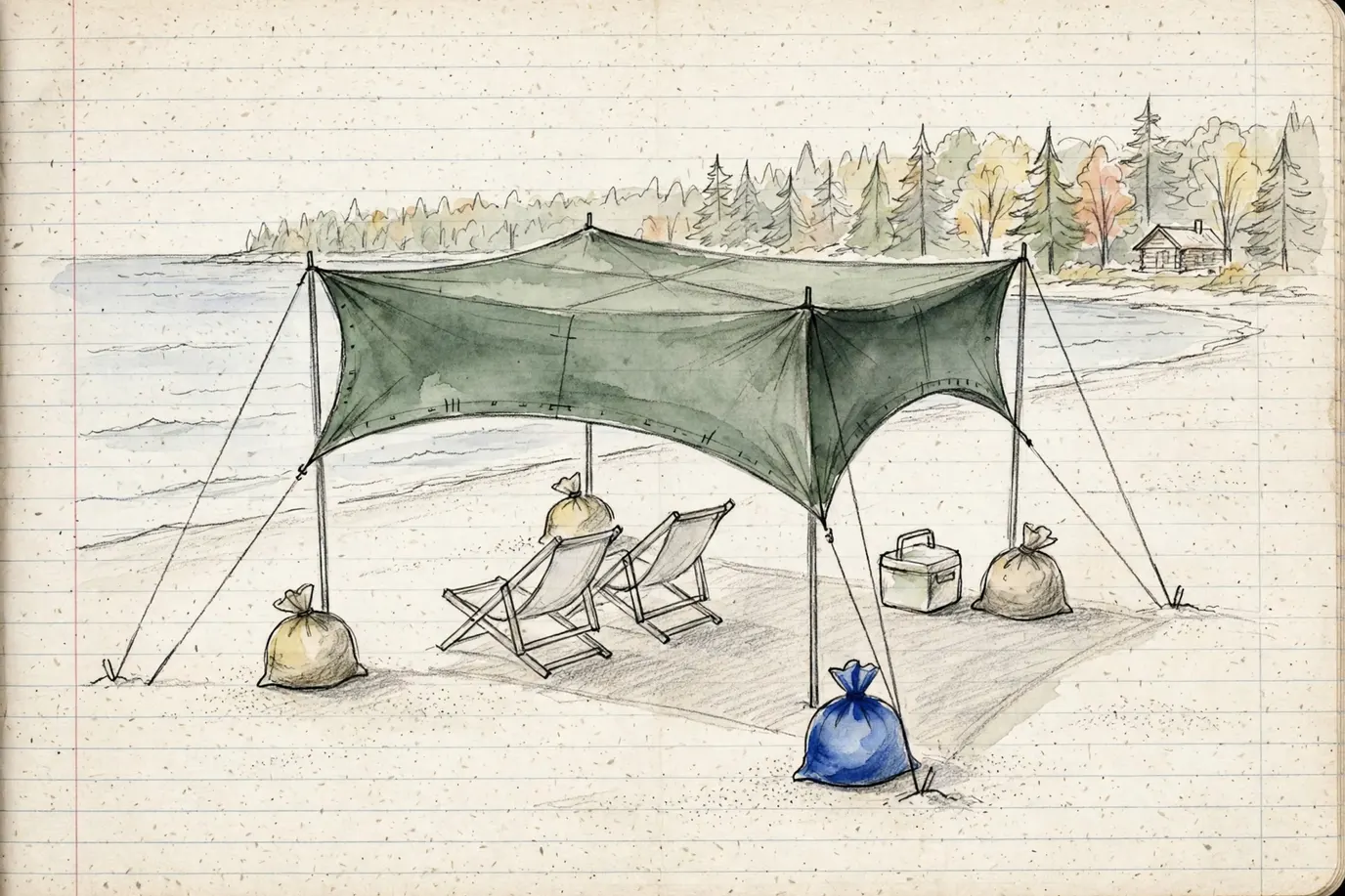
A beach canopy is a roof with no walls: fabric held up on poles or a frame and pinned to the sand, so air moves through and a whole group sits in one shadow. Pick it when you want shade for a crowd and a breeze on your neck. The real choice is how it stays up: a stretch canopy pulled tight by sandbags, a pop-up frame weighted at each leg, or a wind-powered shade that floats on the breeze. (Renee calls our stretch canopy the trampoline. Nobody has tested that. Yet.)
We earn a commission if you buy through our links, at no cost to you. Disclosure
| Model | Shade area | Type | Size | Fits | Amazon |
|---|---|---|---|---|---|
Shibumi Shade Shibumi Shade ClassicBeach shelter More specs
| 150 sq ftlisting | Wind powered canopylisting | — | 3-6listing | Check price |
MoKo MoKo Wind-Supported Beach ShadeBeach shelter More specs
| 100 sq ftlisting | Wind powered canopylisting | — | 4-6listing | Check price |
Neso Neso Grande 9x9Beach shelter More specs
| 81 sq ftlisting | Stretch canopylisting | 9 x 9listing | — | Check price |
Shibumi Shade Shibumi Shade MiniBeach shelter More specs
| 75 sq ftlisting | Wind powered canopylisting | — | up to 4listing | Check price |
Crown Shades 10x10 Beach Tent Sun ShelterBeach shelter More specs
| — | Stretch canopylisting | 10 x 10listing | — | Check price |
Crown Shades 7x7 Beach Tent Sun ShelterBeach shelter More specs
| — | Stretch canopylisting | 7 x 7listing | — | Check price |
Goplus 20x20 ft Beach CanopyBeach shelter More specs
| — | Stretch canopylisting | 20 x 20listing | 2-3listing | Check price |
Gorich Beach Tent with 8 SandbagsBeach shelter More specs
| — | Stretch canopylisting | — | — | Check price |
ihuan Beach Tent 10x10Beach shelter More specs
| — | Stretch canopylisting | 10 x 10listing | 8listing | Check price |
Neso Neso Beach Tent 7x7Beach shelter More specs
| — | Stretch canopylisting | 7 x 7listing | — | Check price |
Neso Neso Grande 9x9Beach shelter More specs
| — | Stretch canopylisting | 9 x 9listing | — | Check price |
Neso Neso Gigante 11x11Beach shelter | — | Stretch canopylisting | 11 x 11listing | — | Check price |
Shibumi Shade Shibumi Shade (previous generation)Beach shelter More specs
| — | Wind powered canopylisting | — | up to 8listing | Check price |
Sport-Brella Sol-Breeze Shelter 10x10Beach shelter More specs
| — | Stretch canopylisting | 10 x 10listing | — | Check price |
Sun Ninja Sun Ninja Beach Tent 10x10Beach shelter More specs
| — | Stretch canopylisting | 10 x 10listing | 8listing | Check price |
VEVOR Pop Up Beach Canopy 10x10Beach shelter More specs
| — | Stretch canopylisting | 10 x 10listing | 4-7listing | Check price |
Wekapo WEKAPO Beach Tent 4 PoleBeach shelter More specs
| — | Stretch canopylisting | — | — | Check price |
Wekapo WEKAPO Beach Tent 11x11Beach shelter | — | Stretch canopylisting | 11 x 11listing | — | Check price |
Wekapo WEKAPO Beach Tent 9x10Beach shelter | — | Stretch canopylisting | 9 x 10listing | — | Check price |
Wekapo WEKAPO Beach Tent 9x10Beach shelter | — | Stretch canopylisting | 9 x 10listing | — | Check price |
Wekapo WEKAPO Beach Tent 9x10Beach shelter | — | Stretch canopylisting | 9 x 10listing | — | Check price |
Wekapo WEKAPO Beach Tent 8x8Beach shelter | — | Stretch canopylisting | 8 x 8listing | — | Check price |
Wekapo WEKAPO Beach Tent 8x8Beach shelter | — | Stretch canopylisting | 8 x 8listing | — | Check price |
Wekapo WEKAPO Beach Tent 9x10Beach shelter | — | Stretch canopylisting | 9 x 10listing | — | Check price |
Wekapo WEKAPO Beach Tent 4 PoleBeach shelter More specs
| — | Stretch canopylisting | — | — | Check price |
Wekapo WEKAPO Beach Tent 8x8Beach shelter | — | Stretch canopylisting | 8 x 8listing | — | Check price |
Wekapo WEKAPO Beach Tent 11x11Beach shelter | — | Stretch canopylisting | 11 x 11listing | — | Check price |
Wekapo WEKAPO Beach Shade 8x8Beach shelter | — | Stretch canopylisting | 8 x 8listing | — | Check price |
Wekapo WEKAPO Beach Tent 11x11Beach shelter | — | Stretch canopylisting | 11 x 11listing | — | Check price |
Wekapo WEKAPO Beach Tent 11x11Beach shelter | — | Stretch canopylisting | 11 x 11listing | — | Check price |
Wekapo WEKAPO Beach Tent 11x11Beach shelter | — | Stretch canopylisting | 11 x 11listing | — | Check price |




What’s in this listOpen beach canopies — stretch and wind-powered designs — largest shade first. “—” means neither the maker nor the Amazon listing states it.
What makes a beach canopy different from a beach tent
A beach canopy has a roof and nothing else. No back wall, no floor, no door. That's the point. Air moves straight through, you can see the water from every chair, and a group can sit in one shadow instead of three.
Here's the trade against a beach tent: no privacy, no wall to stop blowing sand, and no floor for a nap. And because there are no walls, the shadow moves wherever the sun says. The EPA's shadow rule says UV is strongest when your shadow is shorter than you are, around midday, and that's also when a canopy's shadow sits closest to straight under it. In the morning and late afternoon, the shade slides off to one side and you slide the chairs after it.
If you're still choosing between walls and no walls, the beach shade page compares every type. This page is for open shade.
The table under this page lists open beach canopies we track, largest stated shade first: stretch canopies and wind-powered designs, with type, shade area, size, pole material, anchoring, the wind feature the maker names, UPF and weight. Values come from the maker, or from the Amazon listing where the maker is silent (marked as listing values); a dash means neither lists that value. Weight is always the maker's own figure.
The three kinds of beach canopy
Stretch canopy: fabric, poles and four heavy bags
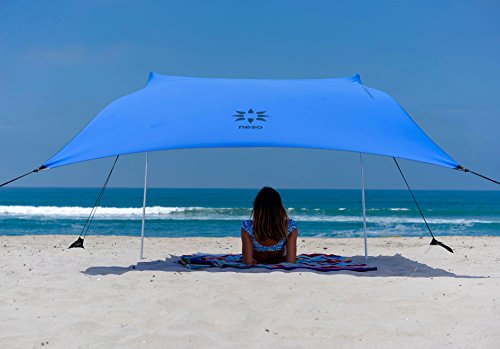
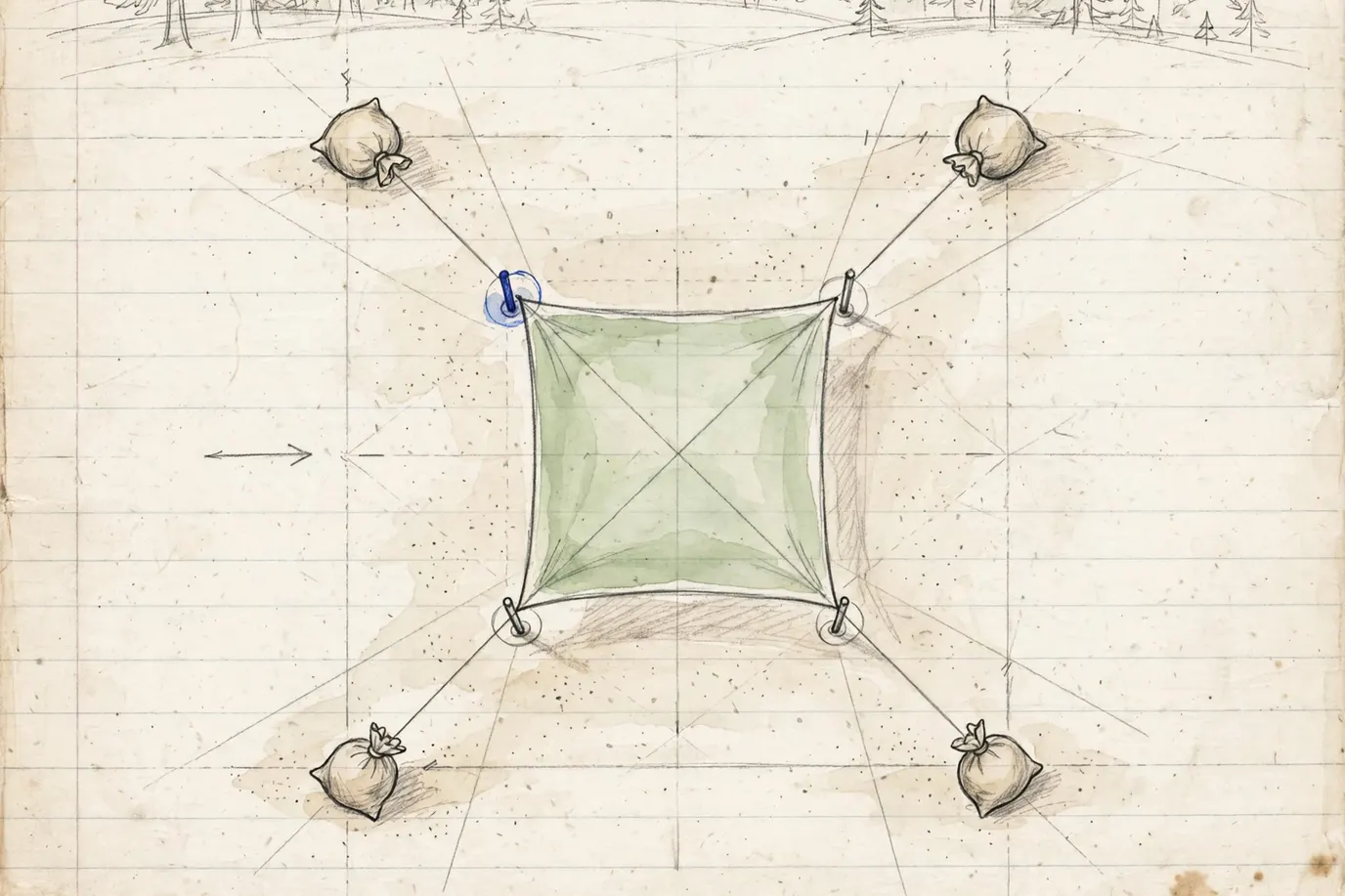
A stretch canopy is a sheet of stretchy fabric with a sandbag sewn or strapped to each corner and two to four poles that push the middle up. No frame. The tension between the bags and the poles holds the shape.
One stretch-canopy maker's setup page lays it out:
- Lay the canopy flat.
- Overfill the bags with sand until each is about the size of a basketball and about 20 pounds.
- Pull the bags apart into a big X so the fabric is tight.
- Brace each bag with extra sand so it doesn't slide in when the poles go up. Don't bury the bags; that puts too much pressure on the fabric.
- Extend the poles and prop the canopy, with each pole 1 to 2 feet in from a corner, not at the corner.
The maker's words, in capitals on the page: more tension equals more stability. Exhibit A for why I fill the bags until my forearms complain.
Pop-up canopy frame: a backyard canopy that went to the shore
A pop-up canopy is the folding steel or aluminum frame with a fabric roof, the same kind you'd put over a yard sale. It works on sand if you weight it like you mean it. One canopy maker's beach guide says regular tent stakes are useless in loose dry sand, suggests roughly 25 to 40 pounds per leg for a 10 by 10 frame, and recommends sand screws at least 12 inches long with guy lines out at about 45 degrees.
It gives the squarest, tallest shade, and it's the heaviest thing on this page to carry. The frames themselves are covered on the canopy tent page and the 10x10 canopy page.
Wind-powered canopy: shade that needs a breeze
A wind-powered canopy is a light fabric on one curved pole arch, pinned by a sandbag at the front and left loose at the back. The breeze fills it like a flag. One maker of this design says just 2 to 3 mph of breeze is all it needs, and that most beaches have enough breeze most of the time. Its largest shade is listed at up to 150 square feet and packs at just over four pounds, per that maker.
On a dead-calm morning, it lies on the sand looking sorry for itself. That same maker sells an add-on that pins the trailing corners down for those days. The design has its own wind powered beach canopy page, so I'll leave it there.
What to look at when you pick a beach canopy
Shade area is the number that seats people
Shade area is the covered area in square feet as the maker or the listing states it. It's the column the table is sorted by, because on an open canopy it's what decides how many chairs fit under one shadow.
Two things to keep in mind. First, shade area and size aren't the same column. A stretch canopy's fabric is bigger than the shade it throws, because the corners slope down to the bags. Second, the shade under the roof is biggest at midday and shifts after that. Buy for the group sitting down at noon, and plan to move the chairs at three.
Real talk: I measure shade the way Jess measures arrows. Lay out the chairs and the cooler on the driveway, tape-measure the rectangle, and compare it to the table. The cooler counts as a person. It has more ice than most people.
Type tells you what you'll be wrestling at 9 a.m.
The Type column separates stretch canopies from wind-powered ones. (Pop-up frames sold as general canopies sit on the canopy pages.) A stretch canopy goes up with bags and poles and some digging. A wind-powered shade goes up with one arch and a bag, then waits for the wind. One maker of the wind design says a single person can set it up.
Poles set the height and the tension
The Poles column shows pole material when the maker lists it: aluminum, fiberglass, steel, or none. On a stretch canopy, the poles are push-sticks that set the height; the fabric does the holding.
Where you put them matters more than what they're made of. The stretch-canopy maker's setup page gives the wind moves:
- Light wind: poles on the windward side, angled slightly into the wind
- Heavy wind: lower the front lip that catches the wind; poles 2 feet from the corners and 6 inches in from the edge stitching
- Swirling wind: use 3 or 4 poles and leave an opening so wind can pass under
A pole jammed right at the corner puts the load on the fabric where it can't spread out. The maker says so plainly: don't place the poles at the corners.
Anchoring is pounds of sand, not the number of stakes
The Anchoring column lists what comes in the box. On an open canopy, that's mostly sandbags, plus stakes or sand screws on some.
My one opinion on this page: fill the bags heavier than seems sensible, every time, before the poles go in. The reason is on the makers' own pages. The stretch-canopy maker's fix for a canopy that won't stay up is to take the poles down and add more sand. The pop-up frame maker's numbers per leg run well past what most people would guess. Sand is free and it's already there. The only cost is your back.
Walt's take, from one of his two trips to the shore with us: "A stretch canopy is a tarp that went to yoga." He then sat under it all afternoon and asked if we could get one for the cabin porch.
Wind handling: an open roof is still a sail
The Wind handling column records what the maker says about wind, in the maker's words, like "works with wind." We don't turn that into a wind rating the maker never gave.
Without walls, a canopy catches less wind than a tent. It still catches some, because the roof is a flat panel tilted at the sky. The pop-up maker's beach guide says to drop the canopy to its lowest height when gusts pick up, face the shorter side to the wind, take off sidewalls, and take the whole thing down above 25 mph. A stretch canopy flexes instead of fighting, but only while the bags hold. When the forecast reads like a hurricane-season preview, the umbrella stays in the trunk and so does the canopy.
UPF on stretchy fabric
UPF is the fabric's sun rating, when the maker states one. The Skin Cancer Foundation explains it for clothing: UPF 50 lets through about 1/50th of the UV. It also notes that stretched fabric pulls the fibers apart and lets more UV through, and wet fabric does worse. That's written about shirts, but a stretch canopy is a shirt for the beach pulled tight on purpose, so treat the stated UPF as the best case and keep the sunscreen on.
Weight and size in the bag
Weight is the stated weight in pounds, and the Size column gives the stated dimensions. A stretch canopy packs into a sack with the bags empty, so it's usually the light end of the table. A pop-up frame is the heavy end. Remember the empty bags weigh nothing on the walk in and carry a little damp sand on the walk out, no matter how well you shake them.
Beach canopy shade vs umbrella vs tent: who should pick which
- Pick a stretch canopy for a group on a breezy beach who want air and a view.
- Pick a pop-up frame if you park close, want stand-up headroom and bring a helper for the legs.
- Pick a wind-powered canopy for a reliably breezy beach and a long walk in.
- Pick an umbrella if you're one or two people, or your town allows only umbrellas.
- Pick a tent if you need a floor, privacy or a nap spot for a baby.
Skip the canopy entirely if your beach is crowded wall-to-wall in July. Ocean City, Maryland's 2025 rules require canopies at least 3 feet apart; a big canopy on a packed beach may not have a legal spot. The beach umbrella page covers the smaller option.
Town size limits for beach canopies
Two examples from opposite coasts show how far rules can go:
- Ocean City, Maryland: canopies no larger than 10 by 10 feet, at least 3 feet apart, anchor lines kept inside the canopy's footprint, and no unattended canopy before 10 a.m., per FOX 5 DC's 2025 report.
- Laguna Beach, California: from May 26, 2026, shade coverings are allowed only at Main Beach and Aliso Beach, up to 8 feet wide, 8 feet deep and 6 feet high, in zones near the lifeguard towers and at least 5 feet from other shade, per FOX 11.
The anchor-line rule is the sneaky one for stretch canopies, since the bags pull out past the roof. Check the town's current beach rules before you buy a big one.
Care: rinse, dry, don't leave it up
The stretch-canopy maker's care page says not to leave its canopy up for more than 24 hours, to shake out sand and make sure everything is dry before packing, and to avoid sharp or abrasive rocks in the anchor bags. For washing, it says to take off the anchor bags, wash cold on gentle and hang dry or tumble low. The wind-design maker says to rinse with fresh water after salt and air dry before storage.
Take the canopy and the bags off the beach every evening. Mote Marine Laboratory says furniture left out at night is an obstacle for nesting sea turtles and asks people to fill their holes. That includes the four craters your sandbags leave.
Safety
An open canopy is not a lightning shelter. The National Weather Service says the only completely safe place is a building or a vehicle. At the first thunder, drop the poles, lay the canopy flat with the bags on it, and go. Wait 30 minutes after the last rumble before going back.
That's a beach canopy: heavy bags, poles in from the corners, and a roof you take down before the wind decides for you.
Brands in this list
Related
Questions people ask
How heavy should the sandbags be on a stretch beach canopy?
One stretch-canopy maker says to overfill each bag until it's about the size of a basketball and weighs about 20 pounds, then brace it with extra sand so it doesn't slide inward when the poles go up. It says not to bury the bags, because that puts too much pressure on the fabric.
Can a pop up canopy go on the beach?
Yes, with weight. One canopy maker's beach guide says regular tent stakes are useless in loose sand and suggests roughly 25 to 40 pounds per leg for a 10 by 10 frame, sand screws at least 12 inches long and guy lines out at about 45 degrees. It says to take the canopy down in winds above 25 mph.
What is a wind powered beach canopy?
A light canopy on one curved pole arch, held by a sandbag at the front and left loose at the back so the breeze lifts it like a flag. One maker says 2 to 3 mph of breeze is enough. With no wind it sags, which is why that maker sells an add-on that pins the trailing corners down. More on our wind powered canopy page.
What size beach canopy is allowed?
It depends on the town. Ocean City, Maryland, limits canopies to 10 by 10 feet, at least 3 feet apart, with anchor lines inside the footprint. Laguna Beach, California, allows shade only at two beaches, up to 8 feet wide, 8 feet deep and 6 feet high. Check the town's beach rules before the trip.
Is a beach canopy shade enough without sunscreen?
No. Dana-Farber notes UV reflects off sand and water at low angles and reaches people under shade. In a randomized trial in JAMA Dermatology, 78% of people under a beach umbrella still got some sunburn in 3.5 midday hours. Use the canopy with sunscreen, a hat and clothing.
Sources
- Neso: Beach tent setup (sandbag fill, pole placement, wind) — accessed 2026-10-22
- Neso: Care and washing instructions — accessed 2026-10-22
- E-Z UP: How to secure a pop-up canopy at the beach (stakes, weights and wind) — accessed 2026-10-22
- Shibumi Shade: Frequently asked questions (how wind-powered shade works, sizes, care) — accessed 2026-10-22
- Skin Cancer Foundation: Sun-protective clothing (UPF explained) — accessed 2026-10-22
- Dana-Farber Cancer Institute: Does staying in the shade prevent sunburn? — accessed 2026-10-22
- JAMA Dermatology: Beach umbrella vs sunscreen with high SPF for prevention of sunburn (randomized trial) — accessed 2026-10-22
- U.S. EPA: UV Index scale — accessed 2026-10-22
- FOX 5 DC: Ocean City bans oversized beach tents — accessed 2026-10-22
- FOX 11 Los Angeles: Laguna Beach bans pop-up tents and canopies — accessed 2026-10-22
- National Weather Service: Lightning safety outdoors — accessed 2026-10-22
- Mote Marine Laboratory: Beach furniture affects nesting turtles in Southwest Florida — accessed 2026-10-22