Brand · Camp Gear
Crown Shades Canopy Tents and Beach Shelters
A Crown Shades canopy is a pop-up shade frame: four legs, a folding truss and a fabric top, from small 8x8 frames up to a 10x30 commercial run. Crown Shades also makes stretch beach shelters that stand on sand anchors. Here's the thing: inside this brand the choice comes down to three specs. Footprint, fabric and walls. Get those right and the rest is color. (I taught shop long enough to know kids read the spec after they cut. Don't be a sophomore about it.)
We earn a commission if you buy through our links, at no cost to you. Disclosure
Crown Shades on Amazon US
18 models- Canopy
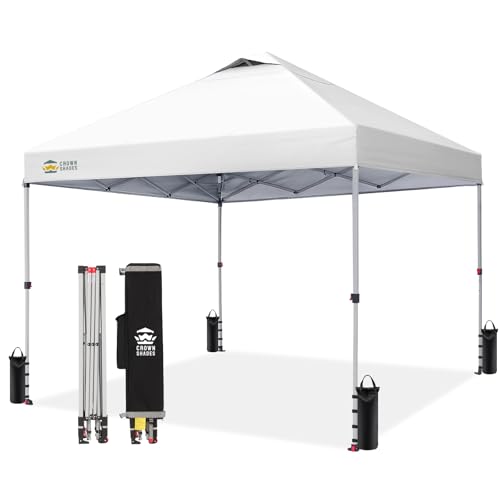
Crown Shades 10x10 One Push Pop Up Canopy
- Size
- 10x10
- Top fabric
- 150D
- Canopy
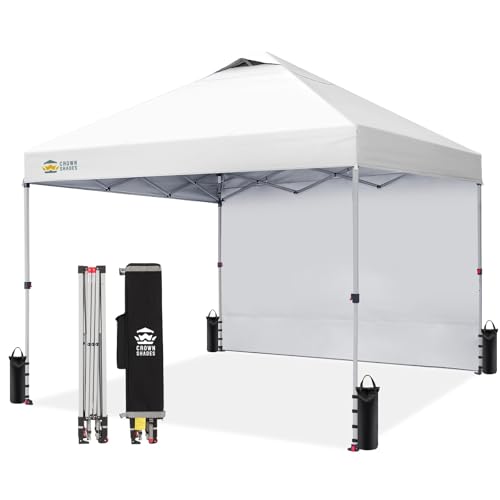
Crown Shades 10x10 Pop Up Canopy with Side Wall
- Size
- 10x10
- Top fabric
- 150D silver-coated
- Canopy
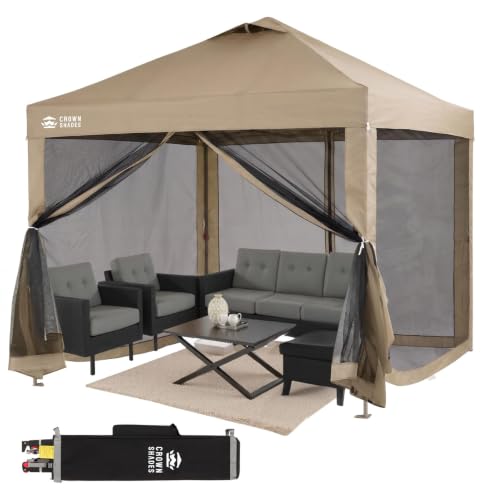
Crown Shades Gazebo 10x10 with Mosquito Netting
- Frame
- Steel
- Size
- 10x10
- Top fabric
- 150D Oxford
- Canopy
Crown Shades 8x8 Pop Up Canopy with Side Wall
- Size
- Other
- Top fabric
- 150D silver-coated
- Canopy
Crown Shades 10x10 Commercial Pop Up Canopy with Sidewalls
- Size
- 10x10
- Shade area
- 100 sq ft
- Top fabric
- 300D silver-coated
- Canopy
Crown Shades 12x12 Pop Up Canopy with Side Wall
- Size
- 12x12
- Top fabric
- 150D silver-coated
- Canopy
Crown Shades Commercial 8x8 Pop Up Canopy
- Size
- Other
- Shade area
- 64 sq ft
- Top fabric
- 400D Oxford
- Canopy
Crown Shades 12x12 One Push Pop Up Canopy
- Size
- 12x12
- Shade area
- 144 sq ft
- Top fabric
- 150D silver-coated
- Canopy
Crown Shades 10x10 Food Tent Pop Up Canopy
- Size
- 10x10
- Top fabric
- 400D
- Canopy
Crown Shades 10x10 Pop Up Canopy with Side Pockets
- Size
- 10x10
- Canopy
Crown Shades 10x10 Pop Up Canopy with Side Pockets Gray
- Size
- 10x10
- Canopy
Crown Shades 10x10 Pop Up Canopy with Game Netting
- Size
- 10x10
- Canopy
Crown Shades 13x13 Pop Up Canopy
- Size
- 13x13
- Shade area
- 169 sq ft
- Top fabric
- 150D silver-coated
- Canopy
Crown Shades 10x30 Commercial Pop Up Canopy
- Size
- Other
- Top fabric
- 400D Oxford
- Canopy
Crown Shades Custom 10x10 Canopy
- Size
- 10x10
- Canopy
Crown Shades 10x10 Commercial Pop Up Canopy with Side Wall
- Size
- 10x10
- Top fabric
- 400D PU coated
- Beach shelter
Crown Shades 10x10 Beach Tent Sun Shelter
- Type
- Stretch canopy
- Size
- 10 x 10
- Beach shelter
Crown Shades 7x7 Beach Tent Sun Shelter
- Type
- Stretch canopy
- Size
- 7 x 7


What Crown Shades makes for campers and hunters
On this site, Crown Shades covers two product types: pop-up canopies and beach shelters. The canopies are the bulk of the grid. They split into groups you can read straight off the model names:
- One Push canopies: 10x10 and 12x12 frames with 150D tops
- Standard pop-ups: 8x8 up to 13x13, many with silver-coated 150D fabric
- A slant-leg 9x9: a steel frame with angled legs
- Commercial frames: 8x8, 10x10 and a 10x30, with 300D or 400D fabric
- Walled and screened versions: sidewalls, half sidewalls, mosquito netting, a four-wall food tent
- Beach shelters: 7x7 and 10x10 stretch canopies on aluminum poles
The grid filters by type and changes as listings come and go. So I'll write about the groups and what separates them, not about how many of each are listed this week.
Nearly every spec here comes from an Amazon listing, and the grid marks those values. Where a listing doesn't say, the grid shows a dash. A dash means nobody told us. It doesn't mean zero, and it doesn't mean yes.
Around deer camp, a canopy earns its keep three ways. It shades the tailgate where lunch gets made. It keeps rain off the camp table where boots and gloves dry. And it covers the folding chairs at the shooting bench when somebody's grandson is sighting in a crossbow and wants to sit down every eight minutes.
Lineup notes: the Crown Shades canopy by group
One Push canopies
The One Push name sits on a 10x10 and a 12x12 in the grid. Their listings give 150D fabric, and the 10x10 lists a top vent. A top vent is a flap at the peak that lets trapped air out of the roof. That matters more than it sounds, because a canopy top is a big sheet of fabric, and wind under a sheet wants out somewhere.
The 12x12 lists 144 square feet of shade, against about 100 for a 10x10. That's an extra 44 square feet, roughly the room for one more table and the people around it. I'll take the extra 2 feet each way on a camp kitchen. You will too, the first time three people try to make breakfast under one roof.
Standard pop-ups from 8x8 to 13x13
The standard frames come in the widest spread of sizes. The listings describe:
- 8x8 with a side wall: the small frame, silver-coated 150D fabric
- 10x10 in several versions: plain, grey, with side pockets, with stepless height, with sidewalls
- 12x12 with a side wall: silver-coated 150D fabric
- 13x13: 169 square feet of shade, silver-coated 150D, a top vent
"Stepless height" on one 10x10 means the legs adjust to any height in their range, not to a few set holes. "Side pockets" on two others is in the model name, and the listings don't say more. The silver coating shows up on many tops in this group. The listings name it. They don't explain it, so I won't either.
More on sizes across brands is on the 10x10 canopy page and the canopy tent page.
The slant-leg 9x9
This one is built differently. Its legs angle outward, so the feet sit wider than the roof. The listing gives a steel frame and 81 square feet of shade.
E-Z UP's guide to leg styles explains the trade. Slant legs take more ground because of the wider stance, and they're steadier in wind and rain. Straight legs need less floor space and can stand right next to another canopy, the way they do at a farmers' market. So a slant leg suits an open field. A straight leg suits a crowded row. Plain and simple.
Commercial frames
The commercial group is where the fabric numbers go up. The listings describe:
- Commercial 8x8: 400D Oxford, 64 square feet of shade
- Commercial 10x10: 400D Oxford
- Commercial 10x10 with sidewalls: 300D silver-coated fabric
- Commercial 10x10 with side wall: 400D PU-coated fabric
- Commercial 10x30: 400D Oxford, the long frame in the grid
The "D" is denier. E-Z UP's fabric guide defines it as the weight in grams of 9,000 meters of one fiber, so a higher number means thicker yarn. The same guide says 150D to 300D suits lighter, occasional use. That's the split here: the everyday frames run 150D, and the commercial line steps up to 300D and 400D.
A 10x30 is a different animal. It covers the ground of three 10x10s in a row. That's a roof for a family reunion or a sportsmen's club raffle, not for one truck at the end of a two-track. Longer runs across brands are on the 10x20 canopy page.
Screened and food tents
Three models in the grid add mesh. The 10x10 gazebo lists mosquito netting, a steel frame and 150D Oxford fabric. The 10x10 food tent lists four sidewalls with mesh and 400D fabric. A third 10x10 is named for game netting and lists a mesh screen.
Mesh walls keep bugs off the table without trapping all the air. For a September bow camp, when the mosquitoes still think it's July, that's worth something. Screened shelters across brands are on the screen tent page.
Beach shelters
The two beach shelters are not pop-up frames. Their listings call them stretch canopies: a fabric sheet on aluminum poles, held down by sand anchors. They come in 7x7 and 10x10.
Neso's setup guide explains how this style works. You fill the anchor bags with sand to about the size of a basketball, pull them apart until the fabric is tight, then raise the poles. More tension means more stability. It also says not to bury the bags, because that strains the fabric. More on the style is on the beach tent page and the beach canopy page.
How to choose within the Crown Shades canopy lineup
Footprint first
Measure what goes under it before you look at anything else. A 10x10 covers a 6-foot table and four chairs with a walkway. An 8x8 covers the table or the chairs, but not both comfortably. A 12x12 or 13x13 covers a camp kitchen with room to walk behind the cook.
Then measure where it'll stand. UC Irvine's canopy safety guide says canopies are best set up away from buildings, dry brush and parked vehicles. At a camp, that rules out the spot right against the cabin wall, which is the spot everybody picks first.
Then the fabric
The fabric number tells you how heavy the top is built:
- 150D: the everyday tops, plain or silver-coated
- 300D: one commercial 10x10 with sidewalls
- 400D: most of the commercial line and the food tent
E-Z UP's FAQ makes a point worth keeping in mind for any brand. Canopy tops are water resistant, not waterproof, and their main job is shade. A canopy over the camp table keeps off a passing shower. It isn't a roof for a three-day soaker.
Then walls or no walls
The walled versions in the grid come with one sidewall, two half sidewalls, sidewalls on all sides, or mesh. A wall blocks low sun and a cold wind off the cooking side. It also turns the canopy into a sail.
E-Z UP's wind guide says sidewalls block airflow and increase pressure, so keep them open or take them off in windy weather. My one opinion on this page is about that: weight every leg, every time, even on a calm morning. UC Irvine's guide recommends 40 pounds per leg for a 10x10 where the maker gives no number, with more in high winds. Wind doesn't check the forecast before it shows up.
Then the legs
Straight or slanted. Most of the grid is straight-leg frames. The 9x9 is the slanted exception. If you set up in a tight row, go straight. If you set up alone in an open field, the slant leg's wider stance is the reason it exists.
Setup and anchoring that apply to every frame
Weights and stakes
E-Z UP's wind guide lays out the basics by ground. On soft ground, drive stakes deep and angle them away from the canopy. On concrete or gravel pads, stakes won't hold, so use weights. It gives about 24 pounds per leg for light wind and 40 to 50 for moderate wind, and it says to add guy lines from the top corners outward once the wind is noticeable.
UC Irvine's guide adds what not to use as an anchor: tables, coolers and vehicles. They make tripping hazards and often don't weigh enough. Danny once tied a corner to his cooler. He said it was "temporary." The cooler said otherwise about forty minutes later.
The same guide suggests breaking weights into 10- or 20-pound pieces so they're easier to lift, and wearing closed-toe shoes when you handle them.
At the beach
E-Z UP's beach guide suggests 25 to 40 pounds per leg on a 10x10, or sand screw stakes at least 12 inches long with guy ropes at a 45-degree angle. It also says to face the short side into the wind, lower the canopy in gusts, and take it down above 25 mph.
Wind and weather
Take it down early. E-Z UP's wind guide says to take the canopy down if winds keep building or turn erratic. A canopy that lifts off can hurt somebody, and it won't land where you'd pick.
If lightning starts, a canopy is not shelter. The National Weather Service says tents and open picnic shelters are not safe places; get inside a building or a vehicle.
Don't cook, run a heater or keep fuel under a canopy. UC Irvine's guide says no flammable or combustible materials inside a tent or canopy. Set the camp stove out in the open, downwind.
Care that keeps a canopy going
The care rules are short, and E-Z UP's FAQ covers them well for any brand:
- Dry it fully before you bag it, to avoid mildew
- Spot clean the top with a non-abrasive cleanser and a brush
- Never machine wash the fabric
- Fold it the way it came out, so the truss bends where it was built to bend
Rule of thumb: a canopy that goes back in the bag wet on Sunday comes out smelling like a root cellar the next time. Set it up in the yard on Monday and let it dry. It's ten minutes. I'd rather spend them in the yard than in the hardware store.
This page doesn't cover Crown Shades' warranty or company details. The box and the listing of the exact model are the place to read them.
Measure the table, weight the legs, and dry it before it goes back in the truck. That's the whole job.
Where Crown Shades shows up
Questions about Crown Shades
Is a Crown Shades canopy good?
What the listings show is checkable: the Crown Shades frames in the grid run from 8x8 to 13x13 plus a 10x30, the fabrics range from 150D to 400D, and several models list sidewalls, mesh or a top vent. Whether one suits you depends on the job: weekend shade, a camp kitchen, a market stall or the beach. Pick the footprint and fabric for that job, then compare.
What size Crown Shades canopy do I need?
Start with what goes under it. A 10x10 frame, the most common size in the grid, gives about 100 square feet of shade by its listings. The 12x12 lists 144 and the 13x13 lists 169. A slant-leg 9x9 lists 81 square feet of shade, because slanted legs spread the frame wider than the top. Measure your table, chairs and walkway first.
Can I use a Crown Shades canopy at the beach?
The pop-up frames can stand on sand if you anchor them for it. E-Z UP's beach guide suggests 25 to 40 pounds per leg on a 10x10, or 12-inch sand screws with guy ropes. Crown Shades also makes 7x7 and 10x10 stretch beach shelters that list aluminum frames and sand anchors, which are built for sand from the start.
How much weight does a canopy leg need?
Use the maker's anchoring instructions first. Where a maker gives none, UC Irvine's canopy safety guide recommends 40 pounds per leg for a 10x10 structure, and more in high winds. E-Z UP's wind guide says weights alone stop being enough once the wind picks up, so add guy lines, and keep sidewalls open or off in wind.
Where can I buy Crown Shades canopies?
The product grid on this page links to Crown Shades listings on Amazon US, filtered by canopy and beach shelter. Before you order, check that the listing names the footprint, the fabric and the number of sidewalls you want, since several models share a size and differ only in walls or fabric.
Sources
- E-Z UP: Which is better, straight leg or slant leg pop-up tent? — accessed 2026-10-23
- E-Z UP: What does 500D mean in canopy tent fabric? — accessed 2026-10-23
- E-Z UP: How to secure a canopy tent in high winds — accessed 2026-10-23
- E-Z UP: How to secure a pop-up canopy at the beach — accessed 2026-10-23
- E-Z UP: Frequently asked questions (care, drying, water resistance) — accessed 2026-10-23
- UC Irvine Environmental Health & Safety: Canopy safety reference guide — accessed 2026-10-23
- National Weather Service: Lightning safety outdoors — accessed 2026-10-23
- Neso: Beach tent setup (sandbag fill, pole placement, wind) — accessed 2026-10-23