Brand · Knives & Tools
ESEE Knives
ESEE Knives makes fixed-blade knives first and almost only: small neck knives, the numbered ESEE-3 through ESEE-6 field knives, a few bushcraft and skinning patterns, and machetes under its Expat name. Here's the thing: nearly every blade in the grid lists 1095 carbon steel, so the choice inside ESEE comes down to size, grind and sheath. The numbers on the knives help. A 4 is bigger than a 3. (Plain and simple. I wish lumber were labeled that honestly.)
We earn a commission if you buy through our links, at no cost to you. Disclosure
ESEE on Amazon US
35 models- Fixed blade knife
ESEE Izula
Check price - Fixed blade knife
ESEE 6P
- Blade length
- 6.5 in
- Blade steel
- 1095
- Steel type
- Carbon
- Fixed blade knife
ESEE Izula-II
- Blade length
- 2.63 in
- Overall length
- 6.75 in
- Blade steel
- 1095
- Fixed blade knife
ESEE Izula-II
- Blade length
- 2.63 in
- Overall length
- 6.75 in
- Blade steel
- 1095
- Fixed blade knife
ESEE Izula-II
- Blade thickness
- 0.16 in
- Blade length
- 2.875 in
- Overall length
- 6.75 in
- Fixed blade knife
ESEE 4P-DT
- Blade length
- 4.5 in
- Overall length
- 9 in
- Blade steel
- 1095
- Fixed blade knife
ESEE Candiru
Check price - Fixed blade knife
ESEE 4P
- Overall length
- 9 in
- Blade steel
- 1095
- Steel type
- Carbon
- Fixed blade knife
ESEE 4S
- Blade steel
- 1095
- Steel type
- Carbon
- Fixed blade knife
ESEE 3P
- Blade length
- 3.88 in
- Overall length
- 8.31 in
- Blade steel
- 1095
- Fixed blade knife
ESEE CR2.5
- Blade thickness
- 0.13 in
- Blade length
- 2.5 in
- Fixed blade knife
ESEE RB3
- Blade thickness
- 0.13 in
- Blade length
- 3.5 in
- Overall length
- 8.125 in
- Fixed blade knife
ESEE JG3
- Blade length
- 7.63 in
- Fixed blade knife
ESEE PR4
- Blade thickness
- 0.125 in
- Blade steel
- 1095
- Steel type
- Carbon
- Fixed blade knife
ESEE ESEE-6HM
- Blade thickness
- 0.188 in
- Blade length
- 6 in
- Overall length
- 11 in
- Fixed blade knife
ESEE Model 5 (5P-E)
- Blade length
- 5.25 in
- Overall length
- 11 in
- Blade steel
- 1095
- Fixed blade knife
ESEE Model 4HM
- Blade thickness
- 0.188 in
- Blade length
- 4.38 in
- Overall length
- 8.88 in
- Fixed blade knife
ESEE 3HM
- Blade length
- 3.63 in
- Overall length
- 8.13 in
- Blade steel
- 1095
- Fixed blade knife
ESEE JG5 Nessmuk
- Blade thickness
- 0.125 in
- Blade length
- 4.5 in
- Overall length
- 9.6 in
- Fixed blade knife
ESEE Izula-II
- Blade length
- 2.63 in
- Overall length
- 6.75 in
- Blade steel
- 1095
- Fixed blade knife
ESEE Pinch Neck Knife
- Blade length
- 1.3 in
- Overall length
- 3.4 in
- Blade steel
- 1095
- Fixed blade knife
ESEE Ashley Game Skinning Knife
- Blade length
- 3.5 in
- Overall length
- 8.25 in
- Blade steel
- 1095
- Fixed blade knife
ESEE ESEE-3 S35V
- Blade thickness
- 0.125 in
- Blade length
- 3.88 in
- Overall length
- 8.19 in
- Fixed blade knife
ESEE Xancudo S35V
- Overall length
- 7.12 in
- Blade steel
- S35V
- Steel type
- Powder steel
- Fixed blade knife
ESEE ESEE-3 1095
- Blade length
- 3.88 in
- Overall length
- 8.19 in
- Blade steel
- 1095
- Fixed blade knife
ESEE ESEE-4 1095
- Blade length
- 4.5 in
- Overall length
- 9 in
- Blade steel
- 1095
- Fixed blade knife
ESEE ESEE-5 1095
- Blade length
- 5.25 in
- Overall length
- 11 in
- Blade steel
- 1095
- Fixed blade knife
ESEE ESEE-6 1095
- Blade length
- 6.5 in
- Overall length
- 11.75 in
- Blade steel
- 1095
- Fixed blade knife
ESEE ESEE-4 S35V
- Blade length
- 4.5 in
- Overall length
- 9 in
- Blade steel
- S35VN
- Machete
ESEE Expat Darien Machete
- Blade length
- 12.38 in
- Blade steel
- 1075
- Steel type
- Carbon
- Machete
ESEE Expat Libertariat Machete
- Blade length
- 9 in
- Blade steel
- 1075
- Steel type
- Carbon
- Machete
ESEE Expat Jaraca Kukri Machete
- Blade length
- 11.5 in
- Blade steel
- 1075
- Steel type
- Carbon
- Machete
ESEE El Deguello Machete
- Blade steel
- 1075
- Steel type
- Carbon
- Sheath included
- Yes
- Fire starter
ESEE Fire Steel Fire Starter
Check price - Folding knife
ESEE Medellin II
- Blade steel
- S35VN
- Steel type
- Stainless


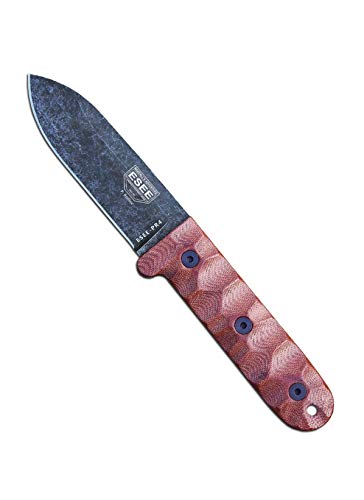


What ESEE Knives makes for hunters and campers
ESEE is a fixed-blade company. On this site its grid covers three groups:
- Fixed-blade knives: neck knives, the numbered field knives, bushcraft and skinning patterns
- Machetes: the Expat line, including a kukri-style blade
- A few extras: a fire steel and one folding knife, the Medellin II
The brand grew out of a survival school. ESEE's about page says it dates to 1997 and to Randall's Adventure & Training, and that its two principals still work on the school, the gear and customer service themselves. That history explains the lineup. These are knives sized for carrying and working, with sheaths in the box, and very few folders.
The grid above shows what's listed on Amazon right now, with filters by type. It changes as listings come and go, so I'll write about the lines and what separates them, not about how many of each are listed this week. Most of the specs come from Amazon listings, and the grid marks those values. Where a listing doesn't say, the grid shows a dash.
The steel that runs through the ESEE lineup
Before the models, the steel, because it's the same answer on almost every line of the grid. ESEE's FAQ says its carbon knives use high-carbon 1095 steel. The listings in the grid say 1095 on everything from the neck knives to the ESEE-6. The machetes list 1075, another carbon steel. A handful of knives list S35VN, a stainless powder steel.
Carbon steel trades rust resistance for easy sharpening. Morakniv's steel guide says carbon steel needs careful drying and oiling after use, is easy to resharpen, and builds a patina over time that helps protect it. Stainless resists corrosion better and asks less of you.
So the first question inside ESEE isn't really which steel. It's whether you'll wipe a blade dry at the end of a wet day. If yes, 1095 is most of the catalog. If no, look at the S35VN versions.
Lineup notes: ESEE knives by size
Izula and the neck knives
The smallest ESEE knives are built to ride on a cord around your neck or clipped to a pack strap. The listings describe:
- Izula and Izula-II: short 1095 blades under 3 inches, the II with Micarta handle scales
- Candiru: a small skeleton-style knife with a molded sheath, per its listing
- CR2.5: a small fixed blade, specs not listed
- Pinch Neck Knife: the smallest in the grid, with a blade near an inch and a quarter
These aren't field-dressing knives for a deer, and they don't pretend to be. They're for cord, tape, packaging, a splinter, a sandwich. Rule of thumb: a knife hanging off your neck is the one knife you can't leave in the truck. The boot knife page and the everyday carry knife page cover small carry knives across brands.
The ESEE-3 and ESEE-4: the middle sizes
This is the center of the lineup. Each number comes in several versions, and the letters after it change the handle, sheath or edge, not the basic knife:
- ESEE-3 family (3P, 3HM, ESEE-3 1095, ESEE-3 S35V): blades just under 4 inches, around 8 inches overall
- ESEE-4 family (4P, 4P-DT, 4S, 4HM, ESEE-4 1095, ESEE-4 S35V): blades around 4 and a half inches, about 9 inches overall
In the grid, the HM versions list Micarta handles and leather sheaths, and the P versions list molded kydex-style sheaths. The 4S lists a serrated edge. The S35V versions are the stainless option: the ESEE-3 S35V lists a G10 handle, a flat grind and a drop point.
A 4-inch drop point is the size most hunters reach for when they field dress a deer. The hunting knife page and the fixed blade knife page compare that size across brands.
The ESEE-5 and ESEE-6: the big field knives
Step up a number and the knife gets heavier work:
- ESEE-5 and Model 5 (5P-E): blades a little over 5 inches, about 11 inches overall
- ESEE-6, 6P and 6HM: blades from 6 to 6 and a half inches, up to nearly 12 inches overall
The 6HM lists a thick blade, close to three-sixteenths of an inch, with a Micarta handle and a leather sheath. These are camp and chopping-adjacent knives: splitting kindling with a baton, notching a stake, cutting brush back from a blind window. They're more knife than most people want on a belt for a deer. The survival knife page and the camping knife page cover the big fixed blades.
Bushcraft and skinning patterns
A few ESEE knives step away from the numbered pattern:
- RB3: a 3 and a half inch drop point with a scandi grind, Micarta handle and leather sheath
- JG3 and JG5 Nessmuk: leather sheaths, the JG3 with a long flat-ground blade, the JG5 a 4 and a half inch Nessmuk shape with Micarta
- PR4: a thin 1095 blade, an eighth of an inch, with Micarta and leather
- Ashley Game Skinning Knife: a 3 and a half inch 1095 blade sold as a skinner
A scandi grind is a single wide bevel straight down to the edge. It's easy to sharpen on a flat stone and good at carving wood, which is why bushcraft knives use it. A flat grind is thinner behind the edge and slices well. Bushcraft shapes are on the bushcraft knife page, and skinners are on the skinning knife page.
ESEE machetes and the Expat line
ESEE's manufacturing page says every knife with the ESEE logo is made in the USA by Rowen Manufacturing in Idaho Falls, Idaho, and that the Expat line includes knives made in the USA and overseas. Three of the four machetes in the grid carry the Expat name. All four list 1075 carbon steel and a sheath:
- Expat Darien: the longest, a little over 12 inches of blade
- Expat Libertariat: about 9 inches
- Expat Jaraca: a kukri-style blade of about 11 and a half inches, heavier toward the tip
- El Deguello: 1075 steel, length not listed
Around deer camp, a machete is for clearing shooting lanes, brush around a ground blind, and the blackberry canes that grow over the trail every August. A kukri shape puts more weight forward for chopping. More on lengths and shapes is on the machete page.
The fire steel and the folder
Two items in the grid sit outside the fixed-blade lineup. The Fire Steel is a sparking rod for starting fires, with no specs listed yet; the ferro rod page explains how they work. The Medellin II is a folding knife, and its listing names a crossbar-style lock, S35VN stainless and a Micarta handle.
ESEE's FAQ notes that its warranty doesn't cover designs made by other companies, naming the Zancudo and Avispa folders. If warranty matters to you on a folder, read the maker's terms for that exact model before you buy.
How to choose within the ESEE lineup
Pick the size by the job you do most
Start with blade length, because ESEE's numbers make it easy:
- Under 3 inches: neck knives, small chores, a backup
- Around 4 inches: the ESEE-3 and ESEE-4, field dressing and general camp work
- 5 to 6 and a half inches: the ESEE-5 and ESEE-6, camp chores and wood
- 9 inches and up: the Expat machetes, brush and lanes
Rule of thumb: buy for the job you do every trip, not the one you do once a decade. A big knife that stays home because it's heavy does less work than a small one that's on you.
Then the grind
Most of the numbered knives don't list a grind. Where they do, it's flat on the ESEE-3 S35V and the PR4, and scandi on the RB3. Pick flat for slicing and skinning, scandi for carving and sharpening on a flat stone.
Then the sheath
Every ESEE fixed blade in the grid lists a sheath, and it's the biggest difference between versions of the same number. Molded sheaths shrug off water. Leather looks right and wants drying. Try the sheath on the belt you actually hunt in, over the coat you wear in November, and with a harness on if you hunt from a stand.
Then carbon or stainless
1095 on almost everything, S35VN on a few. If your knife lives in a wet pack for a week at a time, the stainless versions ask less of you. If you like a blade you can touch up on any stone, 1095 is the common choice in this lineup.
My one opinion on this page: for field dressing, a fixed blade beats a folder because there's no pivot or lock to pack with gunk. It's one reason a lineup like this one is mostly fixed blades. Clean it with hot soapy water and dry it before it goes back in the sheath.
Care that applies to the whole ESEE lineup
ESEE's FAQ says 1095 will rust and stain if it isn't cared for, and that keeping it cleaned and lubricated is the owner's job. It suggests a dry film rust inhibitor. AKTI's maintenance guide adds the basics:
- A toothpick for dirt around the handle scales
- A light coat of oil after cleaning to keep water off the metal
- A cool, dry place for storage
- A dry sheath, because a wet one holds water against the blade
The edge is where carbon steel shows rust first. Wipe it after every use, and before the knife goes back in the sheath, not after.
On sharpening, ESEE's FAQ says the maker applies its edges by hand at about 20 degrees per side and suggests a flat diamond hone or a rod-style sharpener for upkeep. Keep the angle and you keep the edge the maker put on.
Cut away from your body, and carry a fixed blade in its sheath. AKTI's first rule is to cut away from yourself and anyone near you.
ESEE's warranty page says plainly that its knives are not throwing knives and can break if thrown. Don't throw them.
ESEE facts
Here's what I could verify on the maker's own site:
- Beginnings: 1997, with Randall's Adventure & Training, a survival school, per ESEE's about page
- Factory: knives with the ESEE logo are made in Idaho Falls, Idaho, by Rowen Manufacturing
- Expat line: made in the USA and overseas, per the same page
- Steel: high-carbon 1095 on the carbon knives, per the FAQ
- Warranty: an unconditional warranty on ESEE-made knives and Expat knives sold by ESEE; rust, wear and loss aren't covered
The about page doesn't give a formal founding date for the knife company itself, so I've left that out.
Dry it, oil it, put it back in a dry sheath. The 1095 will still be there in April, and so will the edge.
Where ESEE shows up
Questions about ESEE
Are ESEE knives good?
What's checkable is in the listings and on the maker's site. Most ESEE blades in the grid list 1095 carbon steel, a few list S35VN stainless, and every fixed blade lists a sheath. ESEE says its 1095 will rust if it isn't cared for and describes an unconditional warranty on knives it makes. Whether one suits you depends on the size and job, so pick the model by blade length and sheath first.
Where are ESEE knives made?
ESEE says all knives that carry the ESEE logo are manufactured in the USA by Rowen Manufacturing in Idaho Falls, Idaho. Its Expat line, which includes the machetes, is made in the USA as well as overseas, per the same page. Read the listing of the exact knife if the country of origin matters to you.
What warranty do ESEE knives have?
ESEE's FAQ describes an unconditional warranty on ESEE-made knives and on Expat knives sold by ESEE, and says modifications don't void it. Its warranty page excludes rust, normal wear and tear, loss, theft and cosmetic damage, and says a sharpening problem isn't a warranty matter. Designs made by other companies, such as the Zancudo and Avispa folders, aren't covered.
How do I keep an ESEE 1095 blade from rusting?
ESEE says 1095 will rust and stain if it isn't cared for, and that keeping the blade cleaned and lubricated is the owner's job. It suggests a dry film rust inhibitor. Dry the blade the same day it gets wet, pay attention to the edge, and don't store the knife in a damp sheath.
Where can I buy ESEE knives?
The product grid on this page links to ESEE listings on Amazon US, with filters by type. ESEE also runs a store on its own site. Some knives may not ship to every address; Amazon shows that at checkout. Knife carry rules vary by state, so check your state's rules before you carry one.
Sources
- ESEE Knives: About ESEE — accessed 2026-10-23
- ESEE Knives: Manufacturing — accessed 2026-10-23
- ESEE Knives: Frequently asked questions — accessed 2026-10-23
- ESEE Knives: Warranty — accessed 2026-10-23
- ESEE Knives: Expat Knives — accessed 2026-10-23
- Morakniv: Steel types and coatings — accessed 2026-10-23
- American Knife & Tool Institute: Knife safety, sharpening and maintenance — accessed 2026-10-23