Knives & Tools · Gear type
Bushcraft Knives
Bushcraft knives are fixed blades built for working wood: carving, feather sticks for a fire, notches, the odd tent peg. What sets them apart is the grind. Most use a Scandi grind, one wide flat bevel that bites into wood and lies flat on a stone, so you can sharpen it on a log in the rain. Pick the grind first, then the spine, then the steel. (My 7/16 wrench has no opinion here. I do.)
We earn a commission if you buy through our links, at no cost to you. Disclosure
| Model | Blade thickness | Blade length | Overall length | Blade steel | Steel type | Amazon |
|---|---|---|---|---|---|---|
Condor Mini Bushlore KnifeFixed blade knife More specs
| — | 3 inlisting | — | 1075listing | Carbonlisting | Check price |
Bpsknives Finn LiteFixed blade knife More specs
| — | 3.15 inlisting | 7.01 inlisting | — | — | Check price |
Helle ArvFixed blade knife More specs
| — | 3.43 inlisting | — | — | — | Check price |
Condor Trivittata Puukko 3.47"Fixed blade knife More specs
| 0.12 inlisting | 3.47 inlisting | — | 1095listing | Carbonlisting | Check price |
ESEE RB3Fixed blade knife More specs
| 0.13 inlisting | 3.5 inlisting | 8.125 inlisting | 1095listing | Carbonlisting | Check price |
Helle SpeiderFixed blade knife More specs
| — | 3.54 inlisting | — | 12C27listing | Stainlesslisting | Check price |
Morakniv Risberg C CloudberriesFixed blade knife More specs
| 0.126 inlisting | 3.58 inlisting | — | C100Slisting | Carbonlisting | Check price |
Helle HardingFixed blade knife More specs
| — | 3.94 inlisting | — | — | — | Check price |
Helle EggenFixed blade knife More specs
| — | 3.98 inlisting | — | — | — | Check price |
Bpsknives Savage Bushcraft KnifeFixed blade knife More specs
| — | 4.25 inlisting | 9 inlisting | — | — | Check price |
Bpsknives BS2FT CSH Left HandFixed blade knife More specs
| — | 4.25 inlisting | 9 inlisting | — | — | Check price |
Bpsknives B1 SSH Survival KnifeFixed blade knife More specs
| — | 4.3 inlisting | 9.25 inlisting | — | — | Check price |
Condor Bushlore Bushcraft KnifeFixed blade knife More specs
| — | 4.3 inlisting | — | 1075listing | Carbonlisting | Check price |
Morakniv KansbolFixed blade knife More specs
| 0.1 inlisting | 4.3 inlisting | — | — | Stainlesslisting | Check price |
Morakniv Garberg Survival KitFixed blade knife More specs
| 0.13 inlisting | 4.3 inlisting | — | — | — | Check price |
Morakniv Kansbol with Fire StarterFixed blade knife More specs
| 0.1 inlisting | 4.3 inlisting | — | — | Stainlesslisting | Check price |
Condor CaveloreFixed blade knife More specs
| — | 4.31 inlisting | 9.32 inlisting | — | — | Check price |
Condor BisonteFixed blade knife More specs
| — | 4.7 inlisting | — | 1095listing | Carbonlisting | Check price |
Helle NordlysFixed blade knife More specs
| — | 4.8 inlisting | — | 14C28Nlisting | Stainlesslisting | Check price |
Bpsknives HK6Fixed blade knife More specs
| — | 5 inlisting | 9 inlisting | — | — | Check price |
Condor WayfinderFixed blade knife More specs
| — | 5.3 inlisting | — | 1095listing | Carbonlisting | Check price |
Helle JegermesterFixed blade knife More specs
| — | 5.32 inlisting | — | 12C27listing | Stainlesslisting | Check price |
Bpsknives AdventurerFixed blade knife More specs
| — | 5.33 inlisting | 10 inlisting | — | — | Check price |
Helle NordFixed blade knife More specs
| — | 5.79 inlisting | — | 14C28Nlisting | Stainlesslisting | Check price |
BeaverCraft Bushcraft Knife Full Tang Fixed BladeFixed blade knife More specs
| — | — | — | — | — | Check price |
BÖKER Bronco Green ScandiFixed blade knife More specs
| — | — | — | CPM-3Vlisting | — | Check price |
Bpsknives BK06 Camp KnifeFixed blade knife More specs
| — | — | — | — | — | Check price |
Bpsknives B1 CSHFixed blade knife More specs
| — | — | 9.45 inlisting | 1066listing | Carbonlisting | Check price |
Bpsknives KiridashiFixed blade knife More specs
| — | — | — | — | — | Check price |
Bpsknives HK5 CSH Left-HandedFixed blade knife More specs
| — | — | — | — | — | Check price |
Bpsknives Finn WorkerFixed blade knife More specs
| — | — | — | — | — | Check price |
Condor Primitive MountainFixed blade knife More specs
| — | — | — | 1075listing | Carbonlisting | Check price |
Condor Terrasaur DesertFixed blade knife More specs
| — | — | — | 1095listing | Carbonlisting | Check price |
Condor Terrasaur BlackFixed blade knife More specs
| — | — | — | 1095listing | Carbonlisting | Check price |
Gerber Principle Plain EdgeFixed blade knife More specs
| — | — | 7.5 inlisting | — | — | Check price |


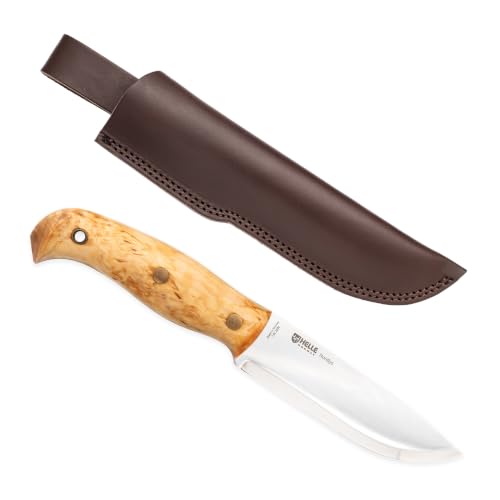


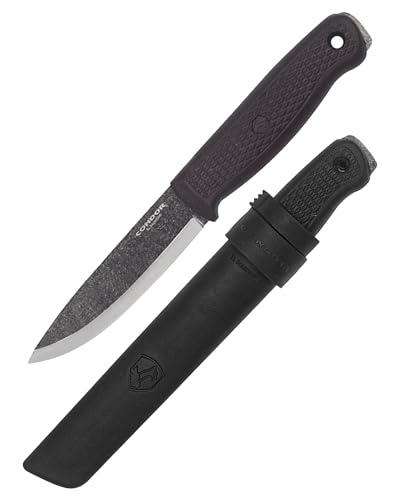

What’s in this listFixed blades with a Scandi grind, as stated by the maker or the Amazon listing — the flat bevel bushcrafters favor for carving and feathering sticks. “—” means neither the maker nor the Amazon listing states it.
What makes a bushcraft knife different
Here's the thing. Every knife on this page cuts. What makes a bushcraft knife its own animal is that it's built to shape wood, all day, in your hand, without wearing you out.
Benchmade's bushcraft page lists the work: batoning hardwood, making feather sticks for fire, carving shelter pegs, and processing food. Montana Knife Company's comparison sums up bushcraft as carving, fire prep and campcraft. Notice what isn't on the list. Prying open things. Digging. That's survival-knife work.
So the bushcraft knife makes a few trades on purpose:
- Grind: usually Scandi, for clean bites into wood
- Handle: rounded, so your grip can shift between cuts
- Guard: small or none, so your hand can choke up near the edge
- Spine: square corners, so a ferro rod throws sparks off it
- Sheath: easy in, easy out, sometimes hung low on a dangler
The shared basics of fixed blades (what a tang is, how steels differ, how sheaths work) are on the fixed blade knife page. Here we stay with the parts that change once wood is the main job.
Our table only takes fixed blades with a Scandi grind, as the maker or the Amazon listing states it. Columns cover blade length, overall length, steel and steel type, grind, tang, handle, sheath and, where stated, blade thickness (maker or listing) and weight (maker only). The table marks values that come from the listing, and a dash means neither states it.
What to look at in bushcraft knives
Shop class taught me this before I ever taught it. Every tool has one spec that decides it, and a few that follow. On a bushcraft knife, the grind decides. My one opinion on this page: pick the grind before the steel. The grind sets how the blade enters wood and how you'll sharpen it in the field. The steel only sets how often.
Choose the Scandi grind if carving is the main job
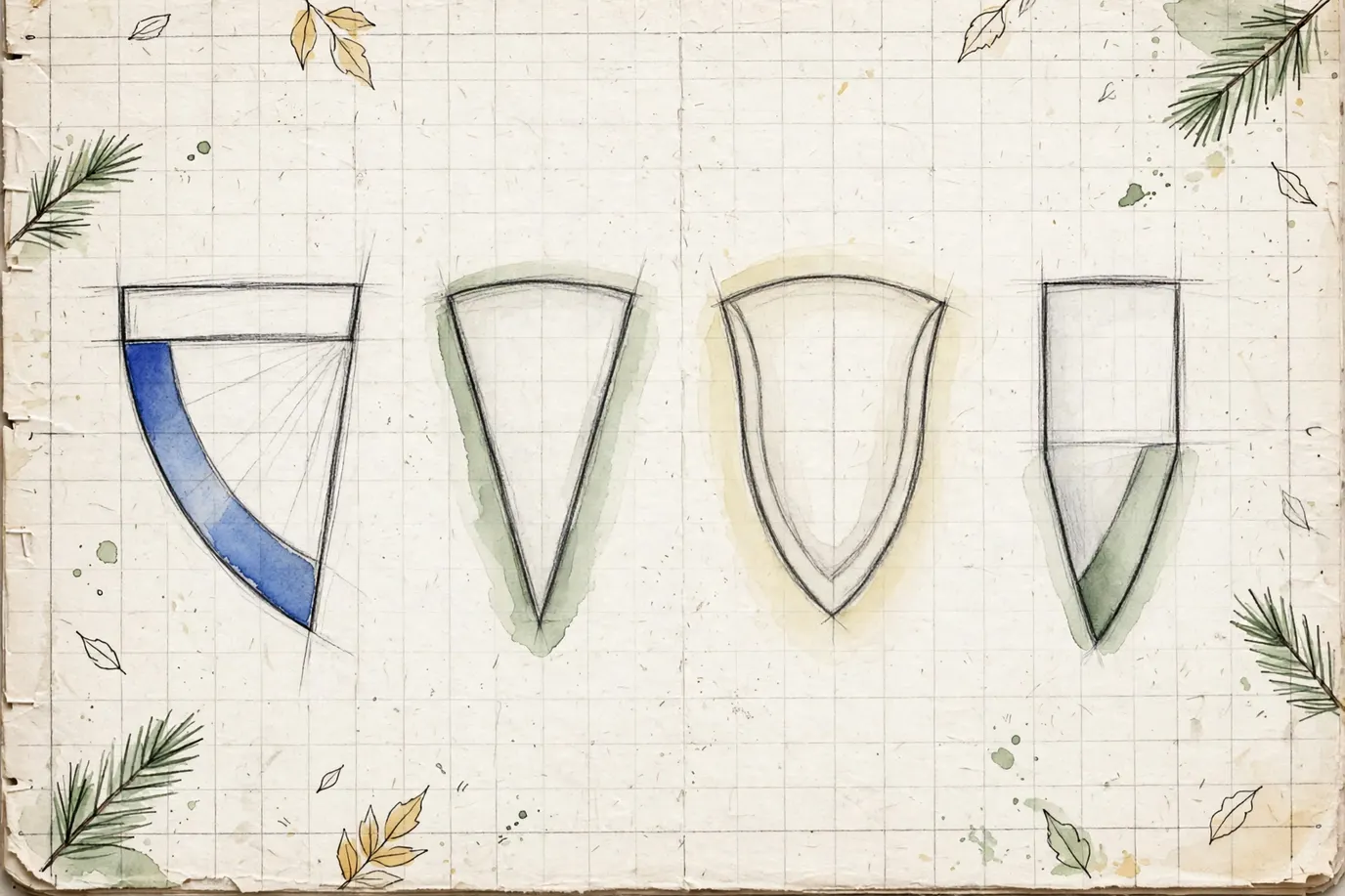
A grind is the shape of the blade in cross-section, from spine to edge. A Scandi grind is one wide flat bevel on each side, running down to the edge, with no second bevel on top of it. Morakniv lists its Scandi knives for bushcraft, woodcarving and all-round outdoor use.
Why does it carve well? That wide bevel acts like the sole of a hand plane. You lay it on the wood and it rides there, and the edge takes a shaving as thick as you angle it. Morakniv's grind guide lists the total edge angle as 23 degrees on blades up to 2.5 mm thick and 27 degrees on thicker blades.
Morakniv also adds a tiny micro bevel at the very edge, about 35 to 45 degrees total and 0.05 to 0.5 mm high, to make it less fragile and hold the edge longer. Its zero-grind carving knives skip the micro bevel. Morakniv says that makes them sharper and more aggressive, but more delicate and more work to maintain.
The other grinds have their own jobs, per the same Morakniv guide. A full flat grind is aimed at cooking and slicing. Its profile grind is shaped for meat and hide. Convex edges are common on axes and survival knives, and hollow grinds leave a very thin, sharp edge that isn't as tough. If the deer gets more of your knife than the woodpile does, look at the hunting knife page instead.
Look for a sharp-cornered spine if you carry a ferro rod
A ferro rod is a sparking rod for starting fires. You scrape it with something hard and sharp-cornered, and the knife spine is the handiest thing you own.
Montana Knife Company's comparison notes that many bushcraft knives have a spine ground sharp for striking a ferro rod and scraping tinder. That saves your cutting edge from the job. Not every spine qualifies. Morakniv lists three: a polished 2.0 mm spine that isn't made for fire starters, a ground and polished 2.5 mm spine that isn't suitable for them either, and a ground, unpolished 3.2 mm spine whose sharp corners suit fire starters.
So polish is not a virtue here. A table column flags a sheath that comes with a fire starter or sharpener. Spine corners aren't in any column, so read the maker's description.
Rods themselves get their own ferro rod page, and the method is in the ferro rod guide.
Blade thickness sets what it can survive
Thickness is the blade stock at the spine. Thin stock carves easily and weighs little. Thick stock takes batoning and twisting without flexing.
Benchmade's bushcraft page puts the spine for batoning and heavy chopping around 4 to 5 mm or more. Montana Knife Company's batoning article says at least 5/32 inch, which is a hair under 4 mm. Its bushcraft-versus-survival comparison notes that survival knives tend to run thicker stock than bushcraft knives.
Rule of thumb: if you mostly carve and feather, a thinner bushcraft blade feels better at hour two. If you plan to split a lot of kindling with it, go thicker. The table lists thickness where the maker or the listing does. Plenty don't, which tells you something too.
Blade length for control, not for show
Shorter blades give you control. Longer blades give you reach. Morakniv says exactly that about its own outdoor range.
Montana Knife Company's comparison page says bushcraft blades typically run three to five inches, for carving control. Longer blades exist, and they split bigger wood. They also get in the way when you're feathering a stick the width of your thumb. That's two kinds of bushcraft: one carves, one splits.
Measure twice here. Buy for the job you'll do most often, not the biggest log you can imagine.
Carbon or stainless steel
Steel type is the column that starts arguments at the cabin. Morakniv's summary is fair: carbon steel offers better sharpness and is easier to sharpen, but needs more maintenance. Stainless resists rust and needs less care, which helps in humid places.
Morakniv is careful to say stainless is rust-resistant, not rust-proof. Leave it wet and it will still stain. Carbon steel will rust faster, and Morakniv's care page says to dry it and give it a layer of food-grade or mineral oil.
Carbon also turns gray with use. That's a patina, a dark oxide layer, and Morakniv says it gives some extra protection. It even suggests starting one on purpose by sticking the blade in an apple or treating it with warm vinegar. (The apple is not for eating afterward. Danny learned that one on his own.)
Montana Knife Company lists 1095, 3V and 52100 as popular steels for both bushcraft and survival knives. Where the maker or the listing names the grade, the table prints it; otherwise you get the plain class.
Full tang or not
The tang is the part of the blade that runs into the handle. Morakniv says a full tang runs the length of the handle and adds strength for chopping or prying, while a knife without a full tang is lighter and more comfortable to carry but not as strong.
Benchmade's bushcraft page says full-tang construction removes weak points under hard use, and Montana Knife Company's batoning guide calls for a full tang. So the tang question is really a batoning question. Plenty of fine carving knives have a partial tang. If you'll pound on the spine with a stick, the full tang earns its weight. A blank tang cell means unstated, not absent.
A handle you can hold three ways
Carving means changing grips every few cuts: forehand, chest lever, thumb on the spine. Montana Knife Company says bushcraft handles are rounded to support that, while survival handles are flat-sided. Benchmade's page adds that the handle has to hold securely when your hands are wet or cold.
The table lists handle material as the maker or the listing gives it. Wood, plastic, rubber, G10, Micarta (a resin-and-linen composite). All of them work. A handle that's comfortable at minute one and a blister at hour two is the one to skip, and only your hand can tell you that.
A sheath you can use one-handed
Montana Knife Company says bushcraft sheaths favor easy access and may hang on a dangler, a short strap that lets the knife ride lower on the belt. Survival sheaths add secondary retention and mounting systems.
The table shows sheath material where it's stated. Montana Knife Company's sheath article says leather absorbs water, swells and softens, and its tanning chemicals can contribute to pitting on a blade over time, even on stainless. Kydex (a molded plastic) doesn't absorb moisture and doesn't need breaking in, but it clicks on the draw. Leather is quieter. Pick your trade.
Bushcraft knife setups that make sense
The carving-first knife
A thin to medium Scandi blade, short enough to choke up on, rounded handle, light sheath. This is the one for spoon blanks, pot hooks and feather sticks. If carving is the whole point, the whittling knife page covers smaller, sharper blades.
The camp all-rounder
A thicker Scandi or flat blade, full tang, squared spine, a sheath with a loop or pouch for a ferro rod. It carves, splits kindling and throws sparks. It's heavier on the belt, so you notice it on a long walk in.
When you actually want a survival knife
If the knife has to pry, dig, and take a beating as your only tool, the trades flip. Thicker stock, a guard, a flat-sided handle and a sheath with extra retention. Those are on the survival knife page.
Batoning with a bushcraft knife
Batoning means splitting wood by tapping the knife's spine with another stick. Montana Knife Company's batoning guide lays out the method:
- Stand the wood on end on solid ground, knife edge on top.
- Position it so a third or more of the blade overhangs the wood.
- Hold the handle and strike the spine with a wooden baton.
- Keep striking the part that sticks out as the blade sinks.
- Keep the blade straight; an angled strike can break it.
Never baton with a rock or a piece of metal. Don't force the blade through a knot; try the other end. For a log bigger around than your arm, the same guide says get a hatchet. That's not cheating. That's the right tool. A bushcraft knife is a carving tool that can split kindling, not a splitting maul with a nice handle.
Sharpening and care
A Scandi grind is the easiest knife edge to sharpen in the field, because the bevel tells you the angle. Work Sharp's angle guide puts it simply: on a Scandi, the primary grind is the sharpened bevel. So you sharpen the whole bevel, flat to the stone. Morakniv's marker trick helps: color the bevel, take a stroke, and adjust until the color comes off evenly. Then feel for a burr (a thin curl of steel) along the edge, and work both sides evenly with light strokes.
Morakniv says to always strop afterward to remove the burr, and if you don't own a strop, the back of a leather belt with polishing paste will do. Plain and simple.
Care is short. Morakniv says clean the knife right after use, never let it air dry, wipe it with a towel, and oil carbon steel. Keep it out of the dishwasher; the detergent and heat can damage the steel, the edge and the handle. Keep the sheath dry and check its loops and stitching now and then.
Jess's take: "A Scandi bevel is the only angle in camp nobody has to measure." She's right, and it bothers her a little.
Carve safely
Carve away from your body, keep the hand holding the wood behind the edge, and keep other people out of arm's reach. Case's whittling tips add a thick cover on your lap and a thumb guard or cut-resistant glove, and Morakniv suggests protective gloves for beginners. Keep the edge keen; a blade you have to force is the one that slips.
Who should skip bushcraft knives
Deer-only knife? Then this isn't your page. A Scandi edge will dress a deer, but a hunting knife or a skinning knife is shaped for it. If you want one knife that rides in your pocket every day, a folder fits better; that's the pocket knife page. And if you never build a fire without a lighter and never carve anything but the turkey, a plain fixed blade will do fine.
Rules on wearing a fixed blade away from camp differ from place to place; check your state's rules.
Buy the grind for the job. The rest is just steel.
Brands in this list
Related
Questions people ask
What is a bushcraft knife?
It's a fixed-blade knife made mainly for woodcraft: carving, making feather sticks, splitting kindling and striking a ferro rod. Most have a Scandi grind, a rounded handle for changing grips, a spine with square corners, and no big guard. Montana Knife Company puts the usual blade length at three to five inches for carving control.
What's the difference between a bushcraft and a survival knife?
Purpose. A bushcraft knife is a carving tool for long days at camp. A survival knife is built to take abuse: prying, digging, heavy batoning. Montana Knife Company's comparison says survival knives tend to run thicker stock, a saber or convex grind, a guard, a flat-sided handle and a sheath with secondary retention. Bushcraft knives favor a Scandi grind and a rounded handle.
What makes a good bushcraft knife?
A grind that carves well and sharpens easily (usually Scandi), a ground spine with sharp corners if you'll use a ferro rod, a fixed blade with a strong tang, a handle that stays put when wet, and a sheath that's easy to get the knife in and out of. Steel comes after that: carbon if you'll oil it, stainless if you won't.
Should a bushcraft knife be carbon or stainless steel?
Either works. Morakniv says carbon steel takes a sharper edge and is easier to sharpen but needs drying and oiling, while stainless needs less care and suits humid places. Stainless is rust-resistant, not rust-proof, so it still gets wiped dry. Pick by how you'll treat it, not by the label.
Sources
- Morakniv: Grinds and edge angles — accessed 2026-10-22
- Morakniv: Steel types and coatings — accessed 2026-10-22
- Morakniv: How to take care of your knives — accessed 2026-10-22
- Morakniv: Find the right outdoor knife — accessed 2026-10-22
- Morakniv: How to sharpen a knife — accessed 2026-10-22
- Morakniv: Whittling for beginners — accessed 2026-10-22
- Work Sharp: Knife sharpening angles explained — accessed 2026-10-22
- Montana Knife Company: Bushcraft knife vs. survival knife — accessed 2026-10-22
- Montana Knife Company: Batoning wood with a knife — accessed 2026-10-22
- Montana Knife Company: Kydex vs. leather sheath — accessed 2026-10-22
- Benchmade: Survival and bushcraft knives — accessed 2026-10-22
- Case Knives: Whittling safety tips — accessed 2026-10-22