


Grizzly Coolers Grizzly 15
Good for one person's lunch and drinks, or a day sit, in the smallest box here at 15 quarts and 12 lb by the maker.
Skip it if you need room for meat or a weekend of food.
Camp Gear · Best-of list
The best coolers for camping are the ones sized to the trip, because a cooler full of ice beats a bigger one full of air. This list holds hard coolers whose maker or Amazon listing states capacity, construction and weight, and it runs from small to large, so you read it like a size chart, not a podium. Every one here is rotomolded, by its maker's word. (Jess calls me "the cooler guy." She means it as a rank. I've decided to take it as one.)
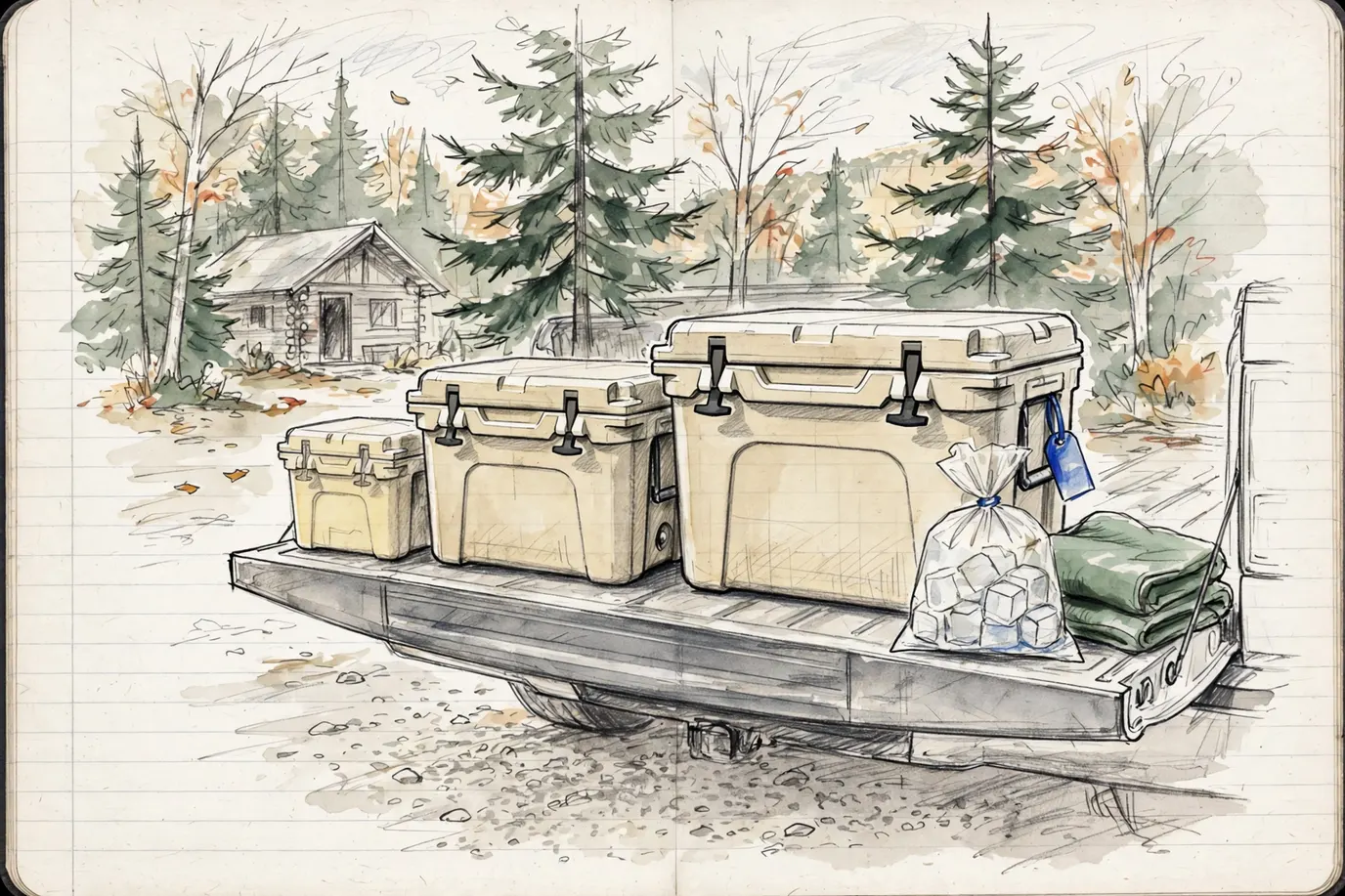
How this list is builtHard coolers whose maker or Amazon listing states capacity, construction and weight, from small to large. Weights are the maker's own figures.
We earn a commission if you buy through our links, at no cost to you. Disclosure
| Model | Weight | Capacity | Ice retention (claimed) | Drain plug | Amazon |
|---|---|---|---|---|---|
Grizzly Coolers Grizzly 15Hard cooler More specs
| 12 lbmaker | 15 qtlisting | — | — | Check price |
Grizzly Coolers Grizzly 15Hard cooler More specs
| 12 lbmaker | 15 qtlisting | — | — | Check price |
Blue Coolers Cobalt 25Hard cooler More specs
| 14.3 lbmaker | 25 qtlisting | 3 dayslisting | — | Check price |
Blue Coolers Cobalt 25Hard cooler More specs
| 14.3 lbmaker | 25 qtlisting | 3 dayslisting | — | Check price |
Engel ENG35Hard cooler More specs
| 22 lbmaker | 35 qtlisting | 10 daysmaker | Yesmaker | Check price |
Engel ENG50Hard cooler More specs
| 24 lbmaker | 48 qtlisting | 10 daysmaker | Yesmaker | Check price |
Dometic Patrol 55Hard cooler More specs
| 33.08 lbmaker | 58.1 qtlisting | — | — | Check price |
Good for one person's lunch and drinks, or a day sit, in the smallest box here at 15 quarts and 12 lb by the maker.
Skip it if you need room for meat or a weekend of food.
Good for a 15-quart rotomolded lunch cooler with the same maker figures as the other Grizzly 15 listing, 12 lb and 18.75 inches long.
Skip it if you want a drain plug or an ice-days figure in the data.
Good for a day trip or overnight for one or two, at 25 quarts and 14.3 lb, the lightest per quart under 30 quarts.
Skip it if you need exterior dimensions before buying; the maker data doesn't list them.
Good for the same Cobalt 25 numbers in a second listing, 25 quarts and 14.3 lb, with 3 days of ice on the Amazon listing.
Skip it if you want a drain plug confirmed in the data or room for a weekend.
Good for a two-person weekend, 35 quarts, 36 cans on the listing, a drain plug and 10 days of ice by the maker's claim.
Skip it if your trunk is short; it's the second-longest box here at 25.5 inches.
Good for a long weekend or the meat run, 48 quarts on the listing at 24 lb, only 2 lb more than the ENG35.
Skip it if you carry it alone up stairs; at 18.25 inches it's the tallest here.
Good for the biggest load on the list, 58.1 quarts on the listing, for a week of food or a deer quartered and bagged.
Skip it if one person lifts it; the maker lists 33.08 lb empty, in a higher price tier.
This is a size chart with buttons. The table starts with the smallest box and ends with the biggest, so the first question is how many quarts your trip needs, and the second is whether you can lift that cooler once it's full.
Every cooler here is a hard cooler, and every one is rotomolded by its maker's own description. That's not a filter I added for looks. The rule picked coolers whose maker or Amazon listing states three things: capacity, construction and weight. The ones that made it all happened to be rotomolded.
Two models show up twice because two listings carry the same cooler. The numbers match, so the verdicts read alike. That's the data being honest, not me running out of words. (Renee would like it noted that I never run out of words about coolers.)
The Grizzly 15 holds 15 quarts by the Amazon listing. The maker gives 12 lb empty and an outside size of 18.75 x 11.5 x 14.5 inches. That makes it the smallest, lightest and shortest box on the list. It's the heaviest per quart, though, at 0.8 lb for each quart of space, which is what thick rotomolded walls do to a small box. The data doesn't list a drain plug or an ice-days figure for it. Think lunch, drinks and a sandwich for a long sit.
The Cobalt 25 holds 25 quarts by the listing and weighs 14.3 lb by the maker. That's about 0.57 lb per quart, the best ratio among the small boxes here. The Amazon listing states 3 days of ice. The maker data doesn't give outside dimensions, so measure your back seat against the listing photos before you count on a fit. It's a day-trip or overnight size for one or two people.
The ENG35 holds 35 quarts and 36 cans by the listing. Engel lists 22 lb, a drain plug, and an outside size of 25.5 x 15 x 15.25 inches. Engel also claims up to 10 days of ice, which is a lab-style number like every ice claim (more on that below). It's long and low, the second-longest box on the list, and at 15 inches across it slides between wheel wells better than the wider coolers.
The ENG50 holds 48 quarts and 60 cans by the listing, despite the 50 in the model name. Engel lists 24 lb, a drain plug, a 10-day ice claim and 24.25 x 17.5 x 18.25 inches outside. Quick ice math: that's 0.5 lb per quart, the lowest on the list. It's also shorter than the ENG35 but taller and wider, so it trades trunk length for height. At 18.25 inches, it's the tallest cooler here.
The Patrol 55 holds 58.1 quarts and 43 cans by the listing. Dometic lists 33.08 lb empty and 29.8 x 18.82 x 16.42 inches outside, the longest and widest box on the list. The data has no ice-days figure or drain plug listed for it. It sits in a higher price tier than the other six. This is the one for a week of groceries or a quartered deer, and it's a two-person lift once it's loaded.
Capacity is the inside volume in quarts. A quart is a quarter gallon, and NIST defines the US liquid quart as exactly 57.75 cubic inches. That number tells you how much a cooler gives up to its walls.
Quick ice math on the Engel ENG35: 25.5 x 15 x 15.25 inches outside is about 5,833 cubic inches. Thirty-five quarts inside is about 2,021 cubic inches. So roughly a third of the box is space for stuff. The other coolers with listed dimensions land in the same neighborhood, from about 28% for the Grizzly 15 to about 36% for the Patrol 55. Rotomolded walls are thick, and the outside size runs big for the quarts you get.
Then take away the ice. Engel suggests filling about two-thirds with ice and one-third with food and drinks. Run that on a 48-quart cooler and you get about 16 quarts of groceries. That's the number to plan the menu around.
Igloo's size guide gives a rough ladder. Personal coolers, 15 quarts or less, cover lunches. Medium coolers, about 16 to 50 quarts, cover weekend trips. Large coolers, 40 quarts and up, cover long family weekends.
My one opinion on this page: pick the smallest cooler that holds the trip, ice included. Grizzly's ice guide says air speeds melting, so empty space in a big cooler costs you ice. A half-full 58-quart box isn't extra room. It's a warm attic with a lid.
The listed weight is empty. Ice and meltwater are the heavy part of any trip, so the full cooler is the number your back meets. A 48-quart cooler packed two-thirds with ice is carrying about 32 quarts of it before a single steak goes in.
On this list, the empty weights go 12, 14.3, 22, 24 and 33.08 lb. Look at the jump between the 48-quart and the 58-quart: 10 more quarts, 9 more pounds of cooler. Walt's rule for heavy things at camp applies here, and he says it every November: "If it takes two to carry, it takes two to decide." He has never once volunteered to be the second person.
Rotomolding, per Grizzly's explainer, puts powdered plastic in a hollow mold that's heated and turned on two axes. The plastic coats the inside of the mold and hardens into one piece. You get even walls and extra material in the corners. That's why these coolers are heavy and why they shrug off a truck bed.
This page only calls a cooler rotomolded when its maker says so. All seven here do. If you're shopping a cooler not on this list and the maker doesn't say how it's built, don't assume.
Two coolers on this list carry a maker's 10-day claim, and one carries a 3-day figure from its Amazon listing. Here's how one maker runs that kind of test. Igloo fills the cooler to 90% with ice chilled to 10°F, keeps the lid shut in a 90°F room, and stops the clock when the inside reaches 40°F.
Your weekend opens the lid. It puts the cooler in a truck bed, then next to a fire ring. So compare claims between coolers if you like, but expect fewer days at camp. Engel's ice page says shade can double ice life, and Grizzly's says ice melts twice as fast in direct sun.
The two Engels list a drain plug. The others don't in the data, which doesn't mean they lack one; it means it isn't stated, so check the listing photos. Meltwater stays in until the end (Engel and Grizzly both say it insulates the ice), so a plug matters most on Sunday.
Length matters more than people think. The boxes here run from 18.75 to 29.8 inches long. Measure the spot in the vehicle where the cooler rides, with the tailgate or hatch closed.
Keep the food cooler at 40°F or colder. The FDA says perishable food shouldn't sit out more than 2 hours, or 1 hour above 90°F. Penn State Extension says to cool venison quickly to 35 to 40°F and hold it at 40°F or below for two to three days at most if you process it yourself. It also says not to put a warm deer in a car trunk. A cooler of bagged ice is part of the plan, not the whole plan.
Game-meat transport rules vary. Check your state wildlife agency before the drive home.
Dry ice turns into carbon dioxide gas as it warms. Erie County's health department says to store it in a container that allows some leakage, handle it with insulated gloves, keep it out of children's reach, and keep vehicle windows open when you haul it. Never put dry ice in a closed truck cap or small, unvented space where people sit or sleep.
In bear country, the Interagency Grizzly Bear Committee says an unlocked cooler is not considered bear resistant, and certified coolers must be secured with a padlock, carabiner or bolts. Check the IGBC list for the model number and your land agency's food-storage rules.
If you hunt from a stand within sight of the truck and come back to the cabin for lunch, skip it. A hard rotomolded cooler is a lot of box for a sandwich. The soft cooler page and the backpack cooler page fit that day better.
Skip it too if you have power where you camp and run a cooler every day of a long trip. Buying ice daily adds up, and a car fridge or an electric cooler might fit better. And if what you need is wheels, this list doesn't sort by them; the cooler with wheels page does.
The rule is simple and the table shows it. A cooler makes the list when it's a hard cooler and its maker or Amazon listing states its capacity, its construction and its weight. The list then runs from the smallest capacity to the largest, with at most two listings per brand so one maker can't fill the table.
Values come from the maker's own product pages first. Where the maker is silent, the Amazon listing fills in, and the table marks those values. On this list, capacity and can counts come from the listings; weight, construction, dimensions, the Engel ice claims and drain plugs come from the makers. A blank means neither source states it.
The list is checked again every week. Listings drop off, new coolers that meet the rule show up, and the order can change. Nothing here is ranked by ratings or by what anyone at Hemlock Run owns. Price is shown only as a tier, never as a number.
Size it by the trip, weigh it full, and pack the ice first. The cooler that still has ice on Sunday is the one somebody packed on Thursday.
Igloo's size guide puts medium coolers, roughly 16 to 50 quarts, in the weekend-trip slot, and large coolers, 40 quarts and up, in the long-family-weekend slot. For two people over two nights, the 35 and 48 quart coolers on this list sit in that middle. Size up for meat, not for drinks; a second small cooler handles the drinks.
Rotomolding means powdered plastic goes into a hollow mold that is heated and turned slowly on two axes until the melted plastic coats the walls. Grizzly's explainer says the result is a one-piece shell with even walls and extra material in the corners. Every cooler on this list is rotomolded, as its maker states.
Ice-days claims come from lab tests, not campsites. Igloo describes its test: fill the cooler 90% with ice at 10°F, keep the lid shut in a 90°F room, and stop when the inside hits 40°F. Your trip opens the lid. Pre-chilling, block ice, shade and a separate drink cooler move the real number more than anything on the label.
Not during the trip, according to Engel and Grizzly. Meltwater is nearly as cold as the ice and helps keep the rest of it frozen. Drain at the end. Keep bare food out of the water: bag meat and anything that can soak through, and use the drain plug once you're packing up.
Erie County's health department says dry ice should go in a container that allows some leakage, because the gas it releases builds pressure in a sealed box. Handle it with insulated gloves, keep it away from children, and keep vehicle windows open when you haul it. Check your cooler maker's instructions before you latch a lid on dry ice.