Archery & Bowhunting · Gear type
Recurve Arrows
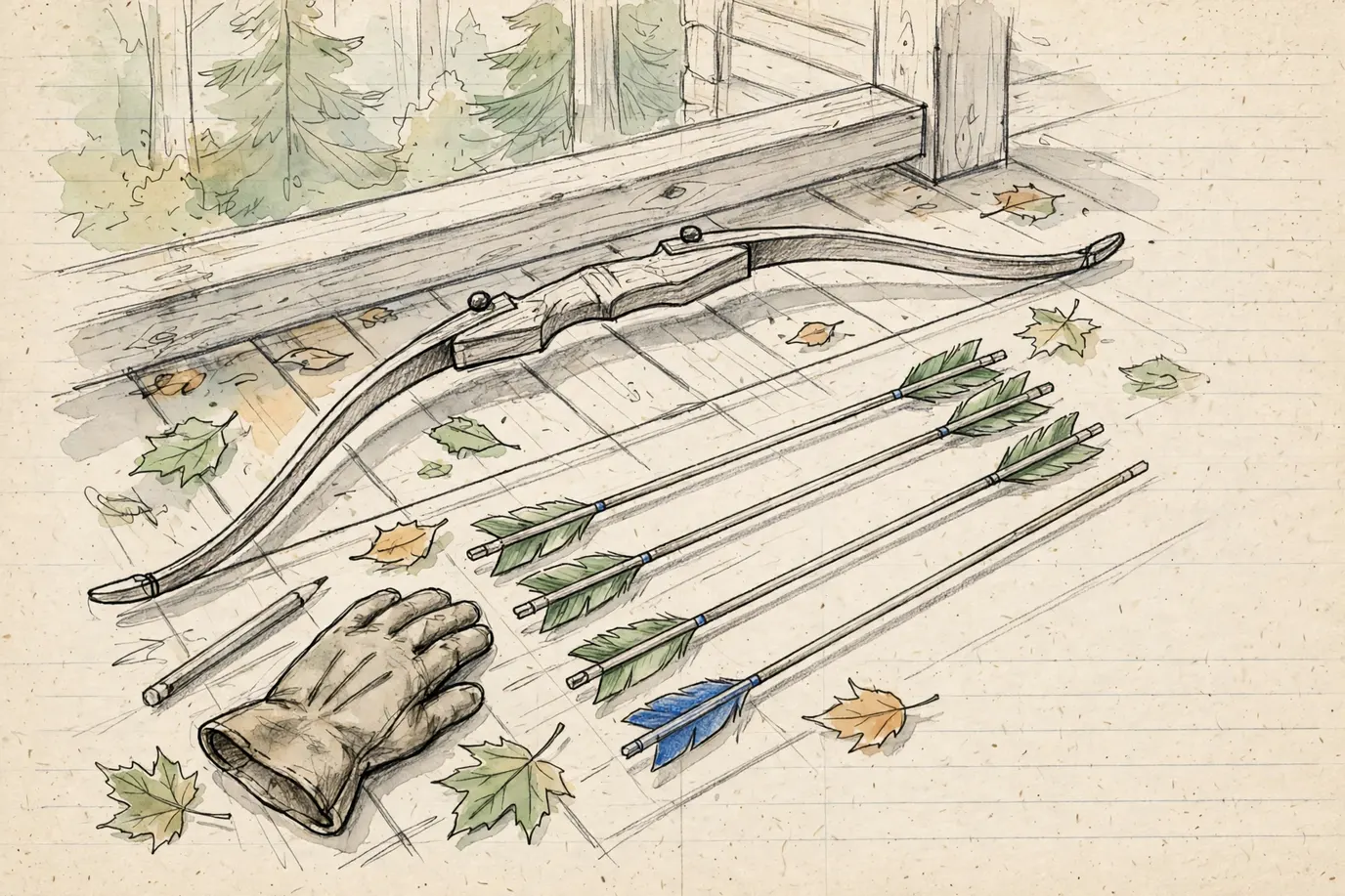
Recurve arrows leave the bow off your fingers and usually off a shelf, so they bend sideways and brush the bow on the way out. That's why they need feathers more often than vanes, and a spine picked for the weight you actually hold, not the number printed on the limb. Wood, carbon or aluminum all work if the spine fits. (Uncle Walt would like it noted that he has said this since before carbon existed.)
We earn a commission if you buy through our links, at no cost to you. Disclosure
| Model | Shaft | Spine | Diameter (ID) | Straightness | Arrows per pack | Amazon |
|---|---|---|---|---|---|---|
Accmos 32in Carbon Arrows 400 SpineArrow More specs
| Carbonlisting | 400listing | — | — | 6listing | Check price |
Accmos 28in Carbon Arrows 800 Spine 6-PackArrow More specs
| Carbonlisting | 800listing | 0.244 inlisting | 0.006 inlisting | 6listing | Check price |
Accmos Custom Length Feathered Carbon ArrowsArrow More specs
| Carbonlisting | — | 0.244 inlisting | 0.006 inlisting | — | Check price |
Accmos Custom Length Feathered Carbon ArrowsArrow More specs
| Carbonlisting | — | 0.244 inlisting | 0.006 inlisting | — | Check price |
Ameyxgs Wooden Arrows 6-PackArrow More specs
| Woodlisting | — | — | — | 6listing | Check price |
Ameyxgs 31.5in Carbon Arrows with FeathersArrow More specs
| Carbonlisting | 500listing | 0.244 inlisting | — | 12listing | Check price |
Ameyxgs 34in Carbon Arrows 400 SpineArrow More specs
| Carbonlisting | 400listing | 0.244 inlisting | — | 12listing | Check price |
Ameyxgs 30in Flu Flu Carbon Arrows 500 SpineArrow More specs
| Carbonlisting | 500listing | 0.244 inlisting | — | 12listing | Check price |
Ameyxgs 30in Flu Flu Carbon Arrows 500 SpineArrow More specs
| Carbonlisting | 500listing | 0.244 inlisting | — | — | Check price |
Ameyxgs 34in Carbon Arrows 500 Spine with FeathersArrow More specs
| Carbonlisting | 500listing | — | — | 12listing | Check price |
Black Eagle Vintage Traditional Feathered 500Arrow More specs
| — | 500listing | — | — | 6listing | Check price |
Easton Carbon Legacy 500Arrow More specs
| Carbonlisting | 500listing | — | — | 6listing | Check price |
Gold Tip Traditional XT 600Arrow More specs
| Carbonlisting | 600listing | — | 0.003 inlisting | 6listing | Check price |
Gold Tip Traditional XT Shafts 340Arrow More specs
| — | 340listing | — | — | 12listing | Check price |
Gold Tip Traditional Shafts 400Arrow More specs
| — | 400listing | — | — | 12listing | Check price |
Gold Tip Traditional XT Shafts 500Arrow More specs
| Carbonlisting | 500listing | — | 0.003 inlisting | 12listing | Check price |
Linkboy Archery Wood Skin Carbon ArrowsArrow More specs
| Carbonlisting | 450listing | 0.244 inlisting | 0.003 inlisting | 12listing | Check price |
Linkboy Archery Carbon Arrows Shaft Kit 100gr TipArrow More specs
| Carbonlisting | 500listing | — | — | 12listing | Check price |
Linkboy Archery 30inch Carbon Arrow 0.001Arrow More specs
| Carbonlisting | — | 0.244 inlisting | 0.001 inlisting | 12listing | Check price |
Linkboy Archery Camo Carbon Hunting ArrowsArrow More specs
| Carbonlisting | — | — | 0.003 inlisting | 12listing | Check price |
Linkboy Archery 30inch Carbon Arrow Gradient FeatherArrow More specs
| Carbonlisting | — | 0.244 inlisting | 0.003 inlisting | 12listing | Check price |
Lwano 31in Feather Carbon ArrowsArrow More specs
| Carbonlisting | — | — | — | — | Check price |
Lwano 30in Carbon Arrows Turkey FeatherArrow More specs
| Carbonlisting | 500listing | — | — | 12listing | Check price |
Lwano 30" Carbon Arrows Spine 500Arrow More specs
| Carbonlisting | 500listing | — | — | 12listing | Check price |
Lwano 31" Carbon Arrows Spine 500Arrow More specs
| Carbonlisting | 500listing | — | — | 12listing | Check price |
Nika Archery Carbon Feather Arrows SP400Arrow More specs
| Carbonlisting | 400listing | 0.244 inlisting | 0.012 inlisting | 12listing | Check price |
Pandarus 31 in Carbon Feather ArrowsArrow More specs
| Carbonlisting | 500listing | 0.244 inlisting | 0.006 inlisting | 6listing | Check price |
Pandarus 31 in Carbon Feather ArrowsArrow More specs
| Carbonlisting | 500listing | 0.244 inlisting | 0.006 inlisting | — | Check price |
Sharrow 31in Carbon Arrows 500 SpineArrow More specs
| Carbonlisting | 500listing | — | — | 12listing | Check price |
Sharrow Carbon Arrow 34in Turkey FeatherArrow More specs
| Carbonlisting | 500listing | — | — | 6listing | Check price |
Sharrow 30in Bamboo Pattern Carbon ArrowsArrow More specs
| Carbonlisting | 500listing | — | 0.006 inlisting | 12listing | Check price |
Sharrow Carbon Arrows 500 Spine Turkey FeatherArrow More specs
| Carbonlisting | 500listing | — | — | 12listing | Check price |
Sharrow Wooden Arrow Shafts 31 inArrow More specs
| Woodlisting | — | — | — | 24listing | Check price |
Sharrow 32in Pure Carbon ArrowsArrow More specs
| Carbonlisting | 340listing | 0.244 inlisting | — | 12listing | Check price |
Sharrow 33in Carbon Hunting Arrows 400 SpineArrow More specs
| Carbonlisting | 400listing | — | 0.006 inlisting | 12listing | Check price |
Toparchery Wooden Arrows 32 inArrow More specs
| Woodlisting | — | — | — | 6listing | Check price |
Toparchery Carbon Arrows 32 inArrow More specs
| Carbonlisting | 400listing | — | — | 6listing | Check price |
Toparchery 31" Bamboo ArrowsArrow More specs
| — | — | — | — | 6listing | Check price |
Toparchery 30in Carbon Hunting ArrowsArrow More specs
| Carbonlisting | 500listing | 0.244 inlisting | — | — | Check price |
Toparchery 30in Carbon Hunting Arrows Turkey FeathersArrow More specs
| Carbonlisting | 500listing | 0.244 inlisting | — | — | Check price |


Toparchery 32" Carbon Arrows Spine 400Arrow More specs
| Carbonlisting | 400listing | — | — | 12listing | Check price |
|---|---|---|---|---|---|---|
Toparchery Wooden Arrows 32 in 12pcsArrow More specs
| Woodlisting | — | — | — | 12listing | Check price |
Toparchery 31in Pure Carbon Hunting ArrowsArrow More specs
| Carbonlisting | 350listing | 0.244 inlisting | — | 12listing | Check price |


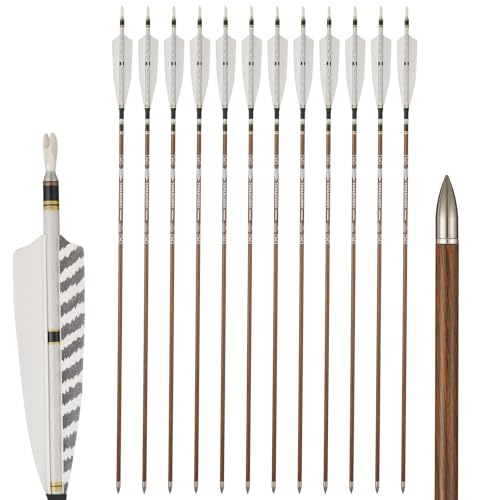
What’s in this listArrows sold for traditional bows or fletched with feathers, as stated by the maker or the Amazon listing — the setup that flies off a recurve shelf. “—” means neither the maker nor the Amazon listing states it.
What makes recurve arrows their own thing
A recurve arrow is built from the same five parts as any arrow, and the shared basics are on the hunting arrows page. What changes is how it leaves the bow.
Easton's tuning guide describes it. With a finger release, the arrow bends horizontally: first in toward the bow, then away from it, and that bending is what carries the shaft clear of the rest. A release aid on a compound makes the arrow flex up and down instead. So a recurve arrow has to bend the right amount sideways, and its fletching has to survive brushing the bow on the way past.
Two things follow from that, and they drive everything else on this page. The spine has to match the weight your fingers actually hold. And the fletching usually has to be feathers.
The table on this page lists arrows their maker sells for traditional bows or fletches with feathers, the setup that flies off a recurve shelf. It shows shaft material, spine, diameter, straightness, arrows per pack and fletching, as the maker or the Amazon listing states them (the table marks listing values). When neither states a value, you get a dash.
What to look at when you pick recurve arrows
Here's what actually changes from one pack of traditional arrows to the next.
Pick spine from the weight on your fingers
The weight printed on a recurve limb is measured at one draw length. One bow maker's traditional recurve manual says it's the Archery Trade Association standard of 28 inches, and notes that actual limb weight depends on draw length, brace height, riser length and limb bolt setting. Archery 360's compound-versus-recurve article adds the part that matters for arrows: the farther you draw a recurve, the heavier it gets, and it never lets off.
So the weight the arrow feels is the weight at your anchor, not the sticker. If you draw past 28 inches, your bow is heavier than marked; if you draw shorter, it's lighter. A bow scale at a shop will tell you the real number at your draw.
Then the usual chart logic applies. Archery 360's primer says a heavier draw weight needs a stiffer arrow and a lighter one needs a softer arrow, and that on the label a higher spine number means more flex. Spine also depends on bow design, arrow length and point weight.
There's a practical shortcut too. Archery 360's wood arrow guide suggests buying a test kit of shafts in various sizes and stiffness, then shooting them to see which flies best from your bow. (The number on the limb is like the number on a bathroom scale at the cabin. Accurate for someone, at some point.)
Feathers for the shelf, vanes for a raised rest
This is the spec that splits recurve arrows from compound arrows.
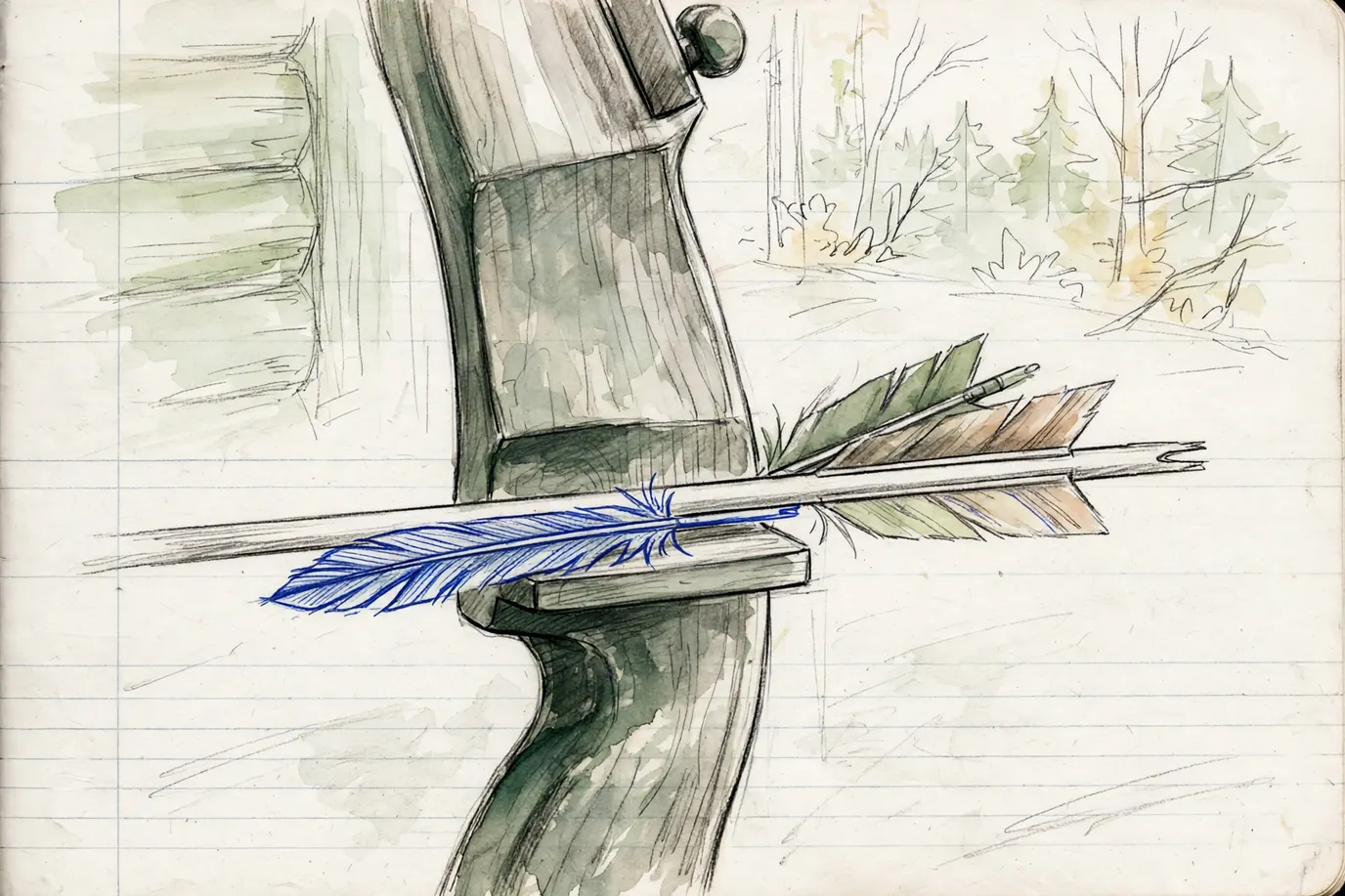
Archery 360's fletching guide says feathers are the pick for shooting off the shelf because they flex and lie flat as they cross its flat, unforgiving surface. It calls vanes a poor option for that style.
Two exceptions:
- Modern recurve with a raised rest: Archery 360's primer says vanes are usually preferred here, since the fletching passes over a rest instead of the shelf.
- Wet weather: feathers don't shed water and can fly inconsistently when soaked, Archery 360 says, but powders and sprays can make them water resistant.
Feathers are also usually longer than vanes, which makes them prone to wind drift at long distances. On a recurve inside typical bowhunting range, that's a fair trade for clean flight off the shelf.
Wood, carbon or aluminum for a stick bow
All three show up on recurves. Here's how Archery 360 compares them:
- Wood: mainly for barebow and traditional recurve shooting, usually with feathers. No performance advantage, because wood varies naturally, and it can warp.
- Carbon: extremely durable, and returns to its original shape when it bends. Hard hits can leave small cracks you can't see without a close look.
- Aluminum: as straight and consistent as carbon for less money, but it bends from hard hits. Archery 360 says it's mainly for high-level indoor shooters and beginners who need a durable arrow.
Wood has one more chore. Archery 360's arrow-building guide says to stain and seal wood shafts so they don't absorb moisture. The full wood story is on the wood arrows page.
If you like the look of wood and enjoy the upkeep, shoot wood. If you'd rather spend the evening on something else, carbon with feathers flies off the same shelf.
Know the weight floor, then decide how heavy to go
A recurve has a minimum arrow weight, like any bow. The traditional recurve manual mentioned above says not to shoot an arrow under 5 grains for every pound of peak draw weight. Its own example: a 40-lb bow needs at least 200 grains. Going lighter can damage the bow and hurt the shooter or people nearby.
The older AMO minimum chart in Easton's guide has a recurve column too. Quick math from it, at a 28-inch draw length: a 60-lb recurve calls for at least 240 grains, which is 4 grains per pound. Where the two disagree, use the higher number, and the one in your own bow's manual first.
Above the floor, it's a trade. Archery 360's arrow weight article calls anything over 8 grains per pound heavy: slower, quieter, less wind drift. Lighter arrows leave faster and drop less. Archery 360 also lists too-light arrows among the ways a bow can be dry-fired, so the floor is not a suggestion.
Use point weight to tune, not just to hit hard
On a stick bow, point weight is a tuning tool. Archery 360's primer lists point weight among the things that change spine. Easton's guide gives the direction: if the arrow acts too weak, go to a lighter point or insert; too stiff, go heavier, staying within a balance range of 7 to 16% FOC (front of center).
For hunting arrows, Easton's FAQ suggests 10 to 15% FOC. Whatever you pick, Easton's FAQ also says each shaft has its own components, so size points, inserts and broadheads to the shaft.
Leave the arrows a little long
Archery 360 measures arrow length from the back of the point to the throat of the nock, and says arrows can be left longer to weaken the spine. It also says, for safety, arrows shouldn't be cut too short.
Traditional archers get extra slack. Easton's guide suggests beginners with recurves add an extra half inch to an inch, so the arrow isn't too short once they get stronger and their form improves. (Every recurve shooter's draw grows a little in the first year. Mine grew, then shrank in November when I put the heavy coat on.)
Nock fit is critical on light bows
Easton's guide says nock tension, the snap fit on the string, can be very critical on light draw-weight bows of 30 lb and under. The test: hang the arrow from the string by its nock, then tap the string sharply about 1 to 2 inches from the nock. The arrow should drop off. For hunting, Easton says a slightly tighter fit is often preferred. More on nock sizes is on the nocks page.
Traditional arrows for a longbow, a hunting recurve or a target recurve
Recurve bow arrows don't all look the same, because recurves don't.
- Hunting recurve or longbow off the shelf: feathers, a heavy finished weight, wood or carbon. Bows are on the hunting recurve bow page.
- Modern target recurve with a raised rest: vanes are usually preferred, per Archery 360. Light, stiff carbon is common.
- Beginner's takedown on the range: durable shafts, cut a little long, and a spine for the actual pull weight.
The one rule that never changes: wood arrows belong on traditional bows only. Archery 360 says plainly that wooden arrows are not for compounds. Compound shafts are on the compound bow arrows page.
Tune the arrow on the bow you have
A recurve gives you a tuning knob a compound mostly doesn't: brace height, the distance from the string to the grip. Easton's guide says raising brace height makes the arrow shoot weaker, and lowering it makes the arrow shoot stiffer. You change it by twisting the string shorter or longer, within the maker's range.
So the order goes like this:
- Pick spine from your real pull weight and length.
- Set brace height at the low end of the maker's range.
- Shoot fletched arrows and adjust brace height, point weight or nocking point, one change at a time.
- Only then move to broadheads.
The bow side of this is on the recurve bow page, and the string on the recurve bow string page.
Write every change down as you make it. I keep an index card in the bow case with three lines on it: spine, point weight, brace height. When a group goes sideways in October, the card tells me what I changed in September. (The card is boring. Boring is the point.)
Carry them in a quiver that suits a stick bow
Archery 360's traditional archery primer lists three ways to carry recurve arrows: a back quiver like the one Robin Hood made famous, a waist quiver on your belt, and a bow quiver, which is popular with bowhunters. Long feathers need room, so whichever you pick, make sure it doesn't crush them. Options are on the recurve bow quiver page and the back quiver page.
Who should skip recurve arrows
If you shoot a compound with a release, recurve arrows with long feathers aren't built for your bow. If your recurve has a raised rest and you never shoot off the shelf, a vane-fletched target arrow may suit you better; those are on the target arrows page. And if you're outfitting a child with a light bow, start on the youth bow arrows page.
Check every shaft before you shoot it
Oregon's wildlife department says to check arrows regularly for nicks, splits and fragments, and never to shoot a questionable arrow. Wood splits and carbon cracks both count. Keep broadheads covered in a quiver, and never dry-fire a recurve.
Broadhead rules, including minimum widths and draw weights for deer, vary by state. Check your state wildlife agency before the season.
Spine for the weight you hold, feathers for the shelf, a little extra length, and all of it on the index card. Walt says he can remember his. I've watched him hunt for his reading glasses while wearing them.
Brands in this list
Related
Questions people ask
What spine do I need for recurve arrows?
Use your bow's real pull weight at your draw length, not the marked weight. One bow maker's manual says the limb weight is measured at a standard 28-inch draw, and Archery 360 notes a recurve gets heavier the farther you draw it. Take the real weight and your arrow length to the shaft maker's chart, or shoot a test kit of shafts.
Should recurve arrows have feathers or vanes?
Feathers if you shoot off the shelf. Archery 360 says feathers flex and lie flat as they cross the shelf, while vanes are a poor option for that style. Vanes are usually preferred on modern recurves with a raised arrow rest. Feathers don't shed water, so treat them with a powder or spray before wet hunts.
Can I shoot carbon arrows from a recurve bow?
Yes. Carbon works on a recurve if the spine fits the bow. Archery 360 says carbon is extremely durable and returns to its original shape when it bends, while wood can warp and needs sealing against moisture. For a traditional setup off the shelf, fletch carbon shafts with feathers, and use the components made for that shaft.
How heavy should recurve hunting arrows be?
Start with the floor. One recurve maker's manual says never to shoot less than 5 grains per pound of peak draw weight, so a 40-lb bow needs at least 200 grains. Above that, it's a trade: Archery 360 calls over 8 grains per pound heavy, which is slower but quieter and drifts less in wind.
How long should arrows be for a recurve?
Long enough to stay on the rest at full draw, with a little to spare. Archery 360 says arrows shouldn't be cut too short, and that extra length weakens the spine. Easton's guide suggests beginners with recurves add an extra half inch to an inch so the arrow isn't too short as their form improves.
Sources
- Archery 360 (Archery Trade Association): Understanding arrow fletchings — accessed 2026-10-22
- Archery 360 (Archery Trade Association): Arrows 101 — accessed 2026-10-22
- Archery 360 (Archery Trade Association): Should your arrows be carbon, aluminum or wood? — accessed 2026-10-22
- Archery 360 (Archery Trade Association): Build wooden arrows in 5 steps — accessed 2026-10-22
- Archery 360 (Archery Trade Association): Traditional archery 101 — accessed 2026-10-22
- Hoyt: Traditional recurve owner's manual (draw weight, minimum arrow weight) — accessed 2026-10-22
- Archery 360 (Archery Trade Association): Compounds vs. recurve bows — accessed 2026-10-22
- Archery 360 (Archery Trade Association): Archery Lingo: Arrow Weight — accessed 2026-10-22
- Easton: Arrow Tuning and Maintenance Guide (incl. AMO minimum recommended arrow weights) — accessed 2026-10-22
- Easton: Archery frequently asked questions — accessed 2026-10-22
- Archery 360 (Archery Trade Association): Archery Lingo: Dry-Fire — accessed 2026-10-22
- Oregon Department of Fish and Wildlife: Bow shooting safety — accessed 2026-10-22