Brand · Fire & Lighting
Blukar Headlamps, Camping Lanterns and Flashlights
Blukar makes rechargeable LED lighting: headlamps, flashlights and camping lanterns. On this site that means a handful of USB rechargeable headlamps with spot and flood beams and red light, one foldable 116-LED camp lantern, a zoom flashlight and small keychain lights. The short version: every Blukar here charges over a cable, so the choice comes down to output, beam and modes, not batteries. (Walt asked where the batteries go. I said inside. He said that's where his patience goes too.)
We earn a commission if you buy through our links, at no cost to you. Disclosure
Blukar on Amazon US
10 models- Flashlight
Blukar Rechargeable Zoom Flashlight
- Body
- Aluminum
- Max runtime
- 16 hours
- Flashlight
Blukar Mini Keychain Flashlight
Check price - Flashlight
Blukar Mini Keychain Flashlight
Check price - Flashlight
Blukar Mini Keychain Flashlight
Check price - Flashlight
Blukar Mini Keychain Flashlight
Check price - Headlamp
Blukar LED Rechargeable Headlamp 2000L
- Max output
- 2,000 lumens
- Power
- Rechargeable
- Headlamp
Blukar LED Rechargeable Headlamp
- Max runtime
- 20 hours
- Power
- Rechargeable
- Headlamp
Blukar LED Rechargeable Headlamp 2000L
- Max output
- 2,000 lumens
- Power
- Rechargeable
- Headlamp
Blukar Blukar 2026 Gen 2 Headlamp Rechargeable, Super Bright Headlight-2 Pack | 10 Modes, Dimmable, Spotlight & Floodlight, Motion Sensor, Waterproof, Upgrade 1400mAh Long Lasting Head Lamp for Hiking
Check price - Lantern
Blukar 116 LED Camping Lantern
- Format
- Collapsible
- Power
- Rechargeable




What Blukar makes for hunters and campers
Blukar's About page calls it a brand dedicated to outdoor activity lighting. Its own store sells LED flashlights, head torches (the British word for headlamps), camping lanterns and a few car phone holders. This site covers three of those types:
- Headlamps: USB rechargeable, with spot and flood beams and a red mode
- Lanterns: one foldable rechargeable camp lantern with 116 LEDs
- Flashlights: a rechargeable zoom flashlight and mini keychain lights
The phone holders aren't listed on this site. Hunters still find a use for one in the truck, mostly so the map stops sliding into the cup holder.
The grid above shows what's on Amazon right now, filtered by type. Listings change week to week, so I'll write about what separates the lines, not how many are up today.
Blukar headlamps: what separates the lines
All the Blukar headlamps here charge from a built-in battery. What changes from one to the next is output, the beam setup and how many modes you get.
The 2000L headlamps
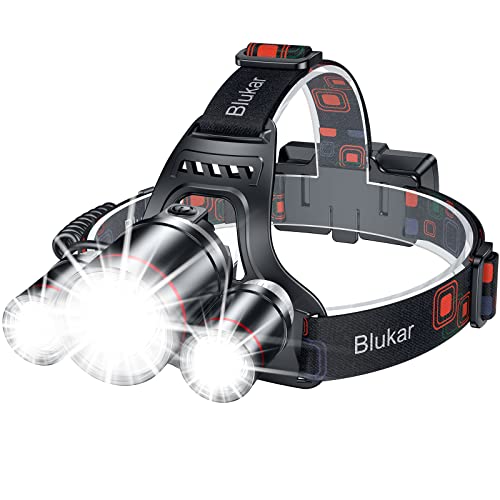
Two listings carry the 2000L name. Per their Amazon listings, both give a top output of 2,000 lumens, spot and flood beams, and red light.
Blukar's own store page for its 2000L two-pack fills in the rest. The maker says it uses two light sources, a COB panel and an XPG LED, for its spot and flood combination. It lists a built-in 1,200 mAh battery that charges over USB-C, and eight modes: five regular ones (three white settings, red, and red strobe) plus three motion-sensor modes. A long press dims the light steplessly, and the lamp head tilts 45 degrees. The maker gives the weight as 2.86 ounces and says the headband comes off for washing.
The sensor modes let you switch the lamp on or off with a wave of the hand. Handy when you're gutting fish or wiring a trailer plug. Less handy when you're the guy waving at Walt across the fire and the lamp thinks you meant it. (It's always the wave. The lamp's fine.)
The LED Rechargeable Headlamp
This listing gives a runtime of 20 hours, with red light and spot and flood beams. Its listing doesn't give a lumen figure, so that cell in the grid shows a dash. If brightness decides it for you, compare it against a lamp where the field is filled.
The 2026 Gen 2
The Gen 2 is Blukar's newest name in the grid. Its listing title names a 2-pack, 10 modes, stepless dimming, spot and flood beams, a motion sensor and a 1400mAh battery, with no lumen or runtime figure in our data. Blukar's store lists a 10-mode sibling with a memory function that keeps the last mode you used, stepless dimming from 30 to 100 percent, a power indicator and a plug over the charging port. Check the Gen 2's own listing for which of those it shares before you count on them.
The Blukar camping lantern
The 116 LED Camping Lantern is the one Blukar lantern here. Its listing marks it rechargeable and collapsible. Blukar's store page describes it in more detail:
- 116 LEDs with a 360-degree spread and warm white light
- Four side panels that fold out 90 degrees to spread the light wider
- Seven modes, including high and low side light, bottom light and red SOS
- Built-in 4,800 mAh battery, up to 10 hours per charge, per the maker
- USB-C charging and a four-light power gauge
- A hook plus a climbing-style clip for a tent loop or a branch
Folded, it's a compact lantern with more focused light. Opened, the maker says it works like a small chandelier. That's a big word for a tent light, but it fits: panels out, hung from the ceiling loop, it lights the whole floor. (Renee saw it opened and asked if it gets satellite TV. It does not.)
Blukar flashlights
Like everything else Blukar sells here, the flashlights charge from a built-in battery.
The Rechargeable Zoom Flashlight
This is the full-size one. Its listing gives an aluminum body, a built-in pack, USB-C charging, a zoom head and a strobe mode, plus a runtime figure. It doesn't give a lumen figure, so that cell in the grid shows a dash. A zoom head slides to turn a wide circle of light into a tight spot, which is the flashlight version of the spot and flood combination on the headlamps.
Mini Keychain Flashlights
Several listings carry the Mini Keychain Flashlight name. Each is listed as a rechargeable keychain light, and our data stops there: no lumens, runtime or cell type. Treat them as versions to compare on the listing itself. A keychain light earns its spot by being there when the truck's dome light is out, not by being bright.
Flashlights across brands are on the handheld spotlight page, and the best rechargeable flashlight list sorts them by its own rule.
How to choose within the Blukar lineup
Start with how bright you really need
Lumens measure the total light a lamp puts out. Streamlight's summary of ANSI/PLATO FL 1, the flashlight industry's voluntary test standard, notes that each maker runs its own tests. Use lumen figures to compare, not to promise.
For camp chores and the walk in, you'll live on the low settings. The top setting is for scanning a field edge or a long driveway. That's where a 2000L lamp earns its number, and it's also where the battery drains fastest. The general picture is on the headlamps page.
Read runtime and beam distance the same way
When a listing gives runtime or beam distance, it helps to know what the numbers usually mean. Under FL 1, per Streamlight's summary, runtime is counted from 30 seconds after switch-on until output drops to 10 percent of that starting level. Beam distance is how far out the light falls to 0.25 lux, a very dim level.
So a 20-hour runtime doesn't mean 20 hours at full blast. It means the lamp keeps making some light for that long on the setting tested. Compare runtimes between lamps that list them, and expect the top setting to run much shorter. When a cell in the grid shows a dash, the listing didn't give that number, and no amount of squinting at the photos will fill it in.
Then spot, flood, or both
A spot beam reaches far and narrow. A flood beam spreads wide and close. Blukar's lamps here mostly do both, which covers the trail and the tailgate with one lamp. If you only ever need close light, a flood-only lamp is simpler to run.
Then red light and how you get to it
My one opinion on this page: for a hunter, red light matters more than top output. The National Park Service explains that your eyes take roughly 20 to 40 minutes to adapt to the dark, and a few seconds of bright light undo it. Dim red light doesn't. On the walk to the stand, that's your night vision when you switch the lamp off. Every Blukar headlamp in the grid lists a red mode. The red light headlamp page compares more.
Then sensor modes, tilt and fit
Motion sensing is a convenience, not a requirement. A 45-degree tilt, which Blukar lists on its store pages, lets you aim at the trail without bending your neck. A washable band is a small thing that matters by the third day of a hunt. More rechargeable options are on the rechargeable headlamp page, and there's a ranked list on best headlamp.
Who should skip the Blukar lineup
Every Blukar on this site is rechargeable. If your camp has no power, no generator and no solar panel, and you're out more than a couple of nights, a lamp that takes AAA cells is simpler to keep running. Spares weigh almost nothing and swap in seconds. Those lamps are on the headlamps page, and battery lanterns are on the battery-operated lantern page.
If you want one plain button and no modes to learn, an eight-mode lamp with sensor settings is more lamp than you need. And if your plan depends on a listed runtime for a long morning sit, pick a lamp where the grid shows that number.
Set it up before opening morning
A few minutes at the kitchen table saves fumbling at the truck:
- Charge it full the week before, indoors
- Learn the modes in a dark room, red mode first
- Fit the band over the hat you'll actually wear
- Aim the tilt so the beam lands a few steps ahead
Blukar's store pages mention a memory function on some models, which brings back the last mode you used. Leave it on red before you put it away. Then the first click at the truck is the quiet one.
How to choose a rechargeable camp lantern
The Blukar lantern is a built-in battery lantern, so the same charging rules apply as for the headlamps. What else to look at:
- Shape: foldable panels spread light wider; a solid cylinder is simpler
- Modes: a red or low mode keeps the tent from glowing like a jack-o'-lantern
- Hanging: a hook and clip beat balancing it on a cooler lid
- Battery gauge: four lights tell you more than "on" and "off"
Other shapes and power types are on the rechargeable lantern page.
Charging and battery care
Every Blukar headlamp, lantern and flashlight here charges from a built-in battery, so charging habits are the care routine. The US Fire Administration's lithium-ion guidance:
- Charge between 32°F and 105°F: not in a freezing truck, not on a hot dashboard
- Store at room temperature when you can, away from anything that burns
- Stop using it if it smells, swells, leaks, gets very hot or changes color
- Never trash it: take it to a battery recycler
Deer camp in November is usually below 32°F at night. Charge in the cabin, not on the truck seat. Then pack it warm.
When a built-in battery is done, it usually can't come out. The EPA's advice for those is to take the whole device to an electronics recycler, a retailer with a takeback program, or a household hazardous waste program. For loose lithium cells, it says to tape the terminals with electrical tape or bag them separately.
One more safety line for the lantern: an LED lantern is the right light inside a tent. The CPSC says never to use fuel-burning portable heaters or lanterns while sleeping in tents, campers or vehicles.
Blukar facts
Blukar's own site describes the brand as dedicated to outdoor activity lighting and sells flashlights, head torches, camping lanterns and car phone holders.
Write "charge Thursday" on the band's tag with a marker. Thursday you will ignore it. Friday you'll be glad it's there.
Where Blukar shows up
Questions about Blukar
Is Blukar a good headlamp brand?
What can be checked: Blukar's own store pages describe its headlamps with a built-in 1,200 mAh battery, USB-C charging, spot and flood light sources, red modes and a 45-degree tilt, and its lantern with a 4,800 mAh battery. Whether one suits you depends on the output, beam and modes you need. The grid on this page lists the values each Amazon listing gives.
How bright is the Blukar 2000L headlamp?
The Amazon listings for the Blukar 2000L headlamps give a maximum of 2,000 lumens, with spot and flood beams and red light. Lumen figures are tested by each maker, so treat them as a guide. For a walk to the stand you'll mostly use the low and red modes; the top setting is for searching a long way out.
How do I charge a Blukar headlamp?
Blukar's store pages say its headlamps charge over USB-C with the included cable, and the 10-mode model adds a power indicator and a plug over the charging port. Charge indoors at room temperature. The US Fire Administration advises against charging lithium-ion batteries below 32°F or above 105°F, which rules out a cold truck in November.
Where can I buy Blukar headlamps?
The grid on this page links to Blukar listings on Amazon US, with filters by type. Blukar also runs its own online store. Check the listing for the exact model name and pack count before you order, because several Blukar headlamps share similar titles.
Does Blukar make flashlights?
Yes. On this site Blukar has a Rechargeable Zoom Flashlight, which its listing describes with an aluminum body, a built-in battery, USB-C charging, a zoom head and a strobe, and several Mini Keychain Flashlights listed as rechargeable. The listings don't give lumen figures, so check each one for output and runtime before you choose.
Does Blukar make a camping lantern?
Yes. Blukar's 116-LED camping lantern is on this site. Its store page describes four side panels that fold out 90 degrees, seven modes including red SOS, warm white light, a hook with a clip, and a built-in 4,800 mAh battery that charges over USB-C, with up to 10 hours per charge per the maker.
Sources
- Blukar: About us — accessed 2026-10-23
- Blukar: Rechargeable headlamp flashlight 2-pack, 2000LM dual beam, 8 modes — accessed 2026-10-23
- Blukar: Rechargeable headlamp, 10 modes, spotlight and floodlight — accessed 2026-10-23
- Blukar: Rechargeable camping lantern, 116 LEDs, 7 modes, 90-degree panels — accessed 2026-10-23
- Streamlight: ANSI/PLATO FL 1 information — accessed 2026-10-23
- National Park Service: Dark adaptation of the human eye and the value of red flashlights — accessed 2026-10-23
- U.S. Fire Administration: Lithium-ion battery safety — accessed 2026-10-23
- U.S. EPA: Used household batteries — accessed 2026-10-23
- U.S. Consumer Product Safety Commission: Portable heaters and camping equipment — accessed 2026-10-23