


Benchmade Mini Bugout 533
Good for the lightest knife here at 1.5 ounces, a 2.8-inch CPM-S30V drop point, crossbar-type lock and polymer handle.
Skip it if you want a lower price tier; it's one of two knives on the list in the higher one.
Knives & Tools · Best-of list
The best EDC knife is the one light enough that you forget it's clipped in your pocket until you need it. This list only takes folding knives that carry on a pocket clip, have a blade of 3.5 inches or less and come with a stated weight. They're sorted lightest first, from 1.5 to 4.1 ounces. Here's the thing: an everyday carry knife gets judged at 9 p.m. by whether it's still on you, not at 9 a.m. by how it looked in the box.
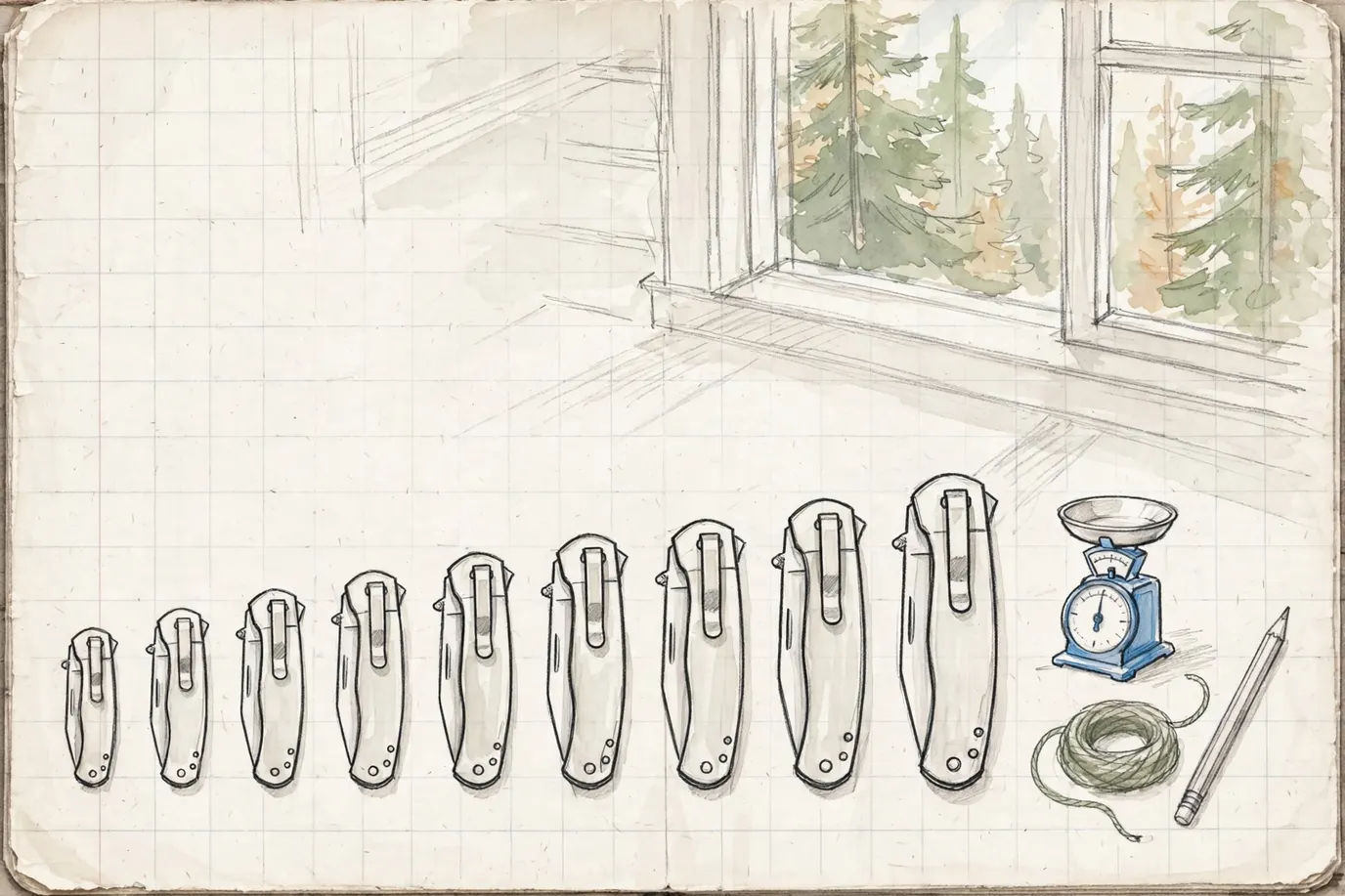
How this list is builtClip-carry folders with a blade of 3.5 inches or less and a stated weight, lightest first.
We earn a commission if you buy through our links, at no cost to you. Disclosure
| Model | Weight | Blade length | Blade steel | Steel type | Blade shape | Edge | Amazon |
|---|---|---|---|---|---|---|---|
Benchmade Mini Bugout 533Folding knife More specs
| 1.5 ozmaker | 2.8 inlisting | CPM-S30Vlisting | Powder steellisting | Drop pointlisting | — | Check price |
Gerber Paraframe Mini Fine EdgeFolding knife More specs
| 1.6 ozmaker | 2.2 inlisting | — | Stainlesslisting | Clip pointlisting | Plainlisting | Check price |
Benchmade Bugout Outdoor EDCFolding knife More specs
| 1.85 ozmaker | 3.2 inlisting | CPM-S30Vlisting | Powder steellisting | Drop pointlisting | Plainlisting | Check price |
Gerber Paraframe Mini SerratedFolding knife More specs
| 2 ozmaker | 2.22 inlisting | — | Stainlesslisting | — | Serratedlisting | Check price |
CRKT MinimalX 5915Folding knife More specs
| 2.6 ozmaker | 2.19 inlisting | 12C27listing | Stainlesslisting | — | — | Check price |
CRKT M16-10KSFFolding knife More specs
| 2.7 ozmaker | 2.94 inlisting | 8Cr14MoVlisting | Stainlesslisting | Tantolisting | — | Check price |
CIVIVI Elementum C907UFolding knife More specs
| 2.74 ozmaker | 2.96 inlisting | D2listing | Tool steellisting | — | — | Check price |
CIVIVI Elementum C907EFolding knife More specs
| 2.89 ozmaker | 2.96 inlisting | D2listing | Tool steellisting | — | — | Check price |
Cold Steel Crawford Model 1Folding knife More specs
| 4.1 ozmaker | 3.5 inlisting | 4034SSlisting | Stainlesslisting | Clip pointlisting | — | Check price |
Good for the lightest knife here at 1.5 ounces, a 2.8-inch CPM-S30V drop point, crossbar-type lock and polymer handle.
Skip it if you want a lower price tier; it's one of two knives on the list in the higher one.
Good for a 1.6-ounce frame lock with a 2.2-inch plain-edge stainless clip point that opens by nail nick.
Skip it if you want one-handed opening; a nail nick takes two hands.
Good for a 3.2-inch CPM-S30V plain-edge drop point at 1.85 ounces, crossbar-type lock and polymer handle.
Skip it if you want a metal handle or the lower price tier on this list.
Good for the only fully serrated edge on the list, a 2.22-inch stainless blade in a frame lock, 2 ounces, 3 inches closed.
Skip it if you want an edge that's easy to touch up on a plain stone.
Good for the shortest blade here at 2.19 inches, 12C27 stainless, frame lock and a steel handle, 2.6 ounces.
Skip it if you need a blade that crosses a feed sack or a big onion in one pass.
Good for the only tanto blade on the list, 2.94 inches of 8Cr14MoV stainless, frame lock and steel handle, 2.7 ounces.
Skip it if you want a curved belly for slicing or a lighter non-metal handle.
Good for the only wood handle here, a 2.96-inch D2 tool-steel blade, flipper opening and liner lock, 2.74 ounces.
Skip it if you want a stainless steel for wet work, or a handle that ignores humidity.
Good for a 2.96-inch D2 tool-steel blade, G10 handle, flipper opening and liner lock at 2.89 ounces.
Skip it if you'd rather not keep oil on a lower-chromium steel after rain.
Good for the longest blade here at 3.5 inches, a 4034 stainless clip point and polymer handle.
Skip it if you want the lightest pocket; at 4.1 ounces it's the heaviest, and the data on this page lists no lock type.
Every label below comes from a number or a word in the maker's or the listing's specs. None of them means "better." They mean "this is the one that has that." Weights are the makers' figures; most other values come from the Amazon listings. The list is re-checked every week, so a label can move to a different knife.
At 1.5 ounces by the maker's figure, the Mini Bugout is the lightest knife here. The blade is a 2.8-inch drop point in CPM-S30V, a powder steel. The lock is crossbar-type, the handle is a polymer and there's a pocket clip. It sits in the higher of the two price tiers on this page, with the other Benchmade.
The Paraframe Mini weighs 1.6 ounces, with a 2.2-inch clip point blade in stainless steel and a plain edge. It's a frame lock, 5.25 inches open, with a pocket clip. The listing gives the opening as a nail nick, the notch your thumbnail catches, and it's the only knife on this list with one. That means two hands to open. Some of us learned on nail nicks and still think that's how knives work.
The Bugout carries a 3.2-inch plain-edge drop point in CPM-S30V at 1.85 ounces. That's the longest blade on this list on a knife under 2 ounces. The lock is crossbar-type, the handle is polymer and there's a pocket clip. Like the Mini Bugout, it sits in the higher price tier on this page. If you want more than 3 inches of blade and less than 2 ounces in the pocket, this is the one here.
This one shares the Paraframe frame lock and the 5.25-inch overall length, with a 2.22-inch stainless blade and a fully serrated edge. It's the only serrated edge on the list. It weighs 2 ounces and is 3 inches closed, the only closed length stated on this page. There's a pocket clip. Serrations suit rope and fibrous stuff. They're slower to sharpen at home, and the listing doesn't give a blade shape.
The MinimalX has the shortest blade here at 2.19 inches, in 12C27 stainless. Boker's steel table lists 12C27 at 0.58 percent carbon, 14 percent chromium and 57 to 59 HRC. The handle is steel, the lock is a frame lock and there's a pocket clip. At 2.6 ounces, it's heavier than its blade length suggests, which is what a steel handle does. It's a knife for tags, tape and twine.
The M16-10KSF is the only tanto on the list. A tanto has a straight edge that angles up to a strong point, rather than a curved belly. The blade is 2.94 inches of 8Cr14MoV stainless in a steel handle, with a frame lock and a pocket clip, at 2.7 ounces. Boker's table doesn't list 8Cr14MoV. Its nearest entry, 8Cr13MoV, sits at 0.8 percent carbon and 13 percent chromium.
This Elementum pairs a 2.96-inch D2 blade with a wood handle, the only wood handle on this list. D2 is a tool steel. Boker lists it at 1.5 percent carbon, 12 percent chromium and 59 to 61 HRC. It opens by flipper, a small lever at the back of the blade, and locks with a liner lock. There's a pocket clip. It weighs 2.74 ounces.
The C907E carries the same 2.96-inch D2 blade, flipper opening and liner lock as the C907U, in a G10 handle instead of wood. G10 is a fiberglass laminate; Benchmade's handle guide says it resists water absorption and holds its shape across temperatures. It weighs 2.89 ounces with a pocket clip. It's the version for a knife that lives in a damp truck.
At 3.5 inches, the Crawford's clip point blade is the longest here, right at the rule's limit. It's also the heaviest knife on the list at 4.1 ounces by the maker's figure. The steel is 4034 stainless, which Boker lists at 0.42 to 0.5 percent carbon and 54 to 55 HRC, the softest range on this page. The handle is polymer, with a pocket clip. The data on this page doesn't list a lock type, so check the maker's page.
The rule behind this list uses three things: a pocket clip, a blade of 3.5 inches or less, and a stated weight. Those are the same three things that decide whether a knife gets carried every day. After them come lock, edge, steel and handle.
On this list, weights run from 1.5 to 4.1 ounces. That doesn't sound like much until it's riding in your jeans from 5 a.m. to supper. Rule of thumb: if you notice it when you sit down in the truck, it's going to end up in the cup holder. Here, the lighter knives get there with polymer handles or a small blade. The heavier ones carry a steel handle or a longer blade.
Blades here run from 2.19 to 3.5 inches. Around 2 inches handles tape, tags, twine and fingernails you shouldn't be cutting with a knife. Around 3 inches crosses a feed sack, a cardboard box or a summer sausage in one pass. Past that, you're carrying a bigger knife for jobs that come up less. Knife carry rules vary by state and city, and some set limits by blade length, so check your state's rules.
Every knife here has a pocket clip; that's part of the rule. How the clip mounts is the next question, and the data on this page doesn't say. Kershaw's guide lays out the options: single-position clips, reversible clips, and three- and four-position clips for tip-up or tip-down carry on either side. Deep-carry clips sit at the very end of the handle so the knife rides lower. Left-handers should check the maker's page before buying.
Kershaw also gives the safe way to clip it: clip facing out, blade side against the pocket seam. Don't clip it to your belt or the outside of the pocket, and don't carry a folder loose.
Three lock types show up on this list, plus one knife without a lock listed:
Benchmade's mechanisms guide says a frame lock is stronger than a liner lock with the same simple operation, and that closing one puts your hand in the blade path. Liner locks close the same way. Benchmade describes its crossbar-type AXIS lock as ambidextrous with smooth one-handed operation. Whatever the lock, keep your fingers out of the blade's closing arc. The American Knife and Tool Institute says that plainly, and it's the rule that matters most.
Eight knives here have a plain edge or don't list one; one is fully serrated. Spyderco's edge page says a plain edge is easy to sharpen and suits general and precise cutting. It says its serrated pattern adds up to 24 percent more cutting edge and cuts fibrous material like rope quickly. If your day has a lot of rope, baling twine or seat belt webbing in it, serrations earn their spot. For everything else, plain is simpler to keep sharp.
Steel is a trade between holding an edge, resisting rust and how easy it comes back on a stone. Boker's steel table gives the numbers for most of the steels on this list:
HRC is a hardness scale. A higher number usually holds an edge longer and takes more work to sharpen. More chromium means less staining. If you sharpen every Sunday, a softer stainless is fine. If you'd rather sharpen twice a season, look higher.
Danny's take: "Picking steel by the chart is like picking a cooler by its ice days. The chart assumes you'll take care of it." He's also the one who leaves his knife in the cooler.
Four handle materials appear here: polymer, steel, G10 and wood. Benchmade's handle guide says glass-reinforced polymer keeps weight remarkably low and resists moisture and warping. It calls G10 light without feeling flimsy, and stable across temperatures. It calls stabilized wood warm and natural, and says it still needs reasonable care. Steel handles add weight, and the two steel-handled knives here sit at 2.6 and 2.7 ounces on short blades.
An EDC knife is for cutting, so carry a pry bar too. That's my one opinion on this page, and AKTI backs it: don't hammer, chop, pry or use the blade as a screwdriver, because a slipping hand can reach the edge and a twisted blade can snap. Folders take it worse than fixed blades, because the pivot and the lock take the load. A 1.5-ounce knife is not a paint can opener. Neither is a 4.1-ounce one.
If you field dress your own deer, skip this list for that job. That's a fixed blade in a sheath, and the hunting knife page covers it. If what you really want is pliers and a screwdriver with a blade along for the ride, you want a multi-tool. If you want a traditional pattern without a clip, the pocket knife page has more of those. And if you fly every week, carrying any knife means remembering to leave it home, and some people never will.
An everyday carry knife lives with lint, sawdust, pocket change and whatever was on your hands at lunch. AKTI's care advice is short:
AKTI also says to sharpen often, because a very dull knife needs heavy grinding. A few strokes on a stone is a Saturday-afternoon fix.
The rule is in the box above, and here it is in full. A knife gets on this list when it's a folding knife that carries on a pocket clip, its blade is 3.5 inches or less, and its weight is stated. Weights come from the maker's own figure. Other values come from the maker first; where the maker is silent, they come from the Amazon listing, and on this page most of them do. The knives are sorted lightest first.
The order follows that rule and the numbers in the data, not a preference for any brand. There are no ratings or review counts behind these picks, and nobody at Hemlock Run has carried any of these knives. The labels describe what each knife is, never which one wins. The list is re-checked every week. A knife can drop off when its listing changes, and a new one can come on when its numbers fill in. If a spec is missing, it isn't mentioned, and in the table it shows as a dash.
The knife in your pocket at 9 p.m. is the one that did the work. The one on the dresser just kept the dust off.
Light enough that you keep carrying it. On this list, weights run from 1.5 ounces for the Benchmade Mini Bugout to 4.1 ounces for the Cold Steel Crawford Model 1. Most sit between 1.5 and 3 ounces. A heavier knife usually brings a longer blade or a steel handle, so decide which of those you'd actually use.
A clip-carry folder with a plain edge and a blade around 2.5 to 3 inches covers boxes, twine, tags and feed sacks. Spyderco says a plain edge is easy to sharpen and suits general and precise cutting, while its serrated edge cuts fibrous material like rope quickly. Pick the lock by how you'll close it, then the steel by how often you'll sharpen.
Neither is better everywhere. Benchmade's mechanisms guide says a frame lock works like a liner lock with the spring cut from the handle frame, and calls it stronger. Both close by pushing the lock bar aside, which puts your hand in the blade path. A crossbar-type lock, which two knives here list, closes with the thumb on a bar instead.
Kershaw's pocket clip guide says to clip the knife with the clip facing out and the blade side against the pocket seam, and never to carry a folder loose in the pocket. Clips come fixed, reversible or in three or four positions, for tip-up or tip-down carry. If you're left-handed, check the clip options on the maker's page first.
Not in your carry-on. The TSA's knives page says knives aren't allowed in carry-on bags but can go in checked bags, sheathed or securely wrapped. Take the knife off your pocket before you leave for the airport, not at the checkpoint. Knife carry rules also vary by state and city, so check your state's rules.