



Barnett Justice Fletched Arrow
Good for compound hunters who want a 350-spine carbon arrow with a stated .204 in diameter and ±.001 in straightness, 6 to a pack.
Skip it if your chart calls for a weaker spine than 350.
Archery & Bowhunting · Best-of list
The best hunting arrows for you are the straight ones in the spine your bow needs. This list only takes hunting arrows whose maker or Amazon listing states a straightness of ±.003 inch or tighter, and it sorts them straightest first. It's re-checked weekly, so the arrows on it can change. Spine is still your call, and it matters more. (Uncle Walt judges straightness by sighting down the shaft like a pool cue. The pool hall is closed.)
How this list is builtHunting arrows with a stated straightness of ±.003 inch or tighter, straightest first.
We earn a commission if you buy through our links, at no cost to you. Disclosure
| Model | Shaft | Spine | Diameter (ID) | Arrows per pack | Amazon |
|---|---|---|---|---|---|
Barnett Justice Fletched ArrowArrow More specs
| Carbonlisting | 350listing | 0.204 inlisting | 6listing | Check price |
Carbon Express Maxima RED DrabArrow More specs
| Carbonmaker | 400maker | — | 6listing | Check price |
Carbon Express Maxima RED DrabArrow More specs
| Carbonmaker | 350maker | — | 6listing | Check price |
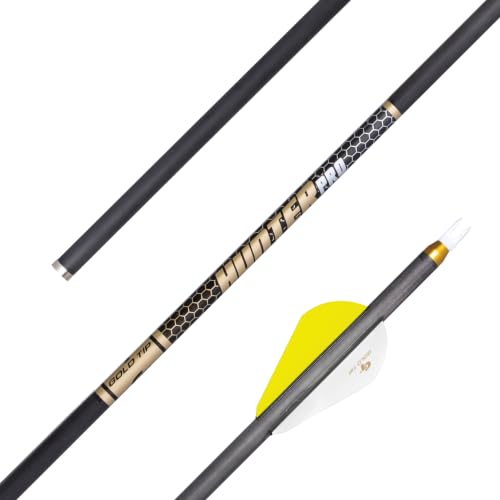
Gold Tip Hunter Pro Shafts 400Arrow More specs
| — | 400listing | — | 12listing | Check price |
Gold Tip Hunter Pro Raptor Vanes 500Arrow More specs
| — | 500listing | — | 12listing | Check price |
Linkboy Archery 30inch Carbon Arrow 0.001Arrow More specs
| Carbonlisting | — | 0.244 inlisting | 12listing | Check price |
sanlida Dragon 10 300 and 310 SpineArrow More specs
| Carbonlisting | — | — | 48listing | Check price |
sanlida Dragon 10 350 and 360 SpineArrow More specs
| Carbonlisting | — | — | 48listing | Check price |
Victory Archery VAP TKO FletchedArrow More specs
| Carbonlisting | 300listing | 0.166 inlisting | 6listing | Check price |
Victory Archery RIP XV 0.204 Bare ShaftsArrow More specs
| Carbonlisting | 300listing | 0.204 inlisting | 12listing | Check price |
Good for compound hunters who want a 350-spine carbon arrow with a stated .204 in diameter and ±.001 in straightness, 6 to a pack.
Skip it if your chart calls for a weaker spine than 350.
Good for setups that chart at 350 spine, with the maker's ±.001 in straightness, carbon shafts and vanes, 6 per pack.
Skip it if your chart calls for 400 or weaker.
Good for setups that chart at 400 spine, with the maker's ±.001 in straightness, carbon shafts and vanes.
Skip it if you want a full dozen in one pack; the listing shows 6.
Good for archers who build their own, with 12 bare 400-spine shafts at a listed ±.001 in straightness.
Skip it if you don't own a fletching jig and cut-off saw; these need vanes, cutting and inserts.
Good for lighter draw weights or shorter arrows that chart at 500 spine, the weakest here, fletched with vanes, 12 per pack, ±.001 in listed.
Skip it if your chart calls for a stiffer spine.
Good for hunters who want feather fletching on a 30-inch carbon arrow, with a listed .244 in diameter, ±.001 in and 12 per pack.
Skip it if you need a stated spine; the listing doesn't give one.
Good for setups that chart at 300 to 310 spine, as the title names, buying in bulk: 48 carbon arrows at a listed ±.001 in.
Skip it if your chart calls for a weaker spine, or you want a smaller pack.
Good for setups that chart at 350 to 360 spine, as the title names, with 48 carbon arrows at a listed ±.001 in.
Skip it if your spine isn't in that range, or 48 arrows is more than you'll shoot.
Good for a stiff 300 spine in a fletched, small-diameter arrow: .166 in, carbon, ±.001 in listed, 6 per pack.
Skip it if your chart calls for a weaker spine than 300.
Good for archers who build their own, with 12 bare 300-spine carbon shafts at .204 in and ±.001 in, per the listing.
Skip it if you don't own a fletching jig and cut-off saw, or need a weaker spine.
There's no single best hunting arrow. There's the right spine for your bow, and then there's how straight the shaft is built. This list handles the second part. It only includes arrows sold for hunting whose maker or Amazon listing states a straightness tolerance of ±.003 inch or tighter.
Straightness is a promise in thousandths of an inch. A ±.001 arrow is allowed to be off true by one thousandth, a ±.003 by three. Smaller is straighter. Easton's tuning guide recommends straightness within 0.004 inch for best grouping, so every arrow on this page sits inside that line by its stated grade.
The table above sorts them straightest first. Inside a tie, the order isn't a ranking. Right now all ten state ±.001, so the whole list is one tie.
These labels describe what each pack is, by its specs. They don't say one is better.
The Barnett Bloodsport Justice is one of four arrows here whose listing gives a diameter: .204 inch. It's a carbon hunting arrow at 350 spine and ±.001 inch straightness, sold 6 to a pack. The title says it comes fletched and 31 inches long, for compound bows. That diameter tells you which nocks fit before you order them. On Feradyne's Nockturnal size chart, for example, the X size is listed for a .204 inside diameter, so check your shaft's inside size against the nock maker's chart. The trade-off is the pack size: 6 arrows, not 12.
This Maxima RED Drab is the 350-spine version. It and the Barnett are the two stated 350s, and it's the one whose values come from the maker: carbon, vanes, hunting use and ±.001 inch straightness. A stiffer spine suits heavier draw weights, longer arrows or heavier points, depending on the chart. The listing shows 6 arrows to a pack. If your chart says 350 and you want fletched carbon, this and the Barnett are the two entries with that spine stated.
The other Maxima RED Drab is the 400-spine version on this list. As with the 350, the maker states carbon, vanes, hunting use and ±.001 inch. It and the Gold Tip bare shafts are the two 400s here, and the Drab is the one that comes fletched. The listing shows 6 per pack.
The Gold Tip Hunter Pro in this listing is a dozen bare shafts at 400 spine and a listed ±.001 inch. Bare means no fletching. Bowhunter's arrow-building guide lists what a bare shaft still needs: vanes glued in a fletching jig, cutting to length with an arrow saw, squaring the ends and gluing in inserts. If you already own the tools, bare shafts let you choose your own vanes and colors.
The fletched Gold Tip Hunter PRO is a 500 spine, the weakest on the page, sold 12 to a pack at a listed ±.001 inch. The title says it comes with 2-inch Raptor vanes. A weaker spine suits lighter draw weights, shorter arrows or lighter points, chart depending. It and the Linkboy are the two fletched dozens on the list.
The Linkboy is a 30-inch carbon hunting arrow, per its title, with a listed ±.001 inch straightness and 12 to a pack. It's the only arrow on this list fletched with feathers, and its .244-inch diameter is the largest stated here. The trade-off is a blank in the data: the listing doesn't state a spine. You'll need that number from the maker before it means anything for your bow.
Two sanlida Dragon 10 packs are here, named for 300 and 310 spine and for 350 and 360 spine. Both listings state carbon shafts, ±.001 inch and 48 arrows to a pack, the largest packs on this list by a wide margin. The listings don't fill in a fletching type. Quick math: 48 arrows is four dozen, which is a lot of arrows to own in the wrong spine. Confirm the spine on a chart first.
Both Victory entries list a 300 spine, the stiffest on the page, carbon and ±.001 inch. The VAP TKO comes fletched, 6 to a pack, and its .166-inch diameter is the smallest stated here. The RIP XV is a dozen bare shafts at .204 inch, so it needs the full build: vanes, cutting and inserts.
Here's what actually changes from one pack to the next. The rule's field comes first, then the ones that decide whether an arrow flies from your bow at all.
Straightness is the field this list is built on, so let's be honest about it. Victory Archery sells one shaft line in three grades: ±.001, ±.003 and ±.006 inch. That's how most makers use the number, as a grade within a model.
Easton's .004 recommendation is the useful line. Every arrow here clears it. Between .001 and .003, the difference is real on paper. In practice, a crooked nock or a wrong spine moves an arrow more than two thousandths ever will. (Walt claims he can see a thousandth of an inch. He also claims his truck still gets 20 miles to the gallon.)
You can check your own set. Archery 360's inspection guide says to balance the point in your upturned palm, nock up, and spin the arrow. A slow wobble suggests a bent shaft; a fast one suggests a bent point. Easton's guide also suggests rolling the shaft on a clean, flat table to spot a crooked nock or insert.
Spine is how much an arrow flexes. Archery 360's arrow guide says it's printed as a number such as 350, 400 or 500, and a higher number means more flex. A heavier draw weight needs a stiffer arrow. Arrow length and point weight move it too.
This list runs from 300 to 500. That's the widest gap on the page, and the most important. Find your spine on the shaft maker's chart using your peak draw weight, your arrow length and your point weight. Then look at this list. If your number isn't here, the right arrow for you isn't either.
Easton's bare shaft planing test is one way to confirm the chart's answer. Shoot a few fletched arrows, then two identically aimed unfletched shafts at 15 to 20 yards. If the bare shafts don't group with or near the fletched ones after adjustment, Easton says to pick a weaker or stiffer shaft based on where they hit. Do that test with field points only.
Arrow length isn't draw length. Easton's guide measures it from the bottom of the nock groove to the end of the shaft, without the point. To find it, draw an extra-long arrow and have a friend mark it at the place Easton's guide describes for your bow and rest.
Archery 360 says to set draw length before buying arrows, since it decides arrow length and can change the spine you need. Cutting a shaft shorter makes it act stiffer. So pick spine for the length you'll shoot, not the length in the box.
Eight of these packs state carbon, none is aluminum, and the two Gold Tip listings don't state a material. Archery 360 says carbon returns to its shape when bent but can crack from hard impacts. Aluminum is as straight and consistent as carbon, often cheaper, and less durable; it can bend from a hard hit or rough handling.
Both fail in ways you can check. Archery 360's inspection guide says to discard bent arrows, cracked shafts and carbon arrows that creak when flexed. On aluminum, a noticeably thinner front end or discolored finish is a sign of wear. Walt's take: "Aluminum tells you when it's hurt. Carbon keeps it to itself." That's the most diplomatic thing he's said about carbon since 1987.
Two packs on this list are bare shafts, the Gold Tip Hunter Pro and the Victory RIP XV. Four come with vanes or feathers per the maker or listing, two more are fletched per the title, and the sanlida listings don't say. Fletched arrows still need cutting to length if they're full length, and they still need tuning. Bare shafts need everything in Bowhunter's 10-step list, from cleaning the shaft with alcohol to squaring the inserts.
Quick math on time: one dozen shafts, three vanes each, is 36 vanes glued one at a time on a single-vane jig. That's an evening and a pot of coffee, not a lunch break.
Four listings state a diameter here: .166 inch for the Victory VAP TKO, .204 for the Barnett and Victory RIP XV, and .244 for the Linkboy. Whatever the outside, the inside diameter matters more than you'd think, because it sets which inserts, nocks and lighted nocks fit. Feradyne's Nockturnal chart lists sizes by inside diameter, from .165 for G to .246 for GT. Look up your shaft on the nock maker's chart before you order. Lighted nocks are on the lighted nocks page.
Packs here come in 6, 12 or 48. Archery 360's budget guide suggests starting with a half dozen to a dozen arrows for consistency and safety. Buying them in one order from one model keeps spine and straightness matched across your set.
Arrow weight isn't on this table because it depends on your cut length, insert and point. It still matters. Bear's owner's manual says the IBO allows a minimum of 5 grains of arrow weight per pound of peak draw weight (437.5 grains make an ounce). Quick math: a 60-lb bow needs at least 300 grains. Underweight arrows, the manual says, have the same effect as dry-firing a bow.
Never shoot a broadhead on an unfletched shaft; Easton's guide calls that flight extremely erratic and dangerous. Flex-check carbon arrows for cracks after each shot, as Easton advises, and discard any that creak or crack. Keep broadheads covered when you're not shooting.
If you shoot a crossbow, skip it. Crossbows use bolts, and those are on the crossbow bolts page. If you shoot a traditional recurve off the shelf with feathers or wood, the recurve arrows page fits your setup better.
And if you haven't settled your draw length and draw weight yet, wait. Buying a dozen straight arrows in the wrong spine is the most expensive way to learn what spine is. The hunting arrows page walks through spine, weight and FOC in more detail.
The rule is in the box above: hunting arrows with a stated straightness of ±.003 inch or tighter, straightest first. An arrow has to be sold for hunting by its maker or listing, and its straightness has to be written down. Arrows that don't state a straightness aren't left off because they're crooked. They're left off because nobody said.
Values come from the maker's page where one exists; the Carbon Express entries do. Where the maker is silent, the value comes from the Amazon listing, and the table marks it. A missing value is a dash, not a guess. Nobody at Hemlock Run shot these arrows for this page.
The list is re-checked every week. New packs that meet the rule can appear and others can drop off, so the picks can change.
Spine first, straightness second, and write the spine on the box in marker. Future you will thank present you in October.
The ones spined for your draw weight, arrow length and point weight, built straight enough to group. Easton's tuning guide recommends straightness within 0.004 inch for best grouping, and every arrow on this list states .003 or tighter. Pick the spine from the shaft maker's chart first, then choose among the shafts that come in it.
It matters, within limits. Straightness is how far a shaft can be off true, in thousandths of an inch. Easton recommends 0.004 inch or better for tight groups. Past that line, a wrong spine or a crooked nock will move your arrows more than the gap between .003 and .001.
They can be. Archery 360 says aluminum can be as straight and consistent as carbon, and it's a common pick for beginners who need a durable arrow. The catch is that it bends from a hard hit instead of springing back, and bent arrows get retired. Carbon is the more common hunting choice today.
Fletched arrows are closer to ready. Bare shafts need vanes glued on in a jig, cutting, squaring and inserts, per Bowhunter's arrow-building guide. If you don't own a cut-off saw and a fletching jig, start with fletched arrows, or have a shop build the bare shafts for you.
Archery 360 suggests starting with a half dozen to a dozen arrows of the same model for consistency and safety. The packs on this list come in 6, 12 or 48. A dozen leaves room for the arrows you'll retire after a flex check.