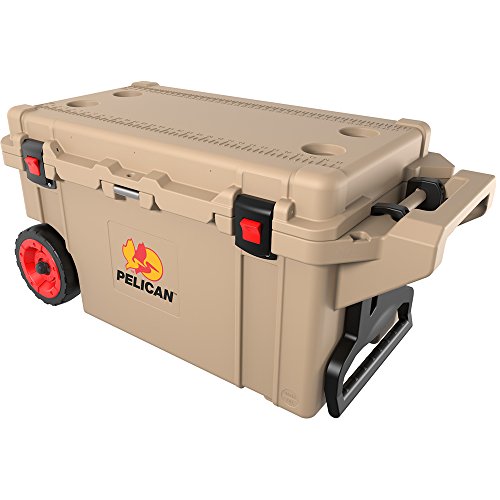
What Pelican makes for hunters and campers
On this site, Pelican covers two kinds of gear:
- Hard coolers: the Elite line, plus wheeled models and two small personal coolers
- Soft coolers: the Dayventure line, as a sling, a backpack and two totes
That's the deer-camp slice of the brand. The company is better known for protective hard cases, and it also makes portable lights. This site doesn't list Pelican cases, and no Pelican flashlights are in its flashlight grids right now, so they get a short section further down and a pair of FAQ answers, not a grid.
The grid filters by type and changes as listings come and go. So I'll write about the families and what separates them, not about how many of each are listed this week. Most capacities in the grid come from Amazon listings and are marked that way. A dash means the listing didn't say. Rule of thumb: a dash is information too. It tells you to go read the maker's page before you buy.
Lineup notes: the Pelican cooler, hard-sided
The Elite line
The Elite coolers are the core of the grid. The model names carry the capacity in quarts, which saves a step: Elite 20, 30, 50, 70, 80, 150 and 250 QT. They run from a cooler one person carries by the handle to a chest that wants two people and a plan.
Pelican's own Elite pages list the same core features across sizes:
- Press & Pull latches: on the wheeled 45QW page, described as wide for gloved use
- A freezer-grade seal around the lid
- Polyurethane foam insulation: the 45QW and 70QT pages give it as 2 inches thick
- A tethered threaded drain plug over a sloped drain, on the 70QT and 45QW pages
- A molded-in lock hasp with a stainless steel plate, on the 70QT page
- A built-in bottle opener and a fish ruler, on the 70QT page
- "Guaranteed for life", on the Elite product pages
The 70QT page also gives ice capacity: 65 lb. The 20QT page gives 19 lb. That's a useful number. It tells you how much room ice takes before the first pound of venison goes in.
The three biggest listings in the grid (the 80, 150 and 250 QT) say 10 days of ice retention. That's what the listing states, not a lab result I can show you. Ice life in the real world depends on how full the cooler is, how cold the food was when it went in, shade, and how many times somebody opens the lid to look for the mustard. The rotomolded cooler page covers how heavy-walled hard coolers differ across brands.
Wheeled Elite models
Two Elite listings in the grid roll: the Elite 45 QT Wheeled and the Elite 80 QT, whose listing names the wheeled version. Pelican's 45QW page lists heavy-duty wheels, molded-in handles with a built-in trolley handle, and a drain plug you can hook a garden hose to.
A loaded big cooler is a two-person lift. A loaded wheeled cooler is a one-person drag, at least until the gravel gets deep. The cooler with wheels page lays out that type across brands.
Personal coolers
The 8 Quart and 14 Quart Personal Coolers are lunchbox coolers. The 8 quart listing says it holds 6 cans. These are for a day in the blind or a sandwich in the truck, not for the camp's weekend food. The small cooler page covers that size class.
The Americana versions
The Elite 50 QT Americana and Elite 70 QT Americana are the same capacities in a different finish. If the color is the only difference between two listings, buy the one that's easier to find in the leaves. Nobody at our camp has ever regretted being able to see the cooler.
Lineup notes: the Pelican cooler, soft-sided
Dayventure sling and backpack
The Dayventure Sling carries on one shoulder; its listing gives about 9 quarts (8.5 liters). The Dayventure Backpack carries on two straps at about 19 quarts (18.4 liters). Pelican's Sling page describes high-density closed-cell foam, a leak-resistant zipper with a waterproof seal, padded shoulder straps and a rubberized carry handle. The maker says it keeps drinks cold all day and works best with an ice pack.
A backpack cooler earns its keep on the walk to a stand or a ground blind. Two hands free for the bow and the seat. The backpack cooler page covers that shape across brands.
Dayventure Carry and Base
The Dayventure Carry and Dayventure Base are tote-style soft coolers. Their listings in the grid don't give a quart capacity, so the grid shows a dash. Read the maker's size on the listing before you count on it holding a day's food. The soft cooler page explains how soft coolers differ from hard ones.
Pelican cases and lights not in this grid
Pelican started with diving gear and protective cases, and its story page says the company grew into temperature-controlled packaging and portable lighting. Two of those turn up in hunters' searches.
Long cases for bows. Pelican's 1745 Air page describes a 44-inch long hard case with wheels, Press and Pull latches, an O-ring seal, a pressure equalization valve and optional pluck foam. The maker says it's waterproof, crushproof and dustproof. Whether a given bow fits depends on the bow's length and how wide it is at the cams, so measure the bow before you shop. The bow case page covers that type across brands.
Flashlights. This site now lists flashlights, but no Pelican models are in the grid at the moment. The tactical flashlight page and the camping flashlight page compare flashlights across brands, and the headlamp page covers hands-free lights.
How to choose within the Pelican lineup
Hard or soft first
Hard coolers hold ice longer and take a beating. Soft coolers weigh less and go where you walk. At a deer camp the usual answer is both: a big hard cooler for meat and meals, and a small soft one for the day's food on the way to the stand.
Then size, counting the ice
Here's the thing about quarts. The number on the lid includes the space the ice takes. Pelican's own figures say a 70QT Elite holds 65 lb of ice, which is a lot of the box. Size for the food plus the ice, not for the food alone. The 50 qt cooler page and the large cooler page cover the middle and the top of the size range.
Then how you'll move it
Weight matters more than capacity once the cooler is full. Ice is heavy, and a big chest full of ice and meat is a job for two people and a tailgate. Ask yourself three things:
- How far from the truck to where it sits
- What's underfoot: pavement, gravel, mud or porch steps
- Who's helping, and whether they'll still be around on Sunday
If the honest answers are "far", "gravel" and "nobody", look at the wheeled models or go smaller.
Then the drain and the lock
A drain plug lets you empty meltwater without tipping the whole cooler. Pelican's 70QT and 45QW pages describe a threaded plug on a tether over a sloped drain, and the 45QW plug takes a garden hose. The lock hasp on the 70QT takes a padlock. That's handy if the cooler rides in an open truck bed or sits at a shared camp.
My one opinion on this page: buy the drain before you buy the extra days of ice. Draining meltwater is the chore you'll do every single morning, and a cooler that drains cleanly gets drained. One that doesn't gets tipped over in the yard, usually onto somebody's boots.
Care that applies to the whole lineup
The FDA's guidance on eating outdoors gives the rules that matter most:
- Keep cold food at 40°F or below to slow bacterial growth
- Pack drinks in one cooler and perishable food in another
- Open the food cooler as little as you can
- Wrap raw meat securely so juices can't reach ready-to-eat food
- Pack meat frozen when you can; it stays cold longer
The drinks rule is the one camps break most. Every trip to the cooler for a soda is a trip that warms the venison. Danny keeps a separate drinks cooler for that reason, and calls the food cooler "the pantry." (He also opens the pantry to check on it. Often.)
After the trip, drain the meltwater, wash the inside, and let it dry with the lid open before storage. A cooler closed up wet in September smells like it in November.
Pelican vs YETI
Both brands come up in the same searches, and both make hard and soft coolers. On this site the differences are in the mix:
- Pelican's grid: Elite hard coolers in a wide run of sizes, wheeled models, two personal lunchbox coolers, and Dayventure soft coolers
- YETI's grid: hard coolers, soft coolers and backpack coolers, plus camp and beach chairs
On the company side, Pelican's story page says it began in Torrance, California, in 1976. YETI's annual report says it was founded in Austin, Texas, in 2006, that it owns no factories, and that its hard coolers use rotomolded or injection-molded construction. Pelican's Elite pages describe a lifetime guarantee; YETI's terms are on its own site. Compare the exact models: latch style, drain, ice capacity, how it moves and the warranty wording. The YETI brand page has its lineup.
Pelican facts
Here's what I could verify outside a store listing:
- Beginning: 1976, in Torrance, California, when Dave Parker built the "Pelican Float" dive marker in his garage, per Pelican's story page
- Early product: a waterproof first-aid case for divers, which people started using for other valuables, per the same page
- Protector Case: dated to 1978 in the timeline published by Australian Defence Magazine, with the first SabreLite light in 1981
- Today: still in Torrance, with manufacturing and office space there, per the story page
- Cooler guarantee: "Guaranteed for life" on the Elite pages, with terms on Pelican's Guarantee of Excellence page
Drain the plug, prop the lid, and put the cooler away dry. It'll be ready when somebody remembers the ice.